Изображение

Превращайте аналитические выводы ИИ в реальные действия

Присоединяйтесь к списку ожидания AeroGenie уже сегодня!

В тренде

Categories

Why Not Every Pilot Aims to Fly the Largest Aircraft
April 22, 2026By ePlane AI
Why Not Every Pilot Aims to Fly the Largest Aircraft
0
0
Pilot Career Choices
Widebody Aircraft
Airline Pilot Lifestyle

Why Not Every Pilot Aims to Fly the Largest Aircraft

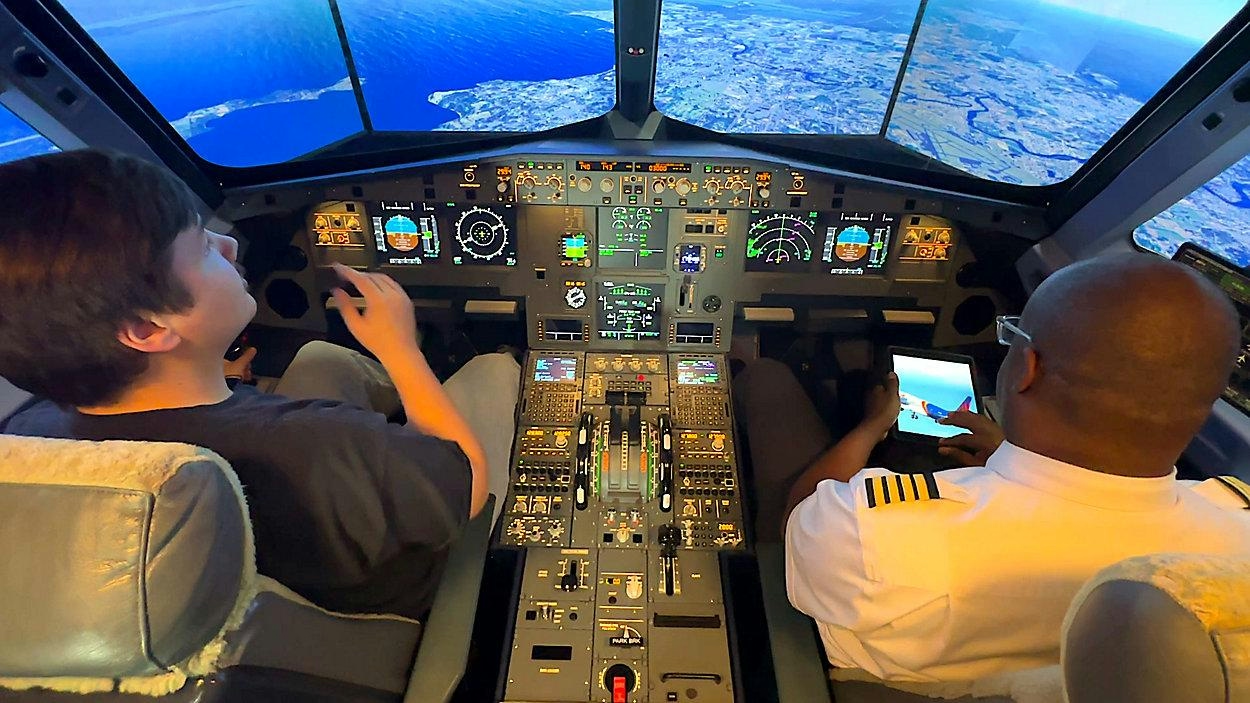
For many aspiring aviators, piloting the largest aircraft in the sky represents the ultimate professional milestone. Widebody jets carry an inherent prestige, often associated with long-haul international travel and, in some cases, enhanced earning potential. Yet, as the experience of a seasoned airline pilot reveals, the reality is far more complex. In aviation, the “best” aircraft is not necessarily the biggest or most iconic; rather, it is frequently the one that aligns most closely with a pilot’s lifestyle, schedule, and long-term aspirations.

A Pilot’s Personal Journey

Noah, a 38-year-old professional pilot who requested anonymity regarding his surname and employer, offers a compelling perspective that challenges the conventional assumption that every pilot aspires solely to command the largest jets. Before entering aviation, Noah spent ten years as a high school teacher. His passion for flight was kindled early, growing up in a family that traveled extensively. However, the uncertainty following the September 11 attacks led him to initially set aside his dream in favor of a more stable career in education. Despite this, his desire to fly endured. After obtaining his private pilot’s license, Noah reignited his ambition and transitioned fully into the airline industry.

Throughout his career, Noah has flown a range of aircraft, from narrowbodies like the Airbus A320 to widebodies such as the Boeing 747. Currently, he is training on the Boeing 737. His journey underscores a critical reality: as pilots advance professionally, their priorities often evolve. While early career goals may emphasize aircraft size and prestige, factors such as family commitments, base location, and work-life balance frequently take precedence. Based in the Midwest and commuting to a West Coast base, Noah exemplifies how lifestyle considerations and logistical complexities can be as influential as the aircraft themselves.

Industry Trends and Their Impact on Pilots

Noah’s personal experience intersects with broader trends shaping the aviation industry. Fleet composition and size are pivotal not only to airline strategy but also to pilot career paths. For instance, American Airlines currently faces challenges in maintaining competitiveness, trailing behind Delta and United in expanding its widebody fleet. With fewer new widebody aircraft on order, American risks constraining its growth in lucrative long-haul markets, potentially ceding ground to rivals investing heavily in these aircraft. Such strategic decisions have far-reaching implications, affecting market share on international routes and shaping the opportunities and choices available to pilots like Noah.

The trajectory to the flight deck is seldom linear, and the definition of success evolves with experience. For many pilots, the ideal aircraft is not simply the largest but the one that best supports a sustainable and fulfilling career—balancing professional ambition with quality of life both inside and outside the cockpit.

More news
GTA Aims to Expand Role in Malaysia’s Defence Self-Reliance Efforts

GTA Aims to Expand Role in Malaysia’s Defence Self-Reliance Efforts

GTA Aims to Expand Role in Malaysia’s Defence Self-Reliance Efforts KUALA LUMPUR, Sept 5 — GTA Holdings Bhd (GTA), a prominent provider of aviation maintenance, repair, and overhaul (MRO) services, is preparing to enhance Malaysia’s defence self-reliance through the establishment of a Centre of Excellence (CoE). This initiative will follow the company’s forthcoming listing on the ACE Market of Bursa Malaysia and is designed to strengthen the nation’s capabilities in the defence sector. Establishing a Centre of Excellence to Drive Innovation The proposed CoE will concentrate on advancing research and development (R&D), training, and technological expertise within the MRO industry. Datuk Nonee Ashirin Mohd Radzi, Managing Director and Chief Executive Officer of GTA, described the initiative as a key component of the company’s post-listing growth strategy. She emphasized that the CoE aims to position GTA as a leading player in research and technology, supported by strong partnerships with original equipment manufacturers (OEMs). “The CoE will allow us to position ourselves as a key player in research and technology, with the backing of our OEM partners. We are investing in a new facility that will include R&D and training programmes, within which there will be a CoE,” Nonee Ashirin stated in a recent interview with Bernama. She further noted that this development aligns with Malaysia’s National Defence Industry Policy (NDIP), which promotes greater self-reliance through local capability enhancement and technology transfer. In addition to the CoE, GTA is exploring investments in advanced testing infrastructure, including a Level 4 test bench and specialised equipment such as the Hydromechanical Unit (HMU), a critical component for helicopter engines. Nonee Ashirin acknowledged the challenges involved, as the HMU is a highly specialised capability typically retained by OEMs who are often reluctant to share expertise. Negotiations are ongoing, with investment details remaining confidential. Strengthening Core Capabilities and Regional Presence GTA is committed to reinforcing its core MRO services while expanding into new areas such as landing gear, wheels, and brakes. This expansion is underpinned by a longstanding relationship with the Ministry of Defence (Mindef) and the Malaysian Armed Forces, cultivated over more than a decade. “We have become the sole provider for the OEM in Malaysia due to the trust and technical expertise we have developed,” Nonee Ashirin explained. The company is also investing in human capital development to meet the evolving demands of Malaysia’s aerospace and defence sectors. Regionally, GTA has established itself as a distributor in Brunei, collaborating closely with the Royal Brunei Air Force. The force operates six helicopters, each equipped with two engines, totaling 12 engines that GTA will support, according to Nonee Ashirin. Challenges and Regional Dynamics While GTA’s expansion is viewed by some as a positive advancement for Malaysia’s defence capabilities, it is not without challenges. Industry observers, including Defence Minister Mohamed Khaled, have warned that miscalculations or misunderstandings within the sector could escalate tensions. Market reactions have been mixed, with some stakeholders expressing skepticism regarding the effectiveness of such partnerships. Furthermore, regional competitors, notably Pakistan—which has recently entered defence agreements with Turkey and Saudi Arabia—may perceive GTA’s growing role as a strategic challenge. GTA’s upcoming listing on the ACE Market is anticipated to reinforce its position within the region as it continues to navigate the complex landscape of opportunities and challenges in Malaysia’s defence industry.
Six Boeing 747 Cabin Designs Still Used by Airlines Today

Six Boeing 747 Cabin Designs Still Used by Airlines Today

Six Boeing 747 Cabin Designs Still Used by Airlines Today The Boeing 747 remains one of the most iconic passenger airliners in aviation history. For decades, it was the default choice for long-haul travel, serving as the flagship aircraft for nearly every major airline. Its unmatched range and capacity established the 747 as a cultural symbol of air travel. However, as the industry increasingly shifts toward more efficient twin-engine widebodies, only a handful of airlines continue to operate passenger 747s today. Despite its gradual retirement, the 747’s cabin innovations have left a lasting impact on modern aircraft design. Airlines now favor smaller, more cost-effective planes such as the Boeing 777-300ER, which can match or even exceed the 747’s range. This transition is evident as carriers like American Airlines explore replacements for aging fleets, including the 777-200, focusing on advanced configurations that prioritize both efficiency and passenger comfort. Enduring Cabin Innovations One of the most significant contributions of the 747 was the introduction of dedicated inflight rest areas. Prior to the 747, relief pilots on long-haul flights often rested in blocked passenger seats. The 747 revolutionized this practice by incorporating crew rest areas, particularly in the upper deck behind the cockpit. Originally designed as a premium lounge, this space evolved into a standard feature for pilot rest on extended flights. Today, similar rest facilities are common in modern widebodies, often located as pods in cargo holds or overhead compartments—a design concept first standardized by Boeing on the 777. Another innovation that originated with the 747 is the enclosed overhead bin. Earlier aircraft typically featured open shelves or netted racks for small items, but the 747 introduced lockable storage lockers, enhancing passenger convenience and safety. This feature has since become ubiquitous across all commercial aircraft. The 747 also pioneered premium cabin configurations, including upper-deck lounges and private suites. However, introducing new premium products remains challenging due to stringent regulatory requirements. Flagship carriers such as American Airlines, Lufthansa, Riyadh Air, and Singapore Airlines have all faced lengthy approval processes for their latest premium offerings, highlighting the ongoing balance between innovation and compliance in cabin design. In terms of inflight entertainment, the 747 was among the first to offer seatback screens and centralized entertainment systems. The expectation for high-tech connectivity and on-demand content among today’s passengers can be traced back to these early innovations, driving airlines to continually upgrade their entertainment offerings. Privacy features in premium cabins, such as enclosed suites and sliding doors, also have their roots in the 747’s design. As modern travelers increasingly seek enhanced privacy, airlines continue to refine cabin layouts to meet these evolving demands. Finally, the 747’s spacious main deck allowed airlines to experiment with a variety of seating arrangements, ranging from high-density economy to luxurious first-class suites. This flexibility remains a key consideration for airlines as they evaluate new aircraft and cabin products. The 747’s Legacy Amidst Emerging Competition As airlines adapt to changing market demands, new competitors are emerging. China’s COMAC C919 recently completed its first international commercial flight, signaling a potential challenge to established manufacturers. However, the C919 still relies heavily on foreign components and has yet to secure certification from major U.S. and European regulators, underscoring the difficulties faced by new entrants in the global aviation market. While the Boeing 747’s role as a passenger workhorse is diminishing, its legacy in cabin design continues to influence the future of air travel. The innovations it introduced have shaped passenger expectations and airline strategies worldwide, ensuring that the spirit of the 747 endures well beyond its operational lifespan.
How to plan a vacation with AI, from cheap flights to personalized itineraries

How to plan a vacation with AI, from cheap flights to personalized itineraries

How to Plan a Vacation with AI: From Cheap Flights to Personalized Itineraries Planning a vacation traditionally involves managing numerous browser tabs—flights, hotels, restaurants, attractions, weather forecasts, and maps—in an effort to create a coherent itinerary. Artificial intelligence is now poised to simplify this complex process through conversational interfaces. By providing a chatbot with details such as destination preferences, travel dates, companions, and budget, AI can suggest suitable locations, compare options, and even generate detailed day-by-day plans. Google is leading this transformation, recently releasing a guide on vacation planning using its Gemini AI and expanding its portfolio of AI-powered travel tools. The company has observed a significant surge in interest for AI-assisted trip planning, mirroring a wider industry trend. Competitors including ChatGPT, KAYAK, Mindtrip, Layla, Wanderlog, and Perplexity are also introducing AI features that range from natural-language travel searches to collaborative itinerary creation. Dreaming and Discovering Destinations Rather than beginning with a predetermined list of destinations, travelers can now articulate their ideal vacation experience. For instance, a user seeking a romantic four-night getaway in November might specify parameters such as maximum flight duration, budget, preferred climate, culinary scene, and hotel location. Gemini AI then evaluates multiple destinations, presenting their advantages, drawbacks, and estimated costs. The precision of AI recommendations improves with the amount of detail provided. Information such as travel dates, budget constraints, number and ages of travelers, accessibility requirements, dietary preferences, and desired travel pace allows the AI to tailor suggestions more effectively. Users can further refine results by excluding destinations with unfavorable weather, adding child-friendly options, or comparing urban breaks with nature retreats. Nonetheless, it remains essential to verify flight schedules, prices, and availability through official sources before making any bookings. Securing the Best Flight Deals After selecting a destination, the next hurdle is finding affordable airfare. Google Flights offers an experimental Flight Deals feature that enables users to describe the type of trip they want—such as “a cheap beach vacation in November with no stops”—without specifying exact destinations or dates. The tool then presents relevant flight options, helping travelers uncover deals that might otherwise go unnoticed. The Expanding Role of AI in Travel AI is reshaping how travelers research and plan their trips, although its impact remains most pronounced during the initial stages of exploration rather than the final booking process. For example, 44% of Chinese travelers utilize AI for trip planning but continue to rely on online travel agencies to complete reservations. Major travel companies are investing heavily in AI technologies. Booking.com has reported a positive return on investment, while Airbnb has significantly lowered support costs and enhanced issue resolution through AI-driven automation. The industry is increasingly focused on ensuring that AI tools serve the interests of travelers rather than solely benefiting companies. As Meta’s Mark Zuckerberg has highlighted, the future of AI in travel depends on aligning these technologies with the goals and preferences of individual travelers. Google’s growing AI ecosystem aims to support users throughout every phase of their journey—from initial inspiration to real-time assistance abroad—making vacation planning more personalized, efficient, and accessible than ever before.
JAL Acquires Hanjin KAL Stake, Strengthening Alliance with Korean Air

JAL Acquires Hanjin KAL Stake, Strengthening Alliance with Korean Air

JAL Acquires Stake in Hanjin KAL, Bolstering Alliance with Korean Air Amid Management Dispute Japan Airlines (JAL) has acquired a stake in Hanjin KAL, the holding company of Korean Air, marking a significant development in the strategic partnership between the two carriers. Although the exact size and value of JAL’s investment have not been disclosed, industry analysts emphasize the timing of the acquisition as critical, coinciding with an intensifying management control dispute involving the Hoban Group. Strategic Investment Amid Shareholder Tensions JAL announced the acquisition in Tokyo on June 3, simultaneously signing a broader strategic partnership agreement with Korean Air. Korean Air clarified that JAL’s investment was made independently, motivated by the long-term market value of Hanjin KAL. The absence of a regulatory filing for large shareholdings—mandatory for stakes of 5% or more—suggests that JAL’s stake remains below this threshold. The investment arrives at a pivotal moment. The Hoban Group has rapidly increased its stake in Hanjin KAL, reaching 20.15% as of July, closely matching the combined 20.57% held by Chairman Cho Won-tae and his allies. Should JAL’s stake be aligned with Chairman Cho, it could serve as a crucial “white knight” in defending his management control amid the ongoing contest. Currently, major shareholders of Hanjin KAL include Delta Air Lines with 14.90%, Korea Development Bank (KDB) holding 10.58%, and the National Pension Service at 5.11%. Both Delta and KDB are regarded as supporters of Chairman Cho. With JAL’s addition, the pro-Cho faction would command over 46% of shares, significantly outnumbering the Hoban Group’s holdings. Potential Challenges and Market Implications Despite the strengthened alliance, challenges remain. There is speculation that KDB, which played a stabilizing role during the 2019 management dispute between Chairman Cho and his sister, might divest its 10.58% stake to recover public funds following the planned merger of Korean Air and Asiana Airlines. Such a move could reignite a full-scale battle for control with the Hoban Group. JAL’s investment also raises questions regarding regulatory approval and the integration process with Korean Air, given the cross-border nature of the partnership. Market reactions have been largely positive, with expectations that the deepening cooperation will boost investor confidence and potentially enhance stock performance for both airlines. Competitors, including Delta Air Lines, a major stakeholder, are closely monitoring the situation and may reconsider their strategic positions in response to JAL’s involvement. Chairman Cho has a history of leveraging foreign airline partnerships to consolidate his control. During the 2019 dispute, Delta Air Lines acquired a stake in Hanjin KAL, reinforcing Cho’s position. Since then, Delta has expanded its cooperation with Korean Air, including a joint bid for Canada’s WestJet. Expanding Cooperation Beyond Equity Investment The partnership between JAL and Korean Air extends beyond equity stakes to encompass broad business collaboration. Despite their membership in different global airline alliances—Korean Air in SkyTeam and JAL in oneworld—the two carriers have agreed to pursue a cooperative relationship that transcends alliance boundaries. Enhanced codesharing on Korea-Japan routes is expected to be the initial focus, particularly as Korean Air advances its merger with Asiana Airlines.
AI Startup Offers $12.5 Million for Spirit Aviation Data

AI Startup Offers $12.5 Million for Spirit Aviation Data

AI Startup Micro1 Surpasses Google with $12.5 Million Bid for Spirit Airlines Data Micro1 Inc., an artificial intelligence startup, has submitted a $12.5 million offer to acquire Spirit Airlines’ extensive business data, outbidding Google’s $10 million proposal by 25%. This development, revealed in a court filing on Thursday, has intensified the competition for access to a vast dataset comprising approximately 100 million corporate emails, 500 million Microsoft Teams messages, over five million crew pairings, and around 16 million customer chat sessions. These records, alongside other operational and internal documents, were created prior to the low-cost carrier’s cessation of operations earlier this year. The auction, conducted in New York’s Southern District Court as part of Spirit Airlines’ Chapter 11 liquidation proceedings, has attracted significant attention due to the scale and commercial value of the data involved. AI firms like Micro1 are keen to obtain such real-world business datasets to train and enhance artificial intelligence models, as well as to gain deeper insights into airline operations. Legal Proceedings and Privacy Concerns Spirit’s advisers have provisionally agreed to sell the data to Google following a court-sanctioned auction. However, the sale has not been finalized. A bankruptcy judge is scheduled to rule on September 9 whether to approve the Google transaction or consider Micro1’s higher, albeit late, bid. Given the judiciary’s general reluctance to overturn auction results post-conclusion, Micro1 faces considerable procedural challenges despite its more lucrative offer. Privacy and data protection issues remain at the forefront of the dispute. Micro1’s legal representatives have highlighted the company’s technical capacity to “deidentify” the records, thereby safeguarding employee privacy. The startup has committed to excluding sensitive personnel files, including disciplinary and investigatory documents, as well as materials related to collective bargaining with unions representing Spirit employees. Furthermore, Micro1 has pledged to store the data exclusively within the United States and to permit oversight by an independent ombudsman appointed by Spirit’s advisers. Unions representing former Spirit workers have voiced opposition to the Google sale, citing concerns over privacy risks. In response, Google has asserted that it “will not receive any personal information from this dataset” and plans to engage an external firm to remove sensitive customer information. The forthcoming hearing on September 9 may establish significant precedents regarding how courts weigh higher bids against the finality of bankruptcy auctions and the privacy protections required when large corporate datasets are transferred. This case highlights the increasing value of business data in the artificial intelligence era and the heightened scrutiny surrounding the handling of such information during corporate liquidations.
Bombardier to Acquire MHICA, Internalize Wing Production

Bombardier to Acquire MHICA, Internalize Wing Production

Bombardier to Acquire MHICA, Internalize Wing Production Bombardier Aerospace has announced an agreement to acquire the assets of MHI Canada Aerospace (MHICA) from Mitsubishi Heavy Industries (MHI), a strategic move designed to enhance Bombardier’s manufacturing capabilities and strengthen its supply chain resilience. The acquisition, which involves MHICA’s facilities located in Mississauga, Ontario, is anticipated to be finalized by late 2026. Expansion of Manufacturing Capabilities and Workforce The transaction will integrate approximately 750 MHICA employees into Bombardier’s workforce, significantly bolstering the company’s in-house expertise in aerostructures and expanding its manufacturing footprint. MHICA currently produces main wings and centre fuselage structures for Bombardier’s Global 5500 and Global 6500 business jets, as well as the main wing for the Challenger 3500. The Mississauga site comprises a 270,000-square-foot manufacturing facility alongside a 70,000-square-foot logistics centre, underscoring the scale of operations being acquired. By internalizing this component production, Bombardier aims to increase operational autonomy and exert greater control over critical elements of its business jet programmes. This strategic integration is expected to enhance supply-chain resilience amid ongoing industry challenges, enabling Bombardier to respond more effectively to market demands and potential disruptions. Integration Challenges and Market Response The acquisition remains subject to customary closing conditions, including regulatory approvals. Bombardier will face the complex task of integrating MHICA’s operations and ensuring a seamless transition for both existing programmes and the incoming workforce. The company’s management of these challenges will be closely observed by industry stakeholders. Market reactions to the deal have been cautiously optimistic. Analysts highlight the potential for Bombardier to strengthen its manufacturing capacity and improve its competitive position within the aerospace sector. The consolidation is being closely monitored by competitors, who are assessing its implications for their own operations and supply chains. Meanwhile, Mitsubishi Heavy Industries has reaffirmed its ongoing commitment to the commercial aerospace and defence sectors despite divesting its Canadian aerostructures assets. This acquisition represents a significant strategic step for Bombardier as it seeks to internalize key production capabilities and reinforce its standing in the global business jet market.
FAI Technik Authorized as Starlink Dealer

FAI Technik Authorized as Starlink Dealer

FAI Technik Authorized as Starlink Dealer FAI Technik, a prominent German business jet maintenance, repair, and overhaul (MRO) provider, has been officially appointed as an authorized dealer and installer of SpaceX’s Starlink satellite internet system for aviation. This authorization is effective immediately, with installations to be carried out at the company’s maintenance facility located at Albrecht Dürer Airport in Nuremberg, Germany. Expanding Connectivity Services for Business Aviation In June, FAI Technik completed its inaugural Starlink installation on a Bombardier Global Express XRS and has planned further installations across its own fleet. The company is also extending Starlink installation services to external aircraft owners and operators. Starlink’s satellite internet system is designed to provide high-speed, reliable in-flight connectivity, enabling video conferencing, streaming, cloud-based applications, and uninterrupted online communication. Michael Axtmann, managing director of FAI Technik, emphasized the significance of this development, stating that the company’s new role as an authorized SpaceX Starlink dealer and installer represents a key milestone in expanding its modification and connectivity capabilities. He noted the increasing demand for high-speed, dependable connectivity within the business aviation sector and expressed confidence that Starlink will become a valuable addition to the suite of services offered to aircraft owners and operators. Positioning Amid Market Challenges FAI Technik operates under EASA Part-145 maintenance organisation approval and offers a comprehensive range of aircraft maintenance, modification, and installation services from its Nuremberg base. The integration of Starlink complements its existing connectivity upgrade portfolio, which includes systems such as Gogo’s Galileo, Honeywell’s Ka-Band, and Collins’ Ku-Band. Nonetheless, FAI Technik’s new role unfolds within a competitive and rapidly evolving market environment. The company may encounter challenges related to market competition, regulatory compliance, and the technical complexities of integrating new satellite systems. Competitors are likely to respond with aggressive pricing strategies or enhanced service offerings to maintain their market positions. Investor sentiment remains divided, with some expressing concerns over Starlink’s declining average revenue per user, while others remain optimistic about its swift market share expansion. Furthermore, regulatory scrutiny concerning orbital congestion and the associated costs could impact the broader satellite connectivity industry. Despite these challenges, FAI Technik’s partnership with SpaceX strategically positions the company to address the growing demand for advanced in-flight connectivity solutions in the business aviation sector.
AI Flight Between Madurai and Chennai to End After 68 Years on Oct. 25

AI Flight Between Madurai and Chennai to End After 68 Years on Oct. 25

Air India Express to Cease Chennai-Madurai Service After 68 Years Air India Express will discontinue its Chennai-Madurai-Chennai flight from October 25, bringing to an end a 68-year legacy of continuous service on this route. The flight, historically operated by Indian Airlines and later Air India, has long been a vital connection for travelers due to its affordability and convenience. Industry sources confirm that the airline has deemed the route commercially unviable, prompting the decision to withdraw the service. Impact on Passengers and Market Dynamics Despite Air India’s claims, travel agents and tour operators contest the rationale, citing robust passenger traffic. On a recent Friday, 159 passengers arrived in Madurai from Chennai, with approximately 70 returning the same day. The daily schedule currently departs Chennai at 10:15 a.m., arriving in Madurai at 11:30 a.m., and returns at noon, reaching Chennai by 1:10 p.m. With Air India Express’s exit, IndiGo will become the sole carrier on this route, operating more than five flights daily. This development raises concerns about a potential monopoly, which could lead to fare increases and reduced travel options for passengers. The termination of this service is expected to have significant repercussions for both tourism and business travel in southern Tamil Nadu. Madurai, a prominent cultural and commercial hub, depends heavily on air connectivity, especially during the peak tourist season from October to March. Travel industry representatives warn that the loss of the Air India Express flight may discourage domestic and international visitors, particularly during major festivals such as Dasara, Deepavali, Christmas, and Pongal. Increased travel costs or limited flight availability could prompt tourists to bypass Madurai or seek alternative destinations. Local Response and Future Prospects The decision has drawn criticism from travel agents and business communities in Madurai, Sivakasi, and Karaikudi, who question the apparent neglect of Madurai amid Air India’s expansion in other cities like Tiruchi, which has seen new flights to Hyderabad, Singapore, and the UAE. These stakeholders have appealed to Members of Parliament from southern districts to petition the Union Aviation Minister for reconsideration, underscoring the strategic importance of maintaining the Chennai-Madurai air link. As the October 25 deadline approaches, uncertainty persists for passengers and the regional travel ecosystem. Many hope for either a reversal of the decision or the entry of new carriers to fill the void left by Air India Express, ensuring continued connectivity for southern Tamil Nadu.
Airbus Reaches 1,000 Orders Amid Delivery Concerns

Airbus Reaches 1,000 Orders Amid Delivery Concerns

Airbus Reaches 1,000 Orders Amid Delivery Challenges European aerospace giant Airbus has achieved a notable milestone this year, securing over 1,000 aircraft orders. This accomplishment underscores the robust demand for commercial airliners, yet the company continues to face significant hurdles in scaling up production to meet these commitments. Production and Supply Chain Constraints Despite strong order intake, Airbus’s production output has consistently lagged behind initial targets, generating concern among investors and customers. The company is contending with persistent supply chain disruptions, which have impeded its ability to deliver aircraft on schedule. Key issues include the limited availability of Pratt & Whitney engines and delays in obtaining necessary regulatory approvals. These challenges have contributed to a growing backlog of deliveries and have recently impacted Airbus’s share price, particularly amid quality concerns surrounding the A330 model. Competitive Pressures and Strategic Investments The commercial aviation sector remains intensely competitive, with Boeing, Airbus’s primary rival, expected to respond to Airbus’s order success through aggressive marketing and pricing strategies. This competitive environment adds complexity to Airbus’s efforts to fulfill its delivery obligations. In response, Airbus is investing heavily in local infrastructure, especially in emerging markets such as India. These investments aim to strengthen the company’s position as a key player in the future of regional air travel. However, ongoing production delays and supply chain issues highlight the challenges Airbus faces in sustaining its leadership role in the industry. Industry analysts emphasize that Airbus’s ability to resolve supply chain bottlenecks and address quality concerns will be crucial to maintaining its growth trajectory. While the aerospace sector’s outlook remains positive, Airbus’s future performance will depend on its capacity to meet ambitious production targets amid the complexities of a global supply network.
The Cost of De-Icing a Boeing 777 for Airlines

The Cost of De-Icing a Boeing 777 for Airlines

The Cost of De-Icing a Boeing 777 for Airlines As winter takes hold across airports in the northern United States, Canada, and Europe, commercial airlines confront a critical safety challenge: the complete removal of ice, snow, and frost from aircraft surfaces before departure. The Federal Aviation Administration’s (FAA) “clean aircraft” mandate enforces this requirement through stringent federal regulations. For airlines operating large widebody jets such as the Boeing 777-300ER—with its wingspan exceeding 212 feet and wing area surpassing 4,600 square feet—de-icing is a complex and costly necessity. Specialized vehicles equipped with heated glycol-based fluids spray aircraft surfaces at high pressure to eliminate contaminants. This process is followed by the application of a thicker anti-icing coating designed to protect the aircraft as it taxis to the runway. Each de-icing event for a Boeing 777 can consume hundreds of gallons of fluid and incur costs running into several thousand dollars. At major winter hubs including Chicago O’Hare (ORD), Minneapolis-St. Paul (MSP), Denver (DEN), and Toronto Pearson (YYZ), airlines may de-ice hundreds of aircraft daily during severe weather. Over the course of a season, a single carrier’s expenditure on de-icing can reach between $30 million and $50 million, involving millions of gallons of fluid. The Safety Imperative of De-Icing Ice accumulation on an aircraft’s wings poses a serious threat to flight safety by disrupting the smooth airflow necessary for lift. Research conducted by NASA indicates that even a thin layer of frost or ice on the leading edge can reduce lift by up to 30% while increasing drag by 40%. This hazard extends beyond the wings to the horizontal stabilizer and control surfaces, potentially impairing pitch control and restricting the movement of ailerons, elevators, and rudders. Additionally, ice can obstruct critical sensors such as pitot tubes, which provide essential data to flight instruments. Erroneous readings from these sensors have been linked to catastrophic incidents, including the crash of Air France Flight 447 in 2009. In recognition of these dangers, FAA regulations strictly prohibit takeoff with any ice, snow, or frost adhering to critical aircraft surfaces, underscoring the indispensable nature of thorough de-icing procedures. Financial and Operational Challenges The financial burden of de-icing widebody aircraft like the Boeing 777 extends beyond the direct costs of fluids and labor. Airlines also incur increased fuel consumption and maintenance expenses due to the additional ground time required for de-icing. These operational delays can cascade through flight schedules, compelling airlines to adjust departure and arrival times, and in some cases, leading to cancellations or missed connections. Market dynamics often compel airlines to transfer a portion of these costs to passengers through higher ticket prices, particularly during peak winter months. In response, carriers are actively exploring more efficient de-icing technologies and investing in aircraft equipped with advanced de-icing systems to reduce turnaround times and operational expenditures. The pursuit of cost-effective solutions remains a priority as airlines strive to balance safety imperatives with efficiency and profitability amid challenging winter conditions. While essential for ensuring flight safety, de-icing represents a significant operational and financial challenge for airlines, influencing winter operations, competitive strategies, and the overall passenger experience.
line









