
AeroGenie — Ihr intelligenter Copilot.

Trends
Categories
China’s Domestic 1,200 kW Turboprop Engine Passes Ignition Test
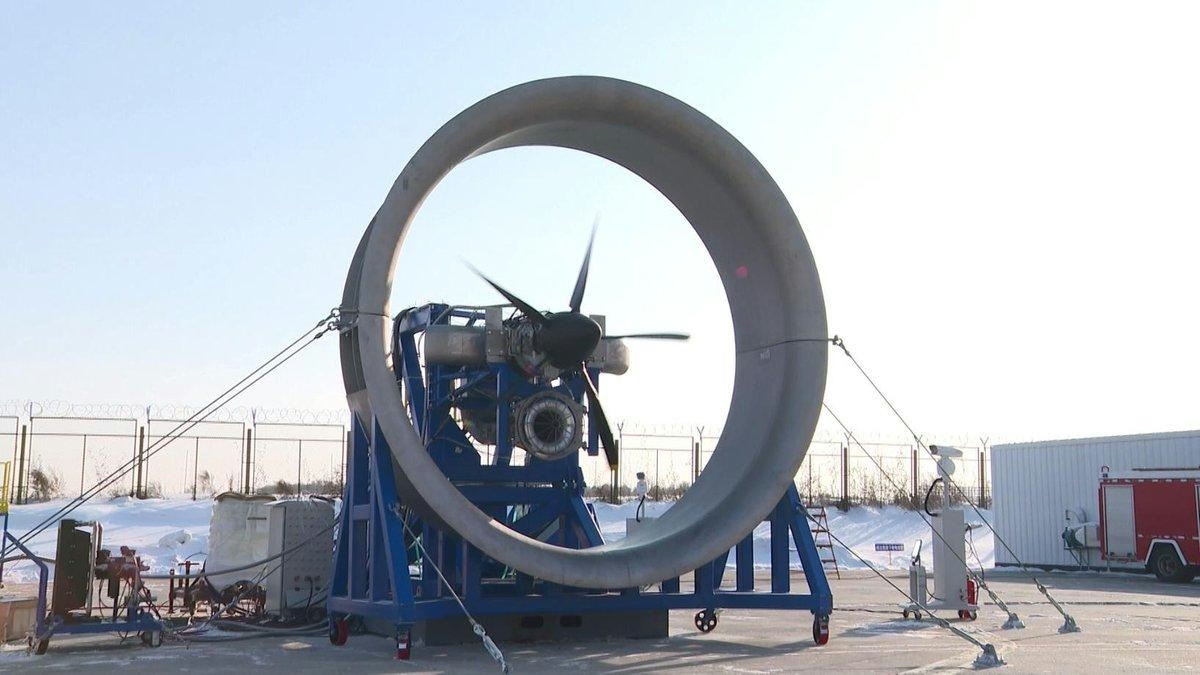
China’s Domestic 1,200 kW Turboprop Engine Passes Ignition Test
A domestically developed 1,200-kilowatt-class turboprop engine has successfully completed its ignition test in Harbin, Heilongjiang Province, marking a significant milestone for China’s aviation industry. This achievement highlights China’s ongoing efforts to achieve self-reliance in critical aerospace technologies and reflects its expanding ambitions to compete with established global manufacturers.
Technical Advancements and Capabilities
The engine, designated ATP120A, was developed by Harbin Dongan Civil Aviation Engine Co., a subsidiary of the Aero Engine Corporation of China (AECC). During the recent ignition test, the ATP120A demonstrated stable ground operation at temperatures as low as -30 degrees Celsius (-22 degrees Fahrenheit). Engineered for low fuel consumption, extended service life, and reduced operational costs, the ATP120A has now entered the testing and verification phase.
According to AECC, the engine is designed with strong environmental adaptability, capable of functioning in extreme conditions ranging from high-altitude cold regions to hot, humid environments with high salt exposure. Its potential applications include general aviation and unmanned aerial vehicles, with future prospects for integration into hydrogen and hybrid propulsion systems.
Implications for the Global Aviation Market
This breakthrough is poised to have significant implications for the global turboprop engine market. By offering a cost-effective and reliable alternative, China’s new engine could challenge established manufacturers such as Pratt & Whitney and Rolls-Royce. Industry analysts anticipate that these competitors may respond with enhanced features or revised pricing strategies to maintain their market positions. The success of the ATP120A also bolsters China’s prospects for exporting advanced turboprop aircraft, potentially increasing its share in the international aviation market.
China’s pursuit of indigenous aviation technology forms part of a broader strategy to reduce dependence on foreign suppliers. Despite notable progress in both defense and commercial aviation, many Chinese aircraft, including the Comac C919, still rely on foreign-made engines such as the LEAP1-C from CFM International, a joint venture between GE Aerospace and Safran. The development of homegrown engines is regarded as a critical step toward achieving full technological sovereignty.
Broader Context of China’s Aviation Ambitions
The establishment of the Commercial Aircraft Corporation of China (Comac) in 2008 laid the foundation for these ambitions. Since then, China has introduced several aircraft models, including the ARJ21 regional jet and the C919 narrow-body airliner, both designed to compete with Western manufacturers. The C919, which began regular flights in May 2023, is seen as a direct competitor to Airbus and Boeing, particularly as plans for a lengthened version advance.
China’s rapid progress in aviation is supported by substantial investments in research and development across multiple high-tech sectors. From materials science to quantum computing, Chinese innovation is increasingly recognized on the global stage. The successful ignition test of the ATP120A not only underscores China’s growing technological capabilities but also signals its intent to become a leading force in the global aviation industry.

Boeing Warned of MD-11 Engine Bearing Risk Years Before UPS Crash
The Crucial Role of Aircraft Structures Alongside Engines

Dubai Plans to Launch Commercial Air Taxi Services by Year-End
Dubai Reveals Timeline for Launch of Air and Self-Driving Taxis
France Orders Airbus VSR700 Uncrewed Aerial Vehicle

Mercuria and Airborne Capital Launch Open-Ended Aircraft Fund
IATA Unveils 2026 Global Events Focused on Cargo, Sustainability, and Aviation Innovation
HAECO Names New General Manager for Composite Services
Bjorn's Corner: Preparing Aircraft for Entry Into Service
Boeing's Orders and Deliveries Forecast for 2025
