
AIによるインサイトを行動へとつなげる

現在のトレンド
Categories
Aircraft Leasing Industry Navigates Uncertain Environment
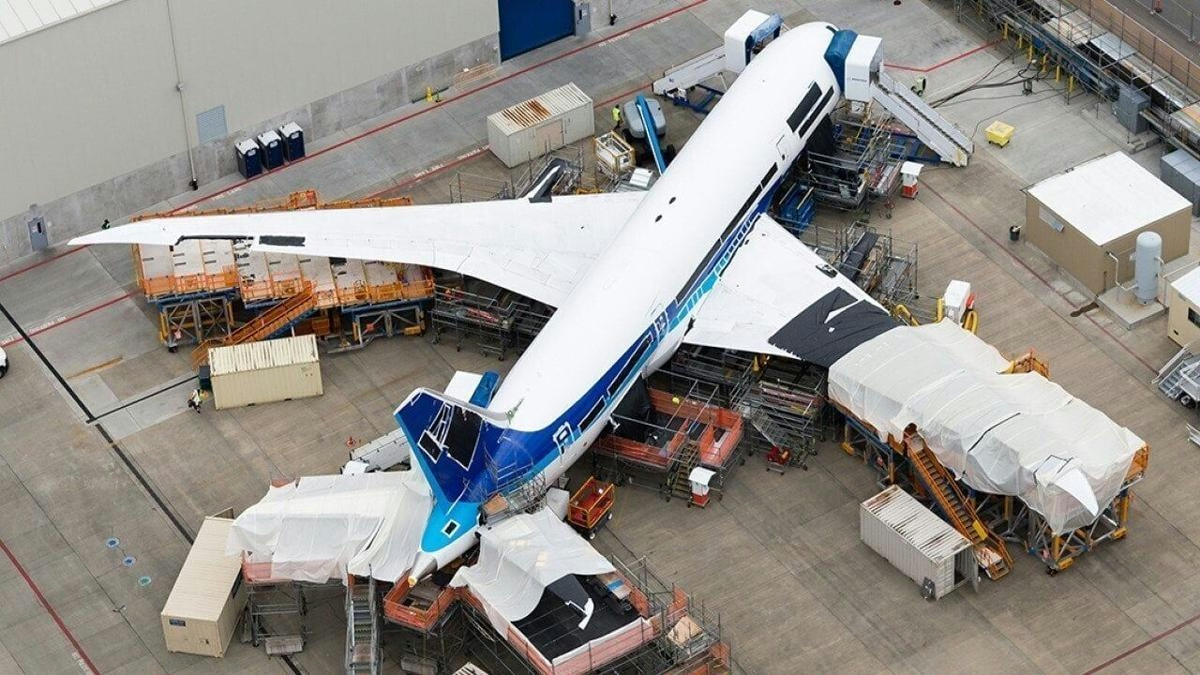
Aircraft Leasing Industry Navigates Uncertain Environment
Despite escalating geopolitical tensions and volatile market conditions, the global aircraft leasing industry continues to demonstrate resilience amid a complex array of risks and operational challenges. Leading lessors, who collectively own approximately half of the world’s commercial aircraft fleet, emphasize their capacity to adapt and manage uncertainty in an increasingly unpredictable environment.
Managing Risks Amid Market Volatility
Aircraft leasing companies have largely maintained tariff-free status for most of their assets, enabling them to move aircraft across borders with relative ease. This flexibility, combined with extensive experience in navigating past crises, underpins the sector’s current stability. At the recent Airline Economics conference in Dublin, industry executives highlighted their proven ability to manage geopolitical risks despite emerging uncertainties.
Tom Baker, CEO of Aviation Capital Group, described the sector as “shockingly stable” despite global volatility. He attributed this resilience in part to a persistent shortage of available aircraft, which continues to support rental rates and asset values. Peter Barrett, CEO of SMBC Aviation, acknowledged an increase in risk levels but emphasized the industry’s capacity to absorb these challenges. He noted that while risks may be evolving, the sector’s track record in managing geopolitical uncertainty remains strong.
Challenges in Supply Chains and Manufacturer Dynamics
The industry is concurrently grappling with ongoing supply chain disruptions and production delays at major aircraft manufacturers. Airbus maintains its dominance in single-aisle jet sales, while Boeing faces difficulties in regaining market share within the narrowbody segment. Airlines worldwide are experiencing extended waiting periods for new aircraft deliveries, a situation particularly pronounced in regions such as Latin America and the Caribbean, where market uncertainty persists.
Avolon, one of the largest lessors, reported that Pratt & Whitney’s efforts to address its powdered metal issue are expected to gradually reduce the number of grounded aircraft. Nonetheless, the company cautioned that these groundings are likely to continue until at least 2028, thereby prolonging supply constraints. AerCap CEO Aengus Kelly urged the industry to avoid overreacting to recent uncertainties, emphasizing the long-term nature of aviation financing cycles. Firoz Tarapore, CEO of Dubai Aerospace Enterprise, echoed this sentiment, suggesting that it will take time to determine whether current reactions will have lasting effects.
Industry Consolidation and Future Outlook
A notable divide has emerged between lessors with substantial aircraft order books and those without, intensifying competitive pressures on smaller firms. This dynamic was underscored by SMBC Aviation’s recent acquisition of U.S. rival Air Lease Corp. Meanwhile, industry veteran Steven Udvar-Hazy is reportedly contemplating a new venture, though he has declined to provide details.
Andy Cronin, CEO of Avolon, highlighted rising barriers to entry in the sector, driven by the necessity for strong balance sheets, extensive order books, and robust credit ratings. He observed that entering the market today is considerably more challenging without the backing of a sovereign wealth fund or a large financial institution.
As the aircraft leasing industry contends with persistent supply constraints, geopolitical uncertainty, and shifting manufacturer dynamics, leading lessors remain cautiously optimistic about their ability to manage risks and sustain stability in a rapidly evolving landscape.

Bangladesh Launches Initiative to Become Regional Aviation Hub
Russia Transports PD-8 Engine to India for International Certification

Kyrgyzstan to Adopt EMPIC GmbH Software for Flight Safety Oversight

Why Hawaiian Airlines Is Waiting Until 2028 To Add A Premium Economy Cabin To Its Airbus A330 Fleet

Engine Fault Causes Royal Navy Helicopter Crash Fatality

Joby Aviation Begins Texas Air Taxi Test Flights Amid Stock Decline

Iberia Receives Full Approval for Airbus A350 Heavy Maintenance

NetJets to Construct Terminal and Hangar at Dallas Love Field

Using AI in Aircraft Purchases

CIAM Unveils RPD-150T Engine to Replace Rotax 150 hp Model
