
AIによるインサイトを行動へとつなげる

現在のトレンド
Categories
Can AI Replace Air Traffic Controllers?
Can AI Replace Air Traffic Controllers?
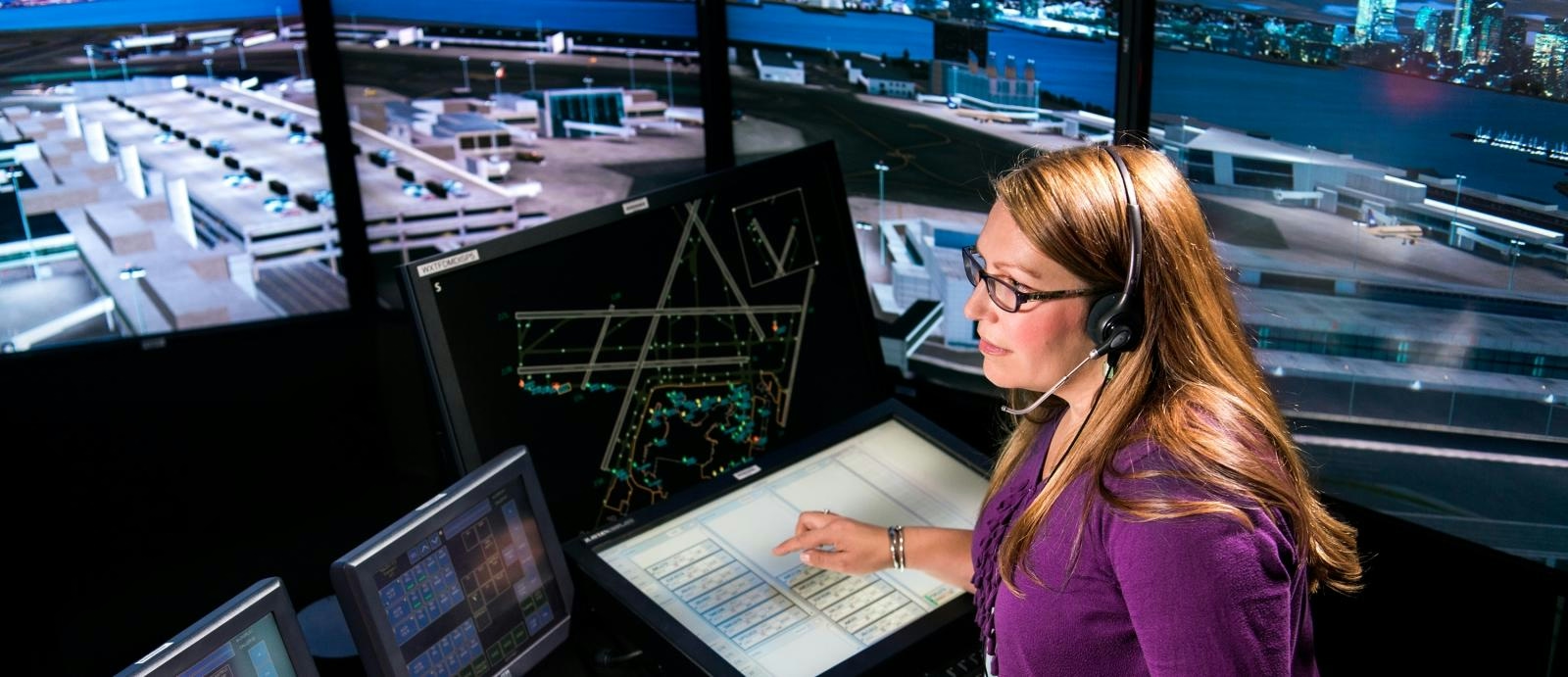
Artificial intelligence (AI) is increasingly recognized as a transformative force in air traffic control, yet experts and officials concur that it should not supplant human controllers. The safety of aviation depends on a combination of data analysis, predictive capabilities, sound judgment, and accountability—qualities that remain indispensable in managing the United States’ highly complex airspace. The Federal Aviation Administration (FAA) oversees more than 45,000 daily flights carrying nearly 3 million passengers across an expanse exceeding 29 million square miles. While advanced technology is vital to managing such a vast system, human expertise is essential to navigate the uncertainties that arise when weather conditions, equipment issues, pilot actions, airport operations, and emergencies converge in real time.
Balancing Modernization and Human Expertise
The ongoing debate over modernizing air traffic control highlights the need to balance technological innovation with human oversight. Congress has allocated $12.5 billion toward upgrading the system, which the FAA describes as a “down payment,” while Transportation Secretary Sean Duffy is advocating for an additional $10 billion to fund advanced software and infrastructure improvements. Reflecting a widespread caution among officials, Duffy has emphasized that AI should function as a supportive tool rather than a replacement for human controllers. This stance is widely shared by industry observers and regulators, who agree that AI can enhance the system but must not become its foundation.
AI’s Role in Predictive Analytics
The most promising application of AI in air traffic control lies in predictive analytics. Sophisticated software can integrate airline schedules, airport capacity, weather forecasts, and FAA traffic data to anticipate congestion before it leads to delays. For instance, the FAA is developing SMART, an AI-driven system designed to forecast and manage air traffic conflicts up to two hours in advance. Such technology can suggest minor schedule adjustments—shifting flights by a few minutes—to alleviate bottlenecks, a task well suited to machines capable of processing extensive datasets rapidly.
The FAA’s NextGen program has already introduced advancements such as digital communication, satellite-enabled surveillance, and enhanced information management. However, the Government Accountability Office has cautioned that many FAA systems remain outdated and require urgent modernization, with some critical upgrades still years away. AI’s effectiveness depends on reliable infrastructure; it cannot compensate for obsolete radios, wiring, or inadequate telecommunications networks.
The Imperative of Human Oversight
Air traffic control differs fundamentally from other AI applications like recommending movies or sorting advertisements. Controllers make critical decisions that ensure aircraft maintain safe separation, runways remain secure, and passenger lives are protected. The Bureau of Labor Statistics highlights the profession’s high stress levels and the demand for unwavering concentration. According to the FAA’s workforce plan, the agency employed 14,264 controllers in fiscal year 2024 and hired an additional 1,811, yet it remains approximately 3,500 controllers short of its target staffing levels. Many controllers are working mandatory overtime and six-day weeks, fueling concerns that AI might eventually be used to justify reducing personnel.
Despite these anxieties, regulators and industry leaders emphasize that AI should be deployed to alleviate controller fatigue and support decision-making rather than as a rationale for cutting staff. Both the National Academies and the FAA stress that staffing models must prioritize safety and operational efficiency.
A Human-Centric Vision for Aviation AI
The FAA’s strategy for integrating AI centers on safety, regulatory standards, and rigorous oversight, as detailed in its AI safety assurance roadmap. Similarly, Europe’s aviation regulator, the European Union Aviation Safety Agency (EASA), advocates a human-centric approach in its Artificial Intelligence Roadmap 2.0. Meanwhile, competition for FAA AI contracts is intensifying, with companies such as Palantir, Thales, and various startups vying to deliver cutting-edge solutions.
Ultimately, the objective is not to replace air traffic controllers but to equip them with enhanced tools that promote safer and more efficient skies. AI’s role is to augment human judgment, not to supplant it.

Etihad Airways Suspends Airbus A380 Flights on Key Route

Aditya Birla Group Seeks Approval for Aircraft Leasing in GIFT City

Qatar Airways Highlights Innovation and Connectivity at Arabian Travel Market 2026

Hong Kong's Five-Year Plan Includes Andrew Fan's Aircraft Parts Processing Hub Proposal

ACIA Aero Leasing Delivers ATR72-600 to Air Nostrum

RTX Appoints Jill Albertelli as Head of Pratt & Whitney

TAT Technologies Joins Beyond Aero Hydrogen Aircraft Program

AURAK Study Highlights Barriers to Air Taxi Adoption in Emerging Economies

Xiamen Air Selects Altitude for 787 Maintenance at Heathrow

Etihad and Swissport Extend Global Partnership
