
AIによるインサイトを行動へとつなげる

現在のトレンド
Categories
Dependent Surveillance-Broadcast Market Projected to Reach $6.3 Billion by 2033
Dependent Surveillance-Broadcast Market Projected to Reach $6.3 Billion by 2033
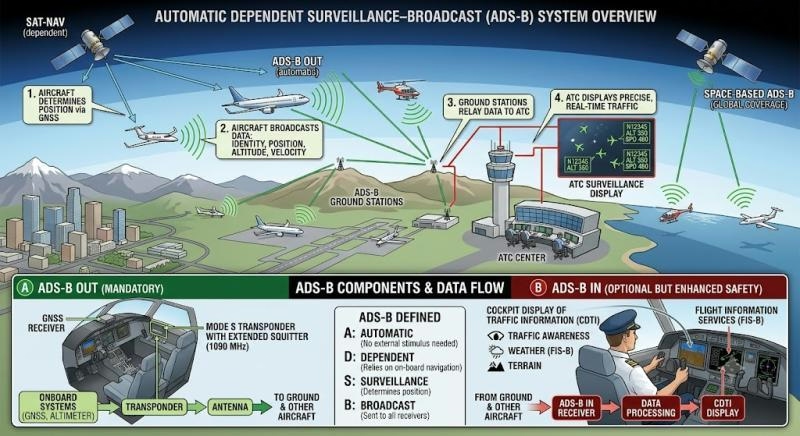
The global Dependent Surveillance-Broadcast (ADS-B) market is poised for substantial expansion, with forecasts indicating its value will reach $6.3 billion by 2033. This growth is driven by the ongoing modernization of air traffic management systems, an intensified focus on aviation safety, and a global transition toward satellite-based, real-time aircraft tracking technologies.
Market Growth and Drivers
ADS-B technology, which significantly improves aircraft position accuracy and situational awareness, is witnessing increased adoption across both commercial and defense aviation sectors. Valued at $1.48 billion in 2025, the market is expected to grow at a compound annual growth rate (CAGR) of 19.9% between 2026 and 2033. Airlines currently dominate the market, accounting for 55% of demand, as regulatory mandates and stringent safety requirements accelerate widespread implementation.
Key factors propelling this growth include regulatory compliance, technological advancements, and emerging applications. Aviation authorities such as the Federal Aviation Administration (FAA) and the European Union Aviation Safety Agency (EASA) have mandated ADS-B Out compliance for aircraft operating in controlled airspace. This has led to extensive retrofitting of older fleets and increased demand for advanced avionics in new aircraft models. Technological progress, particularly the integration of satellite-based ADS-B networks, is enabling comprehensive global coverage, including remote and oceanic regions that were previously underserved by traditional radar systems. The adoption of Performance-Based Navigation (PBN) and NextGen air traffic management programs is further accelerating the deployment of ADS-B systems. Additionally, the rise of unmanned aerial vehicles (UAVs) and urban air mobility (UAM) platforms is creating new avenues for ADS-B integration, broadening the technology’s role in airspace monitoring.
Regional Outlook
North America currently leads the ADS-B market, supported by early regulatory adoption, sophisticated aviation infrastructure, and the presence of major aerospace and avionics companies. Europe follows closely, driven by initiatives such as the Single European Sky and rigorous safety standards. The Asia-Pacific region is anticipated to experience the fastest growth, fueled by increasing aircraft deliveries, expanding commercial aviation networks, and significant investments in air traffic modernization, particularly in China and India.
Competitive Landscape
The competitive environment is dominated by industry leaders including Honeywell International, Garmin Ltd., Collins Aerospace (RTX Corporation), Thales Group, L3Harris Technologies, and Boeing. These companies are at the forefront of innovation, developing advanced avionics, satellite-based surveillance solutions, and integrated air traffic management technologies designed to enhance real-time tracking and communication capabilities. Market differentiation is largely based on system accuracy, integration with next-generation avionics, certification compliance, and the extent of global coverage. Honeywell and Collins Aerospace are noted for their integrated avionics and flight management systems, Garmin specializes in general aviation ADS-B solutions, while Thales and L3Harris focus on defense-grade and satellite-enabled tracking systems.
Challenges and Market Dynamics
Despite promising growth prospects, the ADS-B market faces several challenges. Regulatory complexities and technological integration issues remain significant obstacles as the industry adapts to evolving standards and increasingly complex system requirements. Furthermore, competition from emerging technologies, particularly those applied in precision agriculture and connected farming, introduces new pressures. Advances in artificial intelligence-driven farm intelligence and precision guidance are beginning to reshape global surveillance and monitoring markets, posing potential threats to traditional ADS-B applications.
In response, companies are intensifying investments in research and development to enhance surveillance capabilities and sustain competitive advantages. The ongoing evolution of digital aviation ecosystems and the expansion of space-based ADS-B infrastructure are expected to reinforce the market’s long-term outlook.

Etihad Airways Suspends Airbus A380 Flights on Key Route

Aditya Birla Group Seeks Approval for Aircraft Leasing in GIFT City

Qatar Airways Highlights Innovation and Connectivity at Arabian Travel Market 2026

Hong Kong's Five-Year Plan Includes Andrew Fan's Aircraft Parts Processing Hub Proposal

ACIA Aero Leasing Delivers ATR72-600 to Air Nostrum

RTX Appoints Jill Albertelli as Head of Pratt & Whitney

TAT Technologies Joins Beyond Aero Hydrogen Aircraft Program

AURAK Study Highlights Barriers to Air Taxi Adoption in Emerging Economies

Xiamen Air Selects Altitude for 787 Maintenance at Heathrow

Etihad and Swissport Extend Global Partnership
