
AIによるインサイトを行動へとつなげる

現在のトレンド
Categories
Digital Twin and IR Engine Enhance UAS Training Environment
Digital Twin and IR Engine Enhance UAS Training Environment
Advanced Simulation Solutions for Unmanned Aerial Systems
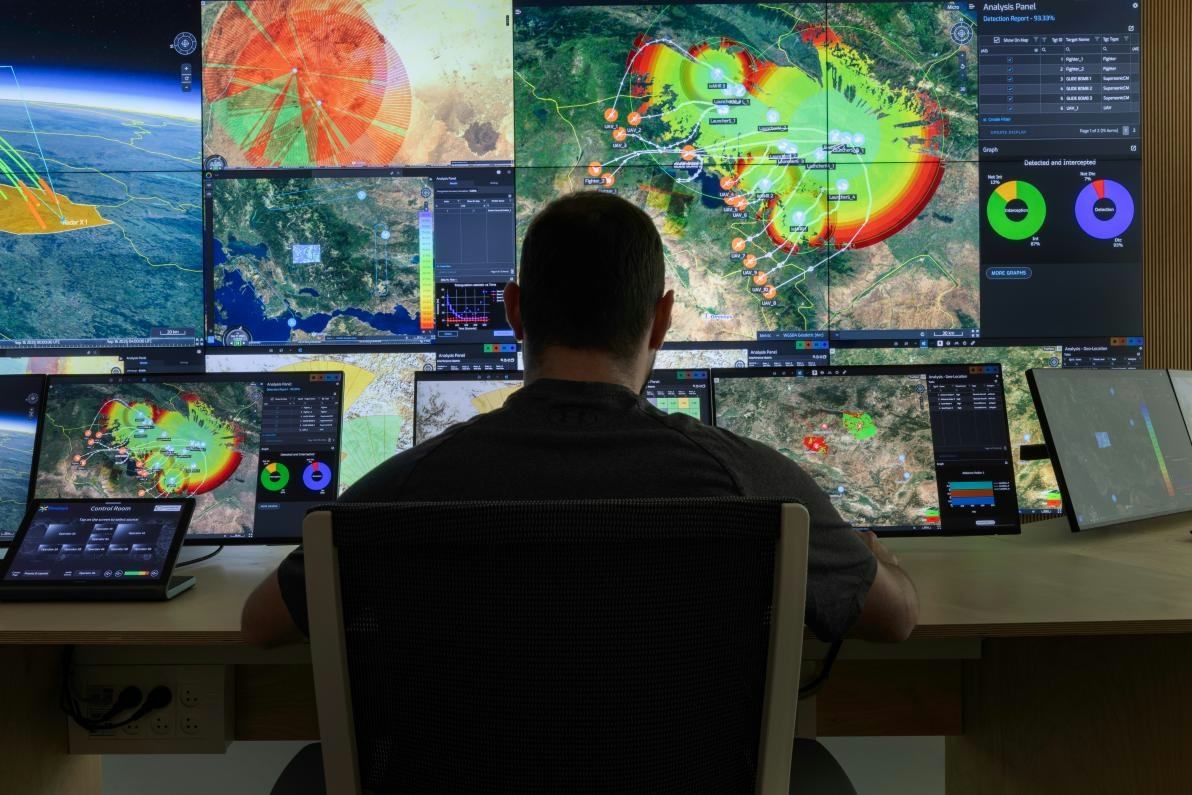
Tiltan Software Engineering Ltd. has secured a pivotal contract within a major Israeli unmanned aerial systems (UAS) programme to deliver cutting-edge simulation and digital twin technologies. The initiative is designed to establish a comprehensive virtual and constructive simulation platform that supports large-scale operational training and mission preparation across integrated system-of-systems scenarios. By consolidating multiple platforms and mission profiles into a unified synthetic battlespace, the programme aims to significantly improve the realism and effectiveness of UAS training exercises.
At the core of Tiltan’s solution is the TOPS-NX infrared (IR) physics-based 3D engine, which offers both IR and visual simulation capabilities. Engineered to function within a cloud environment, TOPS-NX supports multiple simultaneous instances and provides high-resolution sensor rendering. It is capable of simulating complex urban environments populated with thousands of entities, all while maintaining high frame rates—an essential attribute for delivering realistic and scalable training scenarios.
The contract encompasses developer licences alongside approximately 1,000 run-time licences, underscoring the extensive scale of the programme. In addition to the simulation engine, Tiltan will provide its T-VERSE services, which supply material-based, high-fidelity 3D models and digital twins for synthetic operational environments in both IR and visual domains. The company will also offer integration, customisation, and sensor calibration services to ensure the solutions are tailored to meet specific operational requirements.
Market Challenges and Industry Implications
Despite the technological advancements, the adoption of digital twin technology and enhanced IR engines in UAS training environments faces notable challenges. The substantial initial investment required to develop and implement these sophisticated systems may deter some organisations. Moreover, market responses have included skepticism regarding the long-term benefits, particularly if the technology does not produce immediate, measurable improvements in training outcomes.
Industry analysts observe that the introduction of such advanced solutions is likely to prompt competitors to accelerate their innovation efforts, either by developing comparable technologies or by enhancing existing products to maintain market competitiveness. This dynamic could drive rapid progress in UAS training capabilities but also raises concerns about cost-effectiveness and return on investment for end users.
Nonetheless, the integration of digital twin and IR simulation technologies marks a significant advancement in the realism and scalability of UAS training environments. As the market evolves, the effectiveness of these solutions in enhancing operational readiness will remain a focal point for industry stakeholders and defence customers alike.

Etihad Airways Suspends Airbus A380 Flights on Key Route

Aditya Birla Group Seeks Approval for Aircraft Leasing in GIFT City

Qatar Airways Highlights Innovation and Connectivity at Arabian Travel Market 2026

Hong Kong's Five-Year Plan Includes Andrew Fan's Aircraft Parts Processing Hub Proposal

ACIA Aero Leasing Delivers ATR72-600 to Air Nostrum

RTX Appoints Jill Albertelli as Head of Pratt & Whitney

TAT Technologies Joins Beyond Aero Hydrogen Aircraft Program

AURAK Study Highlights Barriers to Air Taxi Adoption in Emerging Economies

Xiamen Air Selects Altitude for 787 Maintenance at Heathrow

Etihad and Swissport Extend Global Partnership
