
AIによるインサイトを行動へとつなげる

現在のトレンド
Categories
EASA Advances Regulations for Increased AI Use in Cockpits
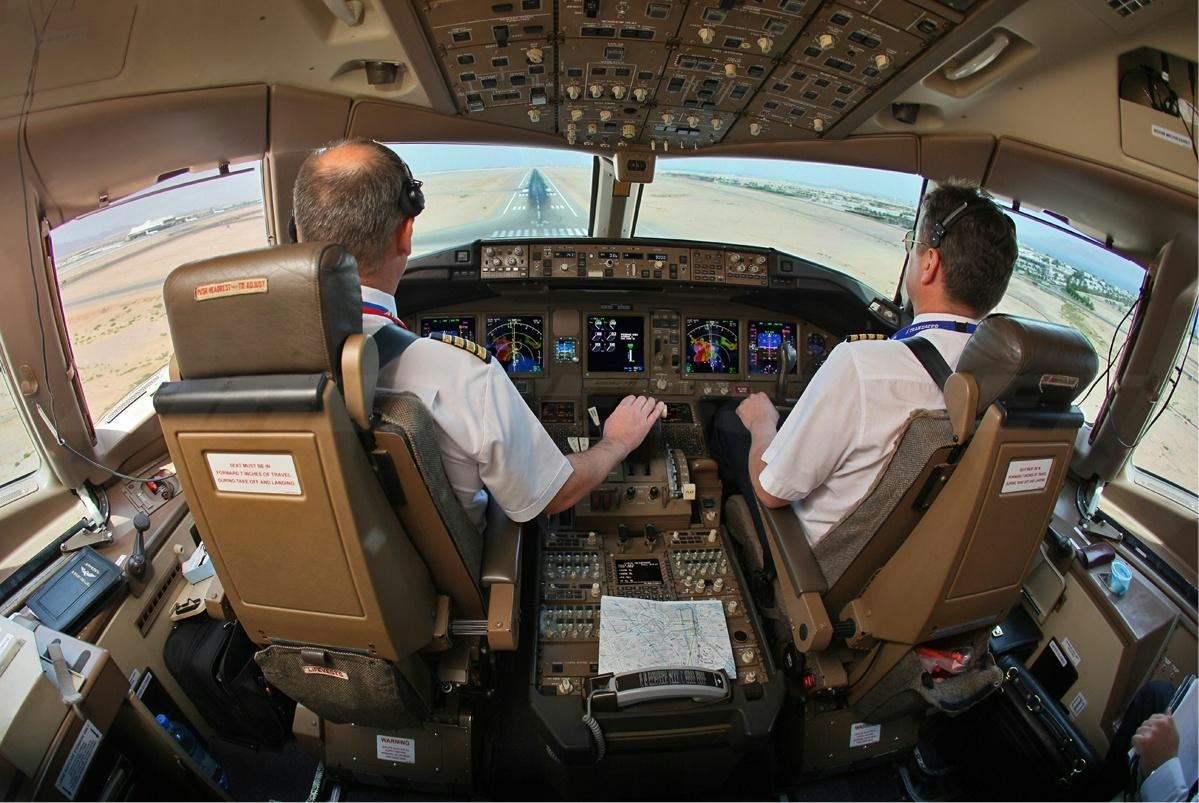
EASA Advances Regulations for Increased AI Use in Cockpits
The European Union Aviation Safety Agency (EASA) is intensifying its efforts to regulate the integration of artificial intelligence (AI) within the aviation sector. This initiative was highlighted during the recent EASA AI Days held in Cologne, Germany, where developers presented sophisticated AI systems designed to enhance cockpit decision-making and safety analysis. Central to the discussions was an update on RMT.0742, EASA’s regulatory framework aimed at establishing comprehensive requirements for AI applications across all regulated aviation activities.
Regulatory Progress and Industry Implications
EASA first introduced its proposed AI regulations in November of last year, setting out foundational standards addressing AI assurance, human factors, and ethical considerations for systems intended to assist or collaborate with human operators. Following a public consultation period that concluded in March, the agency is currently reviewing stakeholder feedback. A subsequent proposal is anticipated to tailor these general principles to specific aviation domains, including aerodromes and other regulated operations.
In its latest concept paper released in June, EASA expanded its regulatory scope to encompass emerging AI technologies such as reinforcement learning, symbolic AI, and Level 3 systems, which represent advanced automation. The agency underscored that these developments enable new operational paradigms where human operators may be remotely located or entirely absent during flight operations.
The integration of AI into aviation presents a range of challenges. Comprehensive safety assessments are required to mitigate risks including atmospheric icing and thermal runaways in lithium-ion batteries. Security concerns are also mounting, particularly as the industry prepares for the transition to unleaded aviation gasoline by 2030 amid escalating cybersecurity threats. Market responses indicate that airlines adopting AI technologies may encounter heightened regulatory scrutiny and increased compliance costs, while competitors may accelerate their own AI initiatives to preserve market position. These dynamics unfold against a backdrop of persistent labor shortages and rising operational expenses.
AI Systems Under Evaluation
At the conference, EASA evaluated ten AI systems selected from a pool of fifty submissions for its inaugural “AI Olympics.” Among the finalists was Kairós Aeroespacial’s FOR-DEC AI, a cockpit assistance tool designed to help flight crews organize operational information, weigh options, and identify uncertainties during decision-making processes. Other notable contenders included an AI platform for analyzing aviation safety reports and Xcert AI, which supports engineers in certification and regulatory compliance tasks.
The list of finalists was published on Wednesday, with conference participants voting to award gold, silver, and bronze distinctions. Kairós emphasized that its system is designed to maintain the pilot as the ultimate decision-maker, providing transparent reasoning to support crew decisions rather than autonomously executing operational commands.
Looking Ahead
The remaining sessions of the conference will focus on research into large language models and reinforcement learning, culminating in a panel discussion addressing the benefits and risks associated with advanced automation. As EASA progresses toward formalizing AI regulations, both the agency and industry stakeholders continue to navigate a complex environment where innovation must be carefully balanced with the imperative to uphold the highest standards of aviation safety.
Comments

Etihad Airways Suspends Airbus A380 Flights on Key Route

Aditya Birla Group Seeks Approval for Aircraft Leasing in GIFT City

Qatar Airways Highlights Innovation and Connectivity at Arabian Travel Market 2026

Hong Kong's Five-Year Plan Includes Andrew Fan's Aircraft Parts Processing Hub Proposal

ACIA Aero Leasing Delivers ATR72-600 to Air Nostrum

RTX Appoints Jill Albertelli as Head of Pratt & Whitney

TAT Technologies Joins Beyond Aero Hydrogen Aircraft Program

AURAK Study Highlights Barriers to Air Taxi Adoption in Emerging Economies

Xiamen Air Selects Altitude for 787 Maintenance at Heathrow

Etihad and Swissport Extend Global Partnership
