
AIによるインサイトを行動へとつなげる

現在のトレンド
Categories
How the Boeing 747SP’s Design Addressed Unique Aviation Challenges
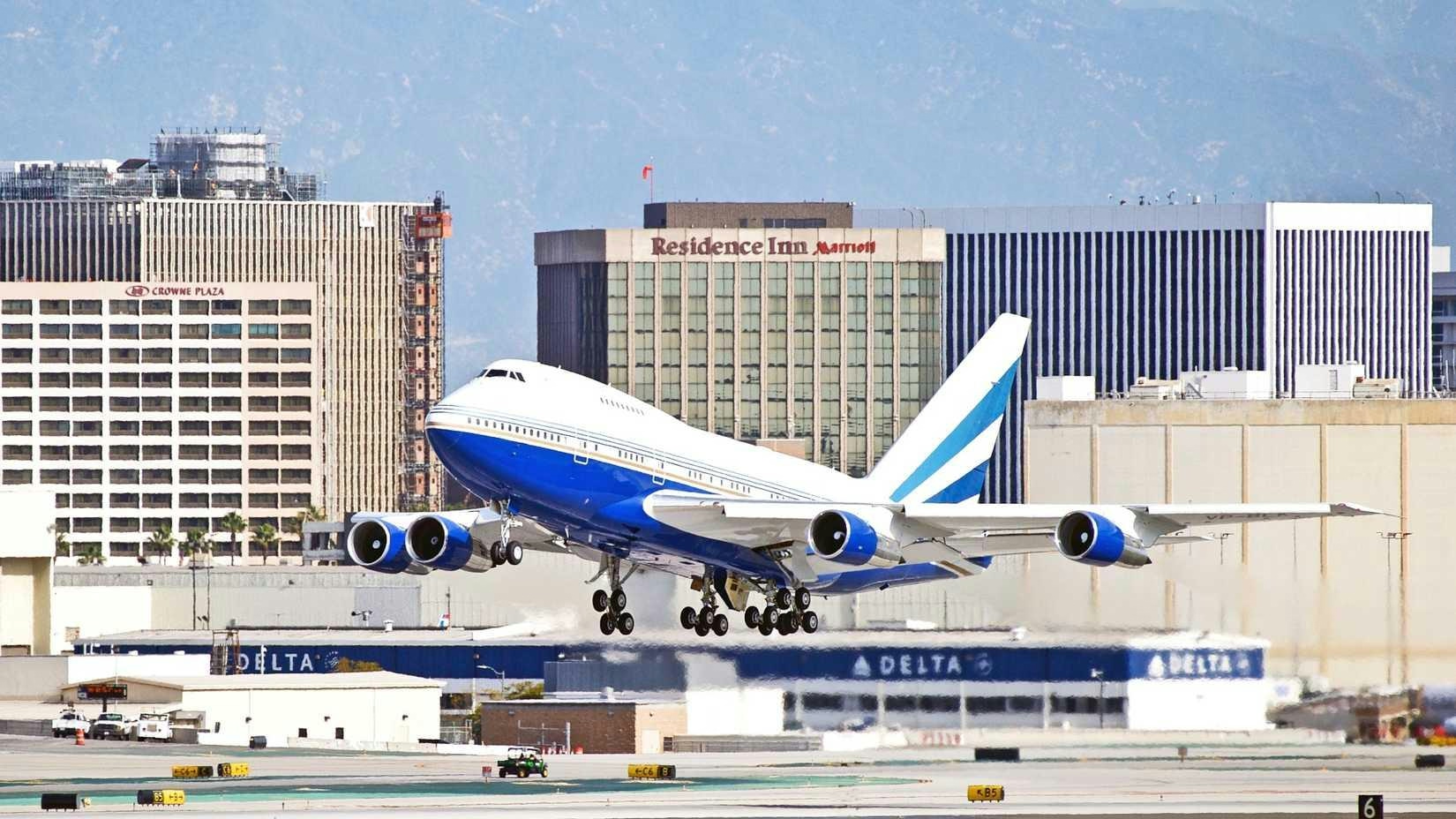
How the Boeing 747SP’s Design Addressed Unique Aviation Challenges
When the Boeing 747SP entered service in 1976, it provided a solution to a persistent challenge in commercial aviation: connecting distant cities nonstop on routes that were too long for most aircraft yet lacked sufficient demand to justify a full-sized jumbo jet. At the time, the market was divided between large aircraft like the original Boeing 747, capable of carrying hundreds of passengers across oceans, and smaller widebody jets such as the McDonnell Douglas DC-10 and Lockheed L-1011 TriStar, which offered better economics on lower-demand routes. However, neither category could efficiently serve ultra-long-haul, low-density routes that airlines increasingly sought to operate.
Innovative Design for Extended Range and Efficiency
Boeing’s response was unconventional. Instead of designing an entirely new aircraft, the company reimagined its flagship 747. The result was the Boeing 747SP—“Special Performance”—a significantly shortened version of the classic jumbo jet. Its compact fuselage combined with an oversized tail gave the aircraft a distinctive, almost disproportionate appearance, earning it nicknames such as the “Baby Jumbo.” Every aspect of the design was purposeful. The 747SP was engineered to fly farther than any commercial airliner of its era while carrying fewer passengers, enabling airlines to launch nonstop services between cities separated by vast distances—routes previously considered impossible.
The aircraft’s shortened fuselage reduced overall weight, while the larger tail enhanced stability at higher altitudes and speeds. Additionally, the 747SP featured a high-speed cruise capability, making it one of the fastest commercial jets of its time. These design elements allowed the 747SP to serve niche markets, including ultra-long-haul flights and luxury charter services, where speed and range were critical.
Market Impact and Legacy
The market response was notably positive, especially among operators seeking faster, more efficient aircraft for transatlantic and transpacific routes. Pan American World Airways, for instance, employed the 747SP to connect New York with destinations in the Middle East and Asia—routes that exceeded the practical range of the DC-10 and L-1011 and were uneconomical for a standard 747. The 747SP’s unique combination of speed and extended range filled a vital gap, allowing airlines to offer nonstop service on “long and thin” routes without the burden of excess capacity.
Competitors took note, prompting other manufacturers to develop long-range, high-speed aircraft in response. Nevertheless, none matched the 747SP’s specific blend of performance and efficiency. Although only 45 units were ultimately built, the 747SP demonstrated that ultra-long-haul travel was feasible decades before modern aircraft made such operations routine.
Far from being a mere curiosity, the Boeing 747SP represented a targeted engineering solution to a problem no other aircraft could solve at the time. Its legacy endures as a testament to innovative design meeting evolving aviation demands.

Etihad Airways Suspends Airbus A380 Flights on Key Route

Aditya Birla Group Seeks Approval for Aircraft Leasing in GIFT City

Qatar Airways Highlights Innovation and Connectivity at Arabian Travel Market 2026

Hong Kong's Five-Year Plan Includes Andrew Fan's Aircraft Parts Processing Hub Proposal

ACIA Aero Leasing Delivers ATR72-600 to Air Nostrum

RTX Appoints Jill Albertelli as Head of Pratt & Whitney

TAT Technologies Joins Beyond Aero Hydrogen Aircraft Program

AURAK Study Highlights Barriers to Air Taxi Adoption in Emerging Economies

Xiamen Air Selects Altitude for 787 Maintenance at Heathrow

Etihad and Swissport Extend Global Partnership
