
AIによるインサイトを行動へとつなげる

現在のトレンド
Categories
ICAO Chief Warns Aviation Must Accelerate Climate Action or Risk Losing Public Trust
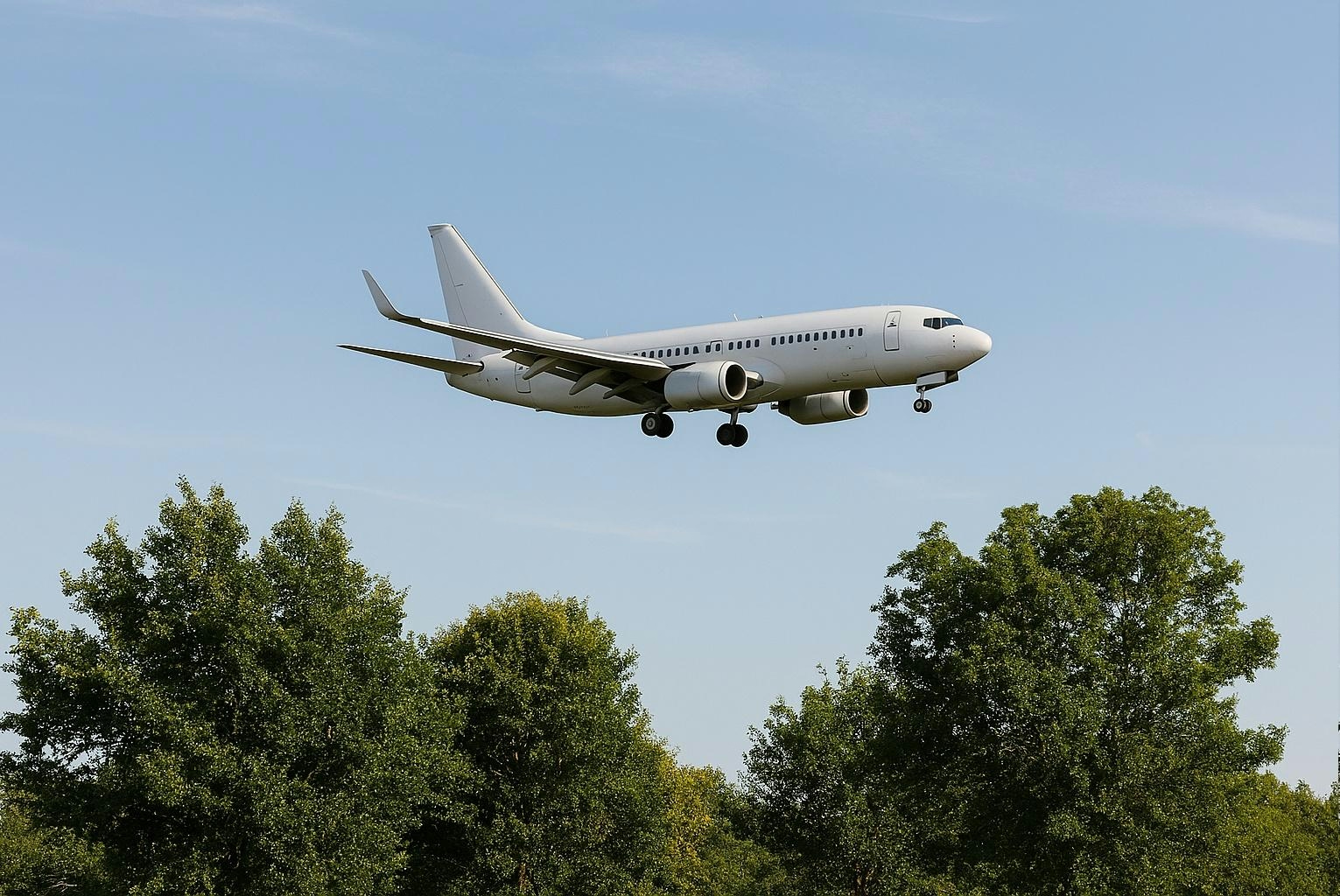
ICAO Chief Urges Aviation to Accelerate Climate Action Amid Growing Challenges
As the global aviation sector prepares for the upcoming ICAO Aviation Climate Week, the International Civil Aviation Organization’s Secretary General, Juan Carlos Salazar, has issued a stark warning about the urgent need for accelerated climate action. Emphasizing the sector’s pivotal role in the global economy, Salazar underscored that the future of aviation hinges on its ability to achieve net-zero carbon emissions by 2050. He cautioned that failure to meet this target at the pace demanded by the climate crisis could result in a significant loss of public trust and political support.
The Imperative for Decarbonization
For decades, civil aviation has been a key driver of globalization and economic development. However, Salazar stressed that the industry must now demonstrate its capacity to adapt to a world increasingly constrained by climate imperatives. “The question is no longer whether aviation can decarbonize—it can,” he stated. “The real test is whether the global community is ready to make the tough choices, and to do so quickly enough.” While recent years have seen incremental improvements through enhanced efficiency, early adoption of sustainable aviation fuels (SAF), and operational optimizations, these measures alone are insufficient. The transformation required is systemic, global, and urgent.
This urgency has been highlighted by recent disruptions, particularly in Europe, where geopolitical tensions in the Middle East have exposed the sector’s heavy dependence on fossil fuels. The resulting fuel supply challenges and soaring costs have sparked debates on how to manage immediate jet fuel shortages without undermining climate objectives. Some industry stakeholders have advocated for easing regulatory frameworks such as the European Union’s Emissions Trading System (ETS) and the RefuelEU initiative, seeking temporary relief amid the crisis. Conversely, environmental organizations argue that the current fuel challenges should reinforce, rather than weaken, commitments to stronger climate legislation.
Bridging Ambition and Implementation
Salazar warned that fragmented or uneven efforts to decarbonize risk not only missing critical climate targets but also eroding the public confidence essential for aviation’s long-term sustainability. ICAO’s Long-Term Global Aspirational Goal of net-zero carbon emissions by 2050 provides a unified direction, yet Salazar emphasized that “ambition without implementation will not deliver results.” He called for the coming decade to be defined by accelerated execution rather than new declarations.
Achieving net-zero emissions will require unprecedented levels of investment and international cooperation. Encouragingly, there has been a notable increase in financing and innovation, ranging from advanced propulsion technologies and digitalized operations to large-scale investments in cleaner energy sources. Sustainable aviation fuels are projected to play a decisive role, potentially accounting for over half of the sector’s emissions reductions by mid-century. However, this transition demands substantial investment in production capacity, infrastructure, and supply chains, particularly in emerging and developing economies.
To help close the gap between ambition and action, ICAO is expanding initiatives such as the Finvest Hub, which connects decarbonization projects with institutional and private capital, especially in regions with limited access to climate finance. Complementary programs like ACT-SAF and ACT-LTAG are assisting states in developing the necessary policy frameworks and technical expertise to support the energy transition.
As the economic risks posed by climate change become increasingly apparent, Salazar concluded that proactive climate risk management is not only an environmental necessity but also a financial imperative. The aviation sector, he asserted, must act decisively or risk being left behind in a rapidly evolving global landscape.

Etihad Airways Suspends Airbus A380 Flights on Key Route

Aditya Birla Group Seeks Approval for Aircraft Leasing in GIFT City

Qatar Airways Highlights Innovation and Connectivity at Arabian Travel Market 2026

Hong Kong's Five-Year Plan Includes Andrew Fan's Aircraft Parts Processing Hub Proposal

ACIA Aero Leasing Delivers ATR72-600 to Air Nostrum

RTX Appoints Jill Albertelli as Head of Pratt & Whitney

TAT Technologies Joins Beyond Aero Hydrogen Aircraft Program

AURAK Study Highlights Barriers to Air Taxi Adoption in Emerging Economies

Xiamen Air Selects Altitude for 787 Maintenance at Heathrow

Etihad and Swissport Extend Global Partnership
