
AIによるインサイトを行動へとつなげる

現在のトレンド
Categories
Innovations in Sustainable Aviation Fuel Supply Chains
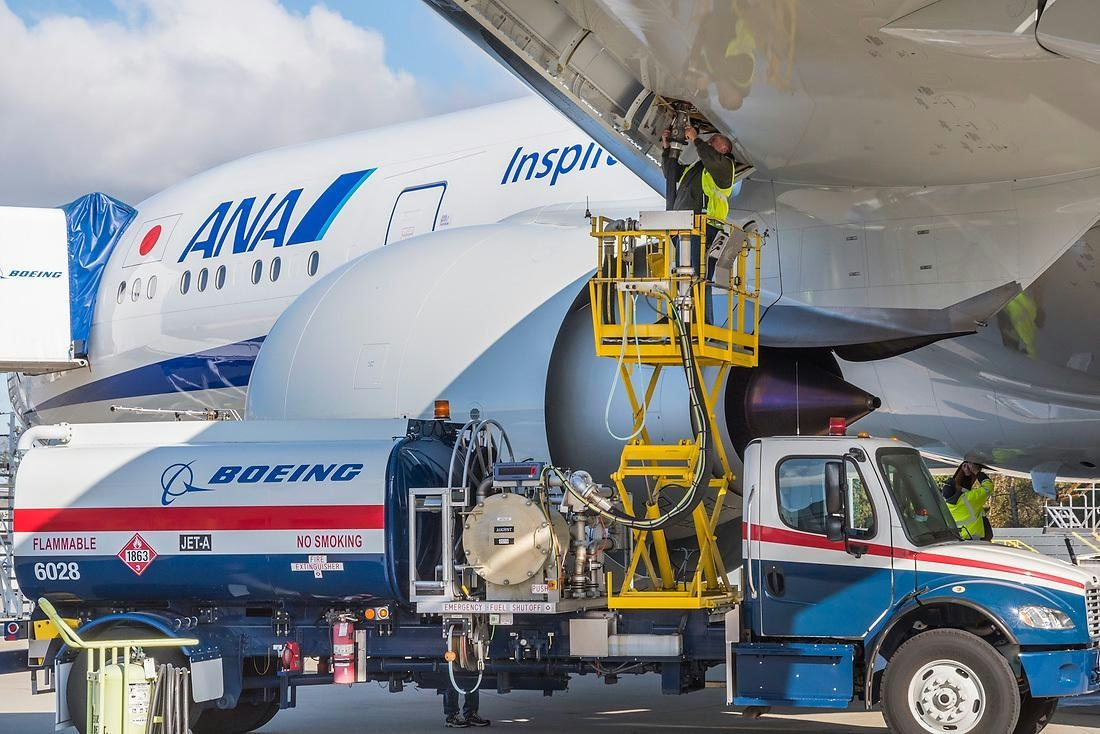
Innovations in Sustainable Aviation Fuel Supply Chains
Louise Burke recently engaged with Damien McLoughlin, Chief Commercial Officer of FlyORO, to discuss the critical challenges and emerging innovations within sustainable aviation fuel (SAF) supply chains. As airlines worldwide intensify efforts to achieve ambitious decarbonization targets, the sector confronts significant obstacles. In particular, fragmented and costly government policies—especially across Europe—have hindered SAF production and escalated costs. Industry leaders warn that these regulatory complexities threaten to undermine the aviation sector’s capacity to scale SAF usage, jeopardizing progress toward net-zero emissions by 2050.
Challenges in SAF Production and Distribution
FlyORO, a Singapore-based technology company, is at the forefront of addressing these challenges by developing novel approaches to SAF distribution. The firm’s patented modular blending units can be deployed flexibly from production sites to airports, facilitating a more distributed and responsive delivery network. McLoughlin underscores that while much of the industry’s focus remains on SAF production, significant difficulties persist downstream in the supply chain. Without localized and adaptable solutions, he cautions, the sector risks creating disparities between airports—some gaining access to SAF while others are left behind.
The global SAF landscape remains uneven. Europe continues to struggle with policy fragmentation, impeding cohesive growth. In contrast, Asia currently stands as the only region experiencing tangible expansion in SAF capacity. Australia, despite recent momentum in its SAF transition, still lacks the structural certainty, coordinated government support, and clear investment signals necessary to establish a sustainable domestic industry. Aviation leaders in Australia emphasize that without these foundational elements, the country will face considerable challenges in building a viable SAF supply chain.
Emerging Pressures and Solutions
Compounding these issues is the rapid growth of artificial intelligence technologies, whose soaring energy demands increasingly compete for the same renewable energy resources required for SAF production. This competition poses a further risk to airlines’ sustainability ambitions.
In response to these complexities, demand is rising for SAF certificates and greater flexibility in accounting for Scope 3 emissions. McLoughlin highlights the critical role of robust traceability and the “book-and-claim” system, which enables airlines to claim environmental benefits from SAF even when physical delivery is not feasible. He argues that this mechanism is essential for scaling SAF demand and maintaining credibility, as it complements physical deployment with transparent and accountable tracking.
While experts acknowledge that the aviation industry is unlikely to meet its 2030 targets for sustainable fuel adoption, innovations such as FlyORO’s modular blending technology and an emphasis on traceable, flexible supply chains offer promising avenues. As the sector navigates complex policy environments, infrastructure limitations, and competing energy demands, localized and adaptable solutions may prove indispensable in accelerating the transition to sustainable aviation.
Comments

Adobe Warns AI-Driven Trip Planning Challenges Travel Sites

The Global Parts Shortage
GE Aerospace's Robust Capital Position Fuels Higher Shareholder Returns
AI Advances Support Sustainable Aviation and Efficient Flight Paths

Airbus Faces Freighter Deadline Amid Weak Order Growth and Stagnant Shares

Integrated CNS System for Low-Altitude Aircraft

Chinese Robots Debut in Aviation and Military Roles at WRC 2026
Kenya Airways Aims to Resume Operations of Grounded Fleet by Early 2027

Avora Aviation Completes A320 Sale-Leaseback Agreement with FTAI
StandardAero Expands Bombardier Global MRO Services at Van Nuys Facility
