
画像

エアロジニー — あなたのインテリジェントな副操縦士。

何でも尋ねてください。全てを分析してください。即座に行動してください。

現在のトレンド

Categories

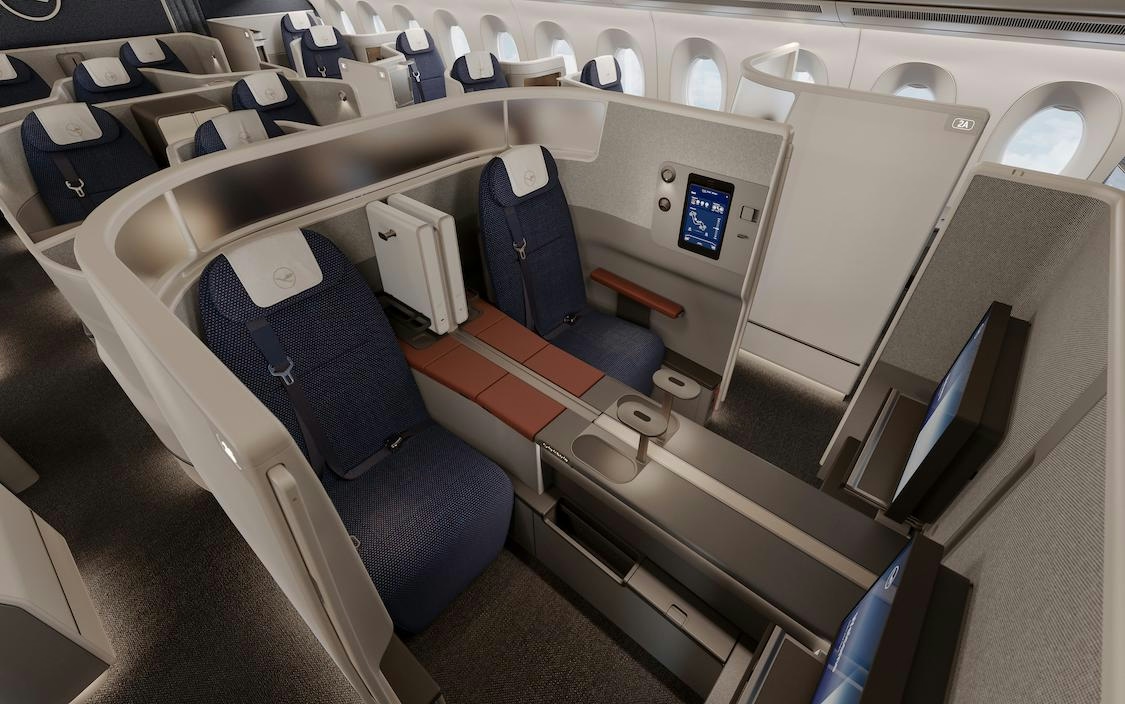
Lufthansa Invests in Both Boeing 777X and Airbus A350
March 2, 2026By ePlane AI
Lufthansa Invests in Both Boeing 777X and Airbus A350
0
0
Lufthansa
Boeing 777X
Airbus A350

Lufthansa Invests in Both Boeing 777X and Airbus A350

Lufthansa, the German flag carrier, has long been known for operating a diverse fleet, currently comprising ten different aircraft types according to Planespotters.net. Historically, the airline has flown as many as 25 different models, including aircraft from manufacturers such as Fokker, McDonnell Douglas, Embraer, Bombardier, Boeing, and Airbus. Today, its fleet is predominantly composed of Boeing and Airbus jets, with Bombardier aircraft primarily serving short-haul routes.

While Lufthansa has expressed intentions to streamline its fleet in order to reduce operating costs, the airline continues to embrace variety. This is evident in its substantial orders for both the Airbus A350 and Boeing 777X, two next-generation long-haul aircraft positioned as flagships by their respective manufacturers.

Competing Flagships: Airbus A350 and Boeing 777X

The Airbus A350 and Boeing 777X represent distinct design philosophies but share the objective of enhancing the economics of long-haul travel through advanced aerodynamics and more efficient engines. The A350, which features a composite airframe and entered service in 2018, has established itself as a reliable and efficient aircraft. In contrast, the Boeing 777X has experienced over six years of delays, with first deliveries now anticipated in 2027 due to supply chain disruptions and an extended certification process. Although Boeing has produced 26 777X aircraft, none have yet entered commercial service.

The two aircraft differ in several key specifications. The 777-9 measures 76.73 meters in length with a wingspan of 235 feet 5 inches, while the A350-1000 is slightly shorter at 73.79 meters and has a wingspan of 212 feet 5 inches. The A350 offers a longer range of 8,900 nautical miles compared to the 7,285 nautical miles of the 777-9. The 777X is powered by two GE9X engines delivering 110,000 pounds of thrust each, whereas the A350 uses two Rolls-Royce Trent XWB-97 engines with 97,000 pounds of thrust. In terms of passenger capacity in a three-class configuration, the 777-9 accommodates 426 passengers, slightly more than the A350-1000’s 410. The maximum takeoff weight is also higher for the 777-9 at 351.5 tonnes compared to 322 tonnes for the A350-1000.

Lufthansa is poised to become the launch operator of the 777-9, having placed orders for 20 passenger variants and seven 777-8 freighters. The airline currently operates 30 A350s and has 29 additional aircraft on order, including both A350-900 and A350-1000 models.

Strategic Diversification Amid Industry Challenges

Lufthansa’s decision to invest in both the Airbus A350 and Boeing 777X carries inherent risks. The airline is contending with ongoing labor disputes and financial underperformance within its mainline operations, which place additional strain on its ambitious fleet renewal strategy. Furthermore, Boeing’s 777X program has recently encountered engine reliability issues, raising concerns about potential further delays and operational challenges.

Market analysts remain divided on Lufthansa’s approach. Some interpret the dual investment as a strategic hedge, providing the airline with flexibility and enhanced negotiating leverage with both manufacturers. Others question the prudence of committing to the 777X, given its troubled development and the A350’s proven track record. Competitors are closely monitoring the situation, with Airbus likely to emphasize the A350’s reliability and performance, while Boeing continues to highlight the 777X’s technological innovations and anticipated market demand.

Despite these uncertainties, Lufthansa’s commitment to both aircraft underscores its strategy of maintaining a versatile and modern fleet. The airline aims to balance innovation, capacity, and operational resilience as it navigates a complex and evolving aviation landscape.

More news
Firefighters Respond to Engine Fire Report on United Airlines Plane at LAX

Firefighters Respond to Engine Fire Report on United Airlines Plane at LAX

Firefighters Respond to Engine Fire Report on United Airlines Plane at LAX A United Airlines flight bound for New Jersey was compelled to return to Los Angeles International Airport (LAX) on Monday morning after encountering an engine issue shortly after takeoff. Flight 2127, operated by a Boeing 787-9 Dreamliner carrying 256 passengers and 12 crew members, departed LAX just after 10 a.m. en route to Newark Liberty International Airport. Incident and Response The Federal Aviation Administration (FAA) reported that the aircraft safely landed back at LAX around 11:20 a.m. following a crew report of a problem with the plane’s left engine. Firefighters were stationed on a taxiway to meet the aircraft as a precautionary measure. The Los Angeles Fire Department confirmed that all passengers and crew disembarked safely, with no injuries reported. Passengers were evacuated using emergency slides and airstairs before being transported by bus to the terminal. United Airlines issued a statement confirming the safe return of Flight 2127, noting that customers deplaned via slides and airstairs and were bused to the terminal. The airline emphasized that there were no reported injuries and that efforts were underway to assist passengers in reaching their final destinations. The emergency prompted a temporary grounding of departures to LAX, although the length of the disruption was not immediately disclosed. Broader Context and Implications This incident occurs amid heightened scrutiny of United Airlines’ maintenance practices. A recent federal watchdog report criticized the FAA’s oversight of airline safety, raising concerns about regulatory effectiveness and airline compliance. The engine issue on Flight 2127 may further intensify questions regarding United’s operational reliability and maintenance protocols. Market analysts suggest that such events often lead to increased regulatory and public scrutiny, as well as potential insurance claims from affected passengers. Competitors may also leverage the situation to underscore their own safety records, potentially influencing customer perceptions and future travel choices. United Airlines has not provided additional details about the specific nature of the engine problem. The FAA is currently investigating the incident, and further information from the airline is pending.
Private Jet Startup Bond Aviation Leases Office Space in Meatpacking District

Private Jet Startup Bond Aviation Leases Office Space in Meatpacking District

Private Jet Startup Bond Aviation Secures Office Space in Manhattan’s Meatpacking District Bond Aviation, a burgeoning private jet startup specializing in part-time ownership of a private jet fleet, has committed to a five-year lease for 4,916 square feet at 22 Little West 12th Street in Manhattan’s Meatpacking District. The property is held by a joint venture between Infinity Real Estate, led by Steve Kassin, and Premier Equities, with RDE Advisors acting as the landlord’s broker. Strategic Location and Leasing Details Although the exact rent was not publicly disclosed, Ross Eisenberg, founder of RDE Advisors, indicated that the lease was secured at a rate in the mid-$70 per square foot range. Eisenberg emphasized Bond Aviation’s fit within the building’s tenant mix, noting the company’s alignment with the Meatpacking District’s creative and design-forward ethos. He also highlighted the sustained demand for boutique office spaces in prime Manhattan locations. Representing Bond Aviation in the transaction was Rob Kluge of Current Real Estate Advisors, who remarked that the startup was drawn to the building’s unique combination of boutique ambiance and upscale finishes. Kluge further noted that the ownership’s cooperative approach facilitated a smooth leasing process despite a competitive market, making this location an ideal choice for Bond’s inaugural New York office. Expansion Amidst a Competitive Private Aviation Market Founded in late 2025 by Bill Papariella and backed by approximately $350 million in funding from investment management firm KKR, Bond Aviation is establishing its first New York City presence as part of a broader national growth strategy. Headquartered in Fort Lauderdale, Florida, the company also operates offices in Las Vegas and Beverly Hills. Bond Aviation’s business model offers affluent clients fractional ownership of private jets, with operations slated to commence in 2027. Last October, the company announced an order for 50 new Bombardier jets and plans to maintain one jet and crew for every ten customers, underscoring its commitment to personalized service. The private jet sector has witnessed robust activity, particularly in the fourth quarter, reflecting strong demand for private aviation services. However, Bond Aviation enters a market marked by intensifying competition and regulatory complexities. In regions such as Asia-Pacific, illegal charter operations are undermining legitimate providers, presenting additional hurdles for new entrants. Furthermore, the industry faces mounting pressure to enhance financial transparency, with investors increasingly scrutinizing the fiscal stability of emerging companies like Bond. The Meatpacking District’s Appeal to Innovative Firms The six-story building at 22 Little West 12th Street, originally a parking garage converted into boutique office space in 2013, hosts a diverse tenant roster including the global law firm Dentons and Kao Salon Academy New York. Bond Aviation’s arrival highlights the Meatpacking District’s continued attractiveness to innovative enterprises and reflects the evolving dynamics within the private aviation industry.
Why British Airways Chose the Airbus A380

Why British Airways Chose the Airbus A380

Why British Airways Chose the Airbus A380 In September 2007, British Airways made a significant strategic decision regarding the modernization of its long-haul fleet by placing a split order between Boeing and Airbus. The airline committed to acquiring 24 Boeing 787 Dreamliners to ensure operational flexibility, alongside 12 Airbus A380s aimed at addressing capacity demands. This dual approach was intended to replace the aging Boeing 747-400s and 767s while supporting growth at the airline’s primary hub, London Heathrow. Given Heathrow’s severe slot constraints, the challenge was not to increase the number of flights but to maximize passenger volume per available slot, a factor that heavily influenced British Airways’ fleet strategy. Strategic and Economic Considerations British Airways’ investment in the Airbus A380 was driven by a combination of economic rationale and brand positioning. The A380, the world’s largest passenger aircraft and the only full-length double-deck jet in regular commercial service, offered significant per-seat cost advantages and a reduced noise footprint—critical benefits for operations at a congested airport like Heathrow. When British Airways received its first A380 in July 2013, the aircraft entered service that autumn configured to seat 469 passengers, a layout designed to optimize capacity on high-density routes. This configuration allowed the airline to maximize revenue potential within the constraints imposed by limited airport slots. Despite these advantages, the decision to invest in the A380 was not without its challenges. The aircraft’s high operational and maintenance costs raised concerns within the industry, especially as the market increasingly favored smaller, more fuel-efficient twin-engine jets. The shift in airline preferences ultimately led Airbus to cease production of the A380 in 2021, reflecting a broader market trend toward aircraft that offer greater flexibility and lower operating expenses. Market Dynamics and Competitive Pressures The competitive environment surrounding British Airways also evolved during this period. The airline’s transition to a spend-based loyalty program prompted rivals such as Virgin Atlantic to launch status-match campaigns aimed at attracting British Airways’ mid-tier customers. Low-cost carriers like easyJet capitalized on passenger dissatisfaction with these loyalty changes, further intensifying competition. Meanwhile, the duopoly of Boeing and Airbus continued to dominate the commercial aircraft market, with airlines such as Lufthansa investing in retrofitting their A380 fleets to maintain competitiveness amid delays in the delivery of newer aircraft models. The A380’s Role in British Airways’ Network The fundamental design philosophy of the A380 remained relevant despite these headwinds: in an environment where airport slots are limited, growth is best achieved by increasing the number of seats per flight. The A380’s typical three-class layout accommodates just over 500 passengers, with certification for up to 853 in an all-economy configuration. Its immense size, characterized by wings wider than its length, combined with its long-haul range, positioned it as a flagship aircraft for airlines serving dense, high-demand routes. The spacious two-deck cabin also allowed for premium-heavy configurations and enhanced onboard amenities, reinforcing the aircraft’s role as a symbol of brand prestige. Although the era of the A380 may be drawing to a close, British Airways’ investment in the aircraft underscores the airline’s ongoing efforts to optimize operations within the constraints of its Heathrow base. By leveraging large-capacity aircraft, British Airways has sought to maintain its status as a central network hub, adapting to operational realities, competitive pressures, and shifting market dynamics in the global aviation industry.
Akwa Ibom Expands Aviation Sector with Delivery of Two Airbuses

Akwa Ibom Expands Aviation Sector with Delivery of Two Airbuses

Akwa Ibom Expands Aviation Sector with Delivery of Two Airbuses Akwa Ibom State is poised to enhance its aviation capabilities with the anticipated delivery of two new Airbus aircraft for its state-owned airline, Ibom Air, later this year. Governor Umo Eno, speaking in Uyo, emphasized that this acquisition will augment the airline’s existing fleet of nine aircraft, which has been operating domestic and regional African routes since its inception in 2019. This expansion reflects the state’s commitment to strengthening its position within the regional aviation market. Infrastructure Upgrades and Strategic Vision In preparation for the launch of international flights scheduled for April 2026, significant upgrade projects are underway at Victor Attah International Airport. Governor Eno outlined these developments as part of a comprehensive strategy to establish Akwa Ibom as a regional aviation hub. The airport enhancements are expected to support increased passenger traffic and facilitate broader connectivity beyond Nigeria’s borders. However, the expansion occurs amid ongoing challenges within the global aviation industry. Airbus, the manufacturer of the new aircraft, has recently encountered supply chain disruptions and production delays, issues acknowledged by its CEO. These complications may impact delivery schedules not only for Akwa Ibom but for airlines worldwide. Concurrently, competitors such as Boeing face their own production and strategic hurdles. The aviation sector is also witnessing significant shifts, including rapid growth among Asia-Pacific carriers and a concerted industry-wide effort to adopt sustainable aviation fuels, championed by leading airlines like Emirates. Broader Development Initiatives and Political Context Beyond aviation, Governor Eno highlighted several key infrastructure projects across Akwa Ibom State. Among these is the imminent inauguration of the State Geriatric Centre, known as the ARISE Elderly Citizens Centre, which will be officially opened by First Lady Oluremi Tinubu during her first visit to the state. Situated along the ARISE Medical Corridor on the Uyo–Ikot Ekpene Road, the centre is designed to provide healthcare and recreational services for citizens aged 65 and above. The inauguration will coincide with the conclusion of a women’s sensitisation and mobilisation tour, underscoring the administration’s focus on social welfare. Additionally, the governor noted the construction of a new jetty in Oron aimed at revitalizing the city’s commercial activities. Preliminary work has also commenced on the Ikot Ekpene International Market, with full-scale construction planned to follow. These projects are integral to the state’s broader economic development agenda. Despite these ambitious initiatives, Governor Eno’s administration faces scrutiny over recent decisions, notably a contentious agreement with a UK firm to manage state-owned hotels. This deal has sparked public debate and raised concerns about political support for the government’s economic and aviation strategies. Governor Eno praised the active involvement of women in the state’s empowerment programmes and conveyed the First Lady’s gratitude to participants. He reaffirmed the government’s dedication to implementing strategic projects across all three senatorial districts, with the goal of fostering economic growth and enhancing the quality of life for residents of Akwa Ibom.
1946 Cessna 140 Preserved as a Time Capsule Aircraft

1946 Cessna 140 Preserved as a Time Capsule Aircraft

1946 Cessna 140 Preserved as a Time Capsule Aircraft The 1946 Cessna 140 remains an enduring symbol of the postwar golden age of general aviation, representing a period when flying became increasingly accessible to the American public. Unlike its more basic counterpart, the Cessna 120, the 140 offered enhanced comfort, wing flaps, and additional windows, elevating the flying experience for private pilots in the late 1940s. Today, this particular model stands out as a meticulously preserved example that bridges mid-century nostalgia with modern functionality. A Classic Aircraft with Modern Enhancements This 1946 Cessna 140 has accumulated just 1,433 total hours on its airframe, an exceptionally low figure given its age. It is powered by a Continental C85-12F engine, which has undergone a major overhaul in 2019 and has since logged only 278 hours. The engine benefits from several modern upgrades, including a Sky-Tec lightweight starter, a Plane-Power alternator, and a spin-on oil filter, all of which contribute to improved reliability and ease of maintenance. Additional features such as a Cessna 150 exhaust system and strong cylinder compressions, ranging from 77 to 79, further attest to the engine’s readiness for continued operation. Despite its vintage airframe, the cockpit is equipped with contemporary avionics, including a uAvionix AV-30c digital display, an Icom A-200 radio, and a Stratus ESG ADS-B Out transponder. The cabin is outfitted with four USB-A power ports and a Sigtronics intercom, enhancing connectivity and comfort during flight. The aircraft cruises at approximately 100 miles per hour while consuming less than five gallons of fuel per hour. Its exterior features durable Imron paint, and the poly-fiber fabric-covered wings were refurbished in 2011. Practical upgrades such as a BAS tail pull handle for easier ground handling, LED position and landing lights for improved visibility, and Hooker harnesses for modern safety standards further enhance the aircraft’s appeal. Inside, the Airtex interior and Cessna 150 seats provide a level of comfort that surpasses the original 1940s factory benches. With a useful load capacity of 436 pounds, the aircraft is well suited for a pilot and passenger to explore regional grass strips or enjoy leisurely weekend flights. Priced at $40,000, this Cessna 140 offers a turnkey opportunity to own a classic aircraft that has been thoughtfully updated to meet today’s airspace requirements. Preservation Challenges and Market Context The preservation of vintage aircraft such as this Cessna 140 is not without its challenges. Regulatory scrutiny has intensified in recent years, particularly following high-profile disputes over aircraft certification. For instance, the United States has threatened to revoke certification for certain Canadian-made aircraft, signaling a potential tightening of compliance and safety standards in vintage aircraft restoration projects. While aviation enthusiasts and collectors continue to show strong interest in classic models, broader industry trends also influence the market. Increased production rates and strategic decisions by major manufacturers like Airbus and Boeing shape the landscape, often emphasizing technological advancements that may overshadow the historical significance of aircraft like the Cessna 140. Nevertheless, for those seeking a harmonious blend of heritage and modern reliability, this 1946 Cessna 140 remains a compelling and well-preserved time capsule, ready to embark on new adventures.
Pratt & Whitney to Invest $200 Million in U.S. Engine Facility Expansion

Pratt & Whitney to Invest $200 Million in U.S. Engine Facility Expansion

Pratt & Whitney Commits $200 Million to Expand Columbus Engine Facility Pratt & Whitney has announced a $200 million investment to expand its engine manufacturing operations in Columbus, Georgia, aiming to increase production capacity in response to growing demand from both commercial and military sectors. The expansion is projected to create 15 new jobs initially, with further employment opportunities expected as the project advances. Expansion of a Strategic Manufacturing Hub This investment builds on a recent expansion that added nearly 400 jobs and 81,000 square feet to the Columbus Engine Center. Established in 1984, the Columbus facility encompasses both the Columbus Engine Center and Columbus Forge, which collectively support a broad range of Pratt & Whitney’s commercial and military engine programs. The Columbus Engine Center serves as a critical maintenance hub for Pratt & Whitney’s geared turbofan (GTF) engines, which power prominent aircraft such as the Airbus A320neo family, Airbus A220, and Embraer E-Jets E2. Additionally, the facility services the F117 engine used in the Boeing C-17 Globemaster III, as well as the F100 engine that powers the McDonnell Douglas F-15 Eagle and Lockheed Martin F-16 Fighting Falcon. The Columbus Forge specializes in manufacturing compressor airfoils and disks for both commercial and military engines, including components for the F135 engine that powers all variants of the Lockheed Martin F-35 Lightning II fighter. Addressing Supply Chain Challenges and Market Competition Industry analysts have welcomed the expansion as a strategic initiative to enhance Pratt & Whitney’s manufacturing capabilities and reinforce supply chain resilience. The investment arrives at a critical juncture, as engine shortages have recently affected key customers such as Airbus, which was compelled to reduce aircraft delivery targets due to limited supplies of GTF engines. By augmenting capacity in Columbus, Pratt & Whitney aims to mitigate these shortages and better support its customers’ production requirements. The expansion also highlights intensifying competition within the aerospace sector. Rival engine manufacturers may respond by increasing their own production capacities or investing in advanced forging technologies to maintain competitiveness. While the $200 million project underscores Pratt & Whitney’s commitment to meeting rising market demand, the company faces the challenge of scaling production efficiently to fulfill both commercial and defense contracts. Nevertheless, the investment is broadly regarded as a proactive measure to secure the company’s position in a rapidly evolving global aerospace market.
NTSB: Bird Strike Caused Engine Failure and Smoke Alert on Alaska Cargo A330 in Cincinnati

NTSB: Bird Strike Caused Engine Failure and Smoke Alert on Alaska Cargo A330 in Cincinnati

Bird Strike Causes Engine Failure and Smoke Alert on Alaska Airlines Cargo Flight in Cincinnati A preliminary report from the National Transportation Safety Board (NTSB) has confirmed that a bird strike was responsible for an engine failure and subsequent smoke alert aboard an Alaska Airlines cargo Airbus A330-343. The incident forced an emergency return to Cincinnati/Northern Kentucky International Airport (CVG) on January 28, 2026. Incident Overview The aircraft, registered as N5827K and operating as Flight 2616 from CVG to Houston’s George Bush Intercontinental Airport, encountered a flock of Canada geese shortly after takeoff. The event occurred at approximately 3:05 p.m. EST, with two crew members on board. Fortunately, no injuries were reported. The flight departed from Runway 27 at CVG in clear weather conditions. While climbing through an altitude of 900 to 1,000 feet, the aircraft struck multiple birds on both sides. This resulted in the flight crew receiving an “ENG 1 FAULT” alert, quickly escalating to an “ENG 1 FAIL” warning, indicating failure of the left Rolls-Royce RB211 engine. The captain promptly declared an emergency and requested an immediate return to CVG. The aircraft was vectored for landing on Runway 36R. During the return, the crew reported smoke in the cockpit accompanied by a Main Deck Smoke alert. Both pilots donned oxygen masks and initiated emergency procedures. The smoke dissipated prior to landing. The first officer, serving as pilot flying, executed a safe landing. Rescue teams were on standby and discharged fire suppression agents into the affected engine as a precaution, although no fire was detected. The aircraft was subsequently towed to the ramp for a detailed inspection. Damage and Investigation The NTSB’s preliminary findings reveal significant damage to several components of the aircraft. The left main landing gear door and strut, left wing inboard flap, right engine pylon, and right wing leading edge slat and slat track all sustained damage. Both engines showed evidence of bird ingestion. The left engine exhibited fan blade damage, restricted rotation, and visible misalignment, while the right engine sustained acoustic liner damage and bird remnants but remained operational. Airport personnel recovered the remains of eight Canada geese from the runway vicinity. Weather conditions at the time were reported as visual meteorological conditions, with winds at 15 knots and temperatures at –9°C. The flight was operating under an instrument flight rules (IFR) plan. Safety Implications and Industry Response This incident underscores the persistent safety challenges posed by bird strikes, engine failures, and in-flight smoke alerts. The NTSB’s findings are expected to prompt renewed scrutiny of airline safety protocols and may have implications for insurance policies within the aviation sector. In response, competing carriers might implement enhanced safety measures or issue public statements reaffirming their commitment to operational safety. The NTSB has previously advocated for software updates to mitigate risks associated with engine failures, such as those involving the CFM Leap-1B engine, highlighting the ongoing need for continuous safety improvements across the industry. The investigation into the Alaska Airlines incident remains active as the NTSB continues to analyze the causes and explore potential preventive strategies.
Davcon Aviation to Develop $100 Million MRO Facility at Salina Regional Airport

Davcon Aviation to Develop $100 Million MRO Facility at Salina Regional Airport

Davcon Aviation to Invest $100 Million in MRO Facility at Salina Regional Airport SALINA, KAN. — Davcon Aviation has announced an ambitious phased development project at Salina Regional Airport, centered on a $100 million investment to establish a new Class A maintenance, repair, and overhaul (MRO) hangar complex. The initiative, undertaken in collaboration with the Salina Airport Authority, will ultimately span more than 300,000 square feet of aviation facilities. Cushman & Wakefield has been appointed as the leasing agent, with a dedicated team led by Jerry Noble, Adam Madison, Kyle Stickles, Robb Vallier, and Faith Kruckenberg managing the leasing efforts. Expansion and Strategic Positioning This project represents Davcon’s latest expansion following recent developments at Wichita’s Dwight D. Eisenhower National Airport and Topeka Regional Airport. Headquartered in Mesa, Arizona, Davcon Aviation Partners LLC specializes in the development of airport hangars on a national scale. The new MRO facility is anticipated to attract airlines seeking alternative maintenance options, potentially enhancing Salina Regional Airport’s role within the aviation maintenance sector. Challenges and Competitive Landscape Despite the promising outlook, Davcon faces several challenges. The company must compete with established regional hubs and global MRO providers, including APAS Chile and RTX, which recently announced a $139 million MRO investment in Singapore. These competitors may respond by expanding their own facilities and services to protect their market share. Furthermore, Davcon will need to address workforce recruitment and retention amid a competitive labor market, while also securing the necessary regulatory approvals to advance the project. The substantial capital commitment underscores confidence in Salina Regional Airport’s potential to emerge as a significant player in the Midwest’s aviation maintenance industry. The phased development is expected to strengthen the region’s aviation infrastructure and position Salina as a strategic hub for MRO services.
The Challenge of Developing Sustainable Aviation Fuel

The Challenge of Developing Sustainable Aviation Fuel

The Challenge of Developing Sustainable Aviation Fuel Aviation has long been a symbol of human innovation, yet it now represents one of the most pressing challenges in the fight against climate change. Commercial aviation accounts for approximately 2.5% of global annual CO₂ emissions, with its overall climate impact further amplified by contrails and nitrogen oxide emissions. Unlike ground transportation, which can transition to batteries or hydrogen, jet engines require energy-dense fuels such as kerosene, making the sector’s decarbonization particularly complex. The Importance of Sustainable Aviation Fuel As international climate targets become more stringent and the aviation industry commits to achieving carbon neutrality by 2050, the search for alternatives to fossil-based jet fuel has become increasingly urgent. Although electric and hydrogen-powered aircraft are under development, current battery technology remains too heavy for most commercial planes, and hydrogen propulsion would necessitate entirely new aircraft designs alongside a global refuelling infrastructure. Sustainable Aviation Fuel (SAF) has thus emerged as the most viable near-term solution. Airlines have begun blending small quantities of bio-based SAF—produced from agricultural residues, used cooking oils, and municipal waste—with conventional jet fuel. These blends offer a reduction in emissions compared to fossil fuels. However, the current scale of production and availability of feedstocks are insufficient to meet the demands of the world’s 25,000 commercial aircraft. Obstacles to Scaling Sustainable Aviation Fuel The expansion of SAF production faces considerable challenges. The supply of bio-based feedstocks is limited and must be shared with other industries, creating competition for resources. More critically, the infrastructure required for commercial-scale SAF production is underdeveloped, and the costs remain significantly higher than those of conventional jet fuels. The European Union’s proposal to mandate 1.2% of aviation fuel to be electro-sustainable aviation fuel (eSAF) by 2030 is currently under debate, as the capacity for large-scale production has yet to be established. Although over 70 eSAF production facilities are in various stages of development, most depend heavily on private and national investments to proceed. Despite these obstacles, progress is being made. Companies such as SkyNRG are constructing new SAF production plants, with the first expected to become operational by 2028. Major airlines and energy corporations, including Delta Air Lines and Shell, are forging partnerships to accelerate SAF adoption. Nonetheless, logistical challenges remain, particularly in emerging markets where infrastructure and supply chains are less developed. The Potential of Electro-Synthetic Aviation Fuel Electro-synthetic aviation fuel (eSAF) represents a promising innovation that could revolutionize the industry. Produced by combining captured carbon dioxide with green hydrogen generated from renewable electricity, eSAF creates a liquid hydrocarbon fuel that closely resembles conventional jet fuel. This technology has the potential to overcome the limitations associated with bio-based feedstocks and enable scalable, low-carbon aviation fuel production. Future Outlook The global market for sustainable aviation technologies is expected to expand rapidly, driven by advancements in electric propulsion, hydrogen engines, and sustainable fuels. However, for SAF and eSAF to realize their full potential, substantial investment and the development of supporting infrastructure are imperative. As the aviation sector strives to meet its climate commitments, the critical challenge remains the scaling of sustainable fuel production to power the future of flight.
Lufthansa Technik Develops Next-Generation Praetor Cabins

Lufthansa Technik Develops Next-Generation Praetor Cabins

Lufthansa Technik Advances Praetor Cabins with Cutting-Edge Technologies Lufthansa Technik (LHT) has announced its integral role as the core development and supply partner for Embraer’s next-generation Praetor 500E and Praetor 600E business jet cabins. This collaboration introduces a range of pioneering technologies designed to transform the in-flight experience for passengers. Innovative Cabin Features and Technologies At the heart of the new cabin design is a revolutionary 42-inch curved OLED Smart Window™, seamlessly embedded into the sidewall. This digital window utilizes live video feeds from three onboard cameras to provide passengers with expansive external views, forming the basis of Embraer’s exclusive Smart Window™ technology. The display is fully integrated with a newly developed Inflight Entertainment and Cabin Management System (IFE & CMS), which features a custom Embraer graphical user interface. This interface offers intuitive control over cabin lighting, climate settings, connectivity options, and wireless charging capabilities. The auditory environment within the cabin is enhanced by Lufthansa Technik’s Red Dot Design Award-winning Omni-Fi membrane speaker system. Employing advanced Ring-mode Converter/Transducer technology, these ultra-slim speakers deliver immersive, omnidirectional sound without compromising the cabin’s sleek aesthetic. To improve operational efficiency, Lufthansa Technik has incorporated a digital ground portal that supports over-the-air updates, remote configuration, and scalable functionality. This system ensures that cabin technologies can be continuously updated and adapted to evolving customer requirements. Collaboration and Industry Context This initiative builds upon the longstanding partnership between Embraer and Lufthansa Technik, which began with the Phenom 100EX and Phenom 300E programs. Their collaboration encompasses all stages from early concept and industrial design to system architecture, engineering, and production readiness, resulting in a portfolio of jointly developed innovations. Despite the promising advancements, the development of these next-generation cabins presents challenges, particularly in ensuring compatibility with existing aircraft systems and managing the costs associated with retrofitting. Nevertheless, the market response has been favorable, with business aviation operators showing increased interest in upgrading their fleets to enhance passenger comfort and connectivity. Lufthansa Technik’s focus on advanced cabin upgrades aligns with a broader industry trend emphasizing improved in-flight experience and digital connectivity. Competitors such as Collins Aerospace and Pratt & Whitney Canada are similarly investing in innovative cabin interiors and electronics, while companies like Thales and JPA Design are advancing comparable technologies for commercial aircraft, including the Boeing 787 Dreamliner. As the business aviation sector continues to prioritize passenger experience and operational flexibility, Lufthansa Technik’s latest developments for the Praetor cabins position both the company and Embraer at the forefront of cabin innovation, setting new benchmarks for the industry.
line









