
AIによるインサイトを行動へとつなげる

現在のトレンド
Categories
Mexico to Host Forum on Sustainable Aviation Fuel with 2026 Rollout Target
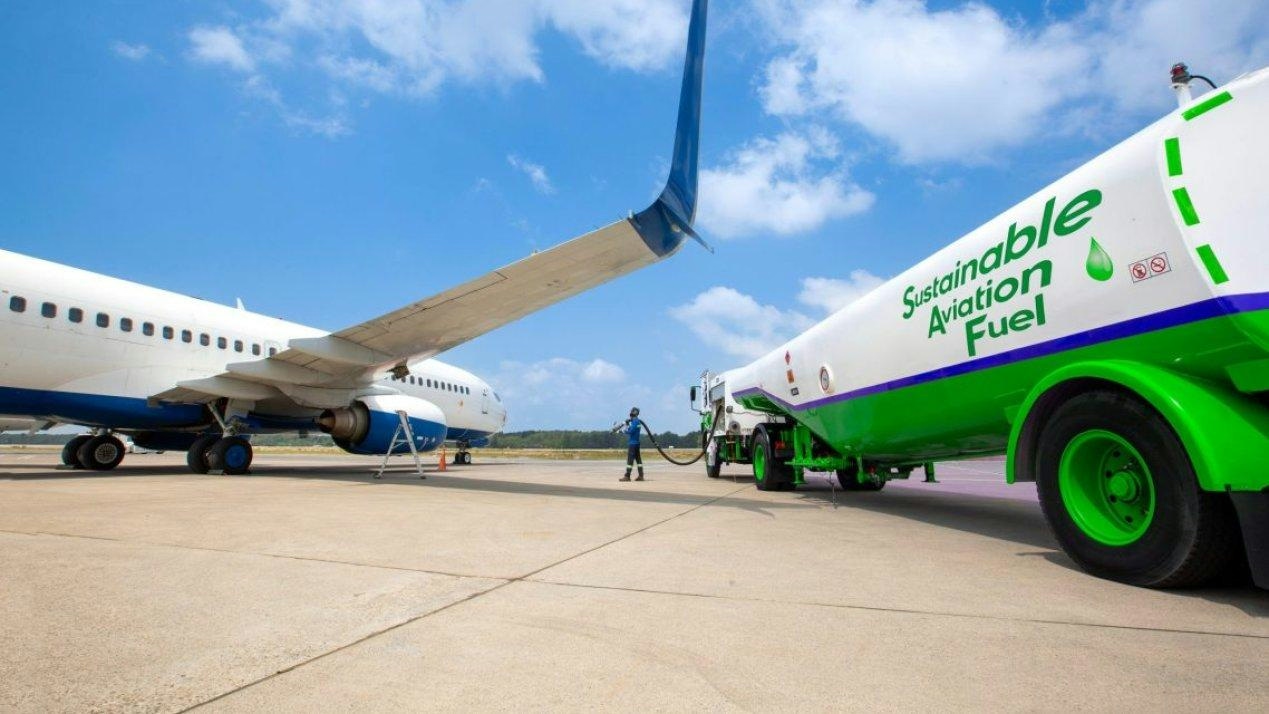
Mexico to Host Forum on Sustainable Aviation Fuel with 2026 Rollout Target
Government Initiative to Advance Sustainable Aviation Fuels
Mexico’s federal government has announced plans to convene its fifth technical forum on sustainable aviation fuels (SAF), with the objective of integrating bioturbosina into the national aviation supply chain and enabling low-emission flights by 2026. This initiative is spearheaded by the Ministry of Infrastructure, Communications and Transportation through Aeropuertos y Servicios Auxiliares (ASA) and the Federal Civil Aviation Agency, in coordination with the Ministry of Energy. Authorities emphasize that the forum will serve as a platform to align public policy and accelerate the transition toward cleaner aviation fuels.
The event is scheduled to take place at the International Training Center of ASA (CIIASA) “Ing. Roberto Kobeh González” and will gather international stakeholders to discuss critical topics such as policy frameworks, certification processes, technological advancements, financing mechanisms, demand generation, and SAF production. A particular focus will be placed on fostering regional integration across Latin America. The government aims to facilitate collaboration among regulators, producers, and airlines to coordinate deployment strategies and strengthen the SAF value chain.
ASA’s Role and Pilot Projects
As Mexico’s primary aviation fuel supplier, ASA has reaffirmed its commitment to sustainability and the decarbonization of air transport. The agency highlights its logistical capacity to incorporate SAF into the national fuel supply, a capability deemed essential as domestic production scales up or imports become available. In line with this, ASA is developing a pilot blending project at the Mexico Fuel Station, designed to enable the incorporation of bioturbosina into aircraft fuel supplies within the current year. This pilot will validate logistics, technical standards, and regulatory compliance necessary for SAF integration, paving the way for Mexico’s first green flights.
Since 2024, ASA has collaborated with stakeholders across the aviation and energy sectors, international organizations, and research institutions to secure feedstock availability and ensure production aligns with international sustainability standards. These standards are critical for certification and cross-border supply. The government has established seven strategic workstreams—covering infrastructure, certification, regulation, innovation, technology, feedstocks, and financing—to address challenges such as certification pathways, capital investment requirements, and scaling production.
Challenges Amid Global Market Pressures
Despite these efforts, Mexico’s ambitions for SAF face considerable challenges. Global demand for sustainable aviation fuels has surged, particularly in Europe, where airlines have tripled their SAF usage to comply with EU mandates. This increased demand has affected U.S. soybean oil prices and compelled American producers to rely more heavily on domestic feedstocks, driving up vegetable oil prices and underscoring the volatility of the global fuel market. The 2026 global fuel crisis and rising jet fuel prices have further exposed the aviation industry’s vulnerabilities, forcing airlines to consider fare increases of at least 20% to maintain financial viability.
Currently, SAF accounts for only 0.7% of the aviation sector’s fuel consumption, constrained by high costs, limited infrastructure, and ongoing sustainability concerns. The sector’s decarbonization trajectory remains uncertain, prompting calls for a multi-faceted approach that includes cautious SAF adoption, carbon offsetting, and investment in advanced e-fuels and domestic supply chains.
Industry Outlook and International Perspectives
The International Air Transport Association (IATA) has warned that aircraft delivery delays and the costs associated with environmental compliance will continue to exert pressure on airlines throughout 2026. IATA Director General Willie Walsh highlighted that supply chain disruptions have compelled airlines to operate older, less fuel-efficient aircraft, resulting in increased fuel consumption and maintenance expenses. IATA estimates that delivery delays added over $11 billion in costs in 2025, with approximately two-thirds attributable to fuel and maintenance.
As Mexico prepares to host its SAF forum and advance its 2026 rollout plans, the country confronts a complex landscape of both opportunities and obstacles in its pursuit of sustainable aviation.

Etihad Airways Suspends Airbus A380 Flights on Key Route

Aditya Birla Group Seeks Approval for Aircraft Leasing in GIFT City

Qatar Airways Highlights Innovation and Connectivity at Arabian Travel Market 2026

Hong Kong's Five-Year Plan Includes Andrew Fan's Aircraft Parts Processing Hub Proposal

ACIA Aero Leasing Delivers ATR72-600 to Air Nostrum

RTX Appoints Jill Albertelli as Head of Pratt & Whitney

TAT Technologies Joins Beyond Aero Hydrogen Aircraft Program

AURAK Study Highlights Barriers to Air Taxi Adoption in Emerging Economies

Xiamen Air Selects Altitude for 787 Maintenance at Heathrow

Etihad and Swissport Extend Global Partnership
