
AIによるインサイトを行動へとつなげる

現在のトレンド
Categories
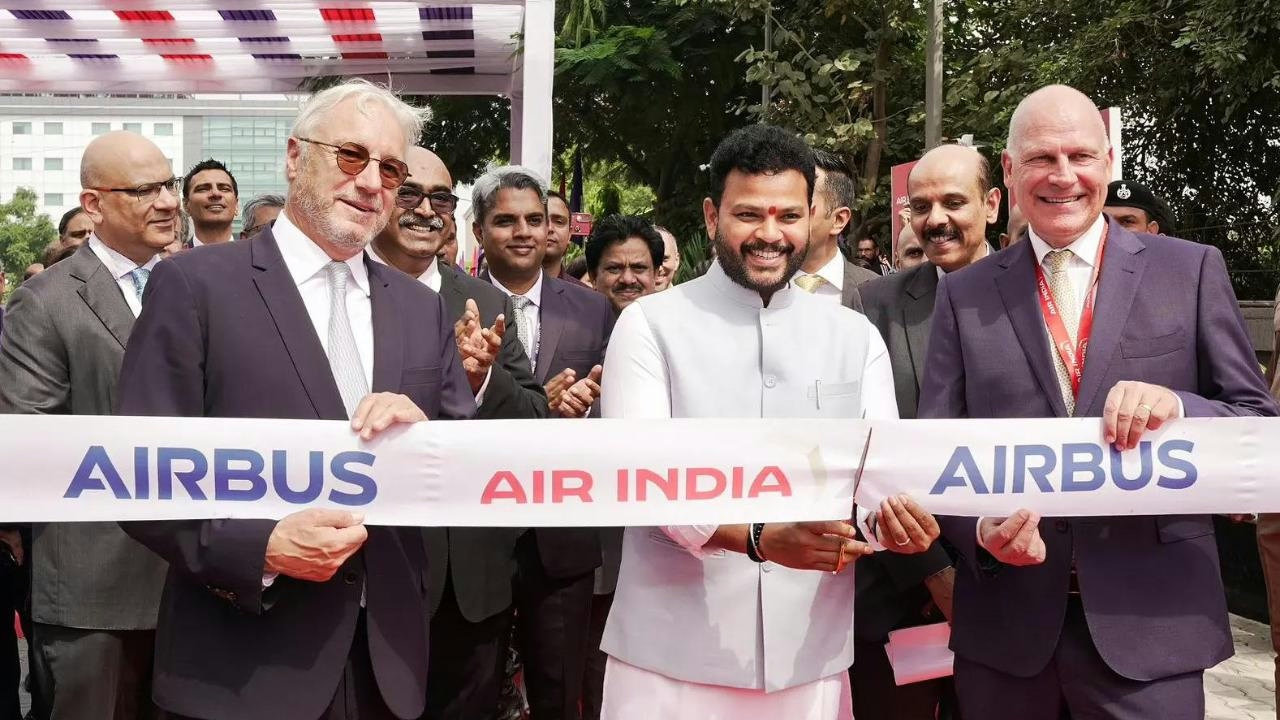
Piyush Goyal Meets Airbus India Chief to Discuss Aerospace Manufacturing and MRO
Piyush Goyal Meets Airbus India Chief to Discuss Aerospace Manufacturing and MRO
Strengthening India’s Aerospace Sector
Union Commerce and Industry Minister Piyush Goyal met with Jurgen Westermeier, President and Managing Director of Airbus India and South Asia, in New Delhi on May 6 to explore avenues for expanding India’s aerospace manufacturing and aviation-related capabilities. The discussions centered on enhancing sourcing from India, advancing aerospace manufacturing, scaling up supply chains, and improving Maintenance, Repair, and Operations (MRO) capacities. Both leaders also emphasized the importance of skill development initiatives aimed at positioning India as a global aviation hub.
Goyal described the meeting as “productive,” highlighting the commitment to deepen collaboration between India and Airbus across manufacturing, supply chains, and workforce development. This engagement comes amid a growing trend of global aerospace companies viewing India as a strategic destination for sourcing and manufacturing, driven by efforts to diversify supply chains and reduce reliance on traditional markets.
Industry Context and Strategic Developments
The meeting gains significance in light of recent developments within the aerospace sector. Competitors such as Liebherr-Aerospace have announced plans to expand MRO capacity for Airbus A350 components, intensifying competition in the Indian MRO market. Concurrently, leadership changes at Airbus and ongoing negotiations between General Electric and Hindustan Aeronautics Limited (HAL) for the assembly of F414 engines in India underscore the dynamic nature of the country’s aerospace industry.
India’s push for greater localization in aerospace manufacturing aligns with its broader trade and economic strategies. Earlier this year, Westermeier welcomed the framework for an interim Bilateral Trade Agreement (BTA) between India and the United States, describing it as a “runway for Indian suppliers to scale globally.” He emphasized that such agreements extend beyond tariff reductions, facilitating the integration of Indian suppliers into the global aerospace supply chain. “For capital-intensive sectors such as aerospace manufacturing, certainty in tariffs and predictability in policy are critical for sustained growth,” Westermeier noted.
The meeting also coincides with India’s ongoing negotiations for a free trade agreement with New Zealand, aimed at deepening economic ties and expanding market access amid global trade disruptions. These efforts reflect India’s ambition to establish itself as a major global hub for aviation and aircraft component production.
As India continues to attract interest from leading aerospace firms, the government’s focus on enhancing manufacturing capabilities, supply chain resilience, and MRO infrastructure is poised to play a pivotal role in shaping the country’s future within the global aviation industry.

Etihad Airways Suspends Airbus A380 Flights on Key Route

Aditya Birla Group Seeks Approval for Aircraft Leasing in GIFT City

Qatar Airways Highlights Innovation and Connectivity at Arabian Travel Market 2026

Hong Kong's Five-Year Plan Includes Andrew Fan's Aircraft Parts Processing Hub Proposal

ACIA Aero Leasing Delivers ATR72-600 to Air Nostrum

RTX Appoints Jill Albertelli as Head of Pratt & Whitney

TAT Technologies Joins Beyond Aero Hydrogen Aircraft Program

AURAK Study Highlights Barriers to Air Taxi Adoption in Emerging Economies

Xiamen Air Selects Altitude for 787 Maintenance at Heathrow

Etihad and Swissport Extend Global Partnership
