
AIによるインサイトを行動へとつなげる

現在のトレンド
Categories
Qatar Airways Uses Retired Widebodies to Replace Grounded Airbus A350s
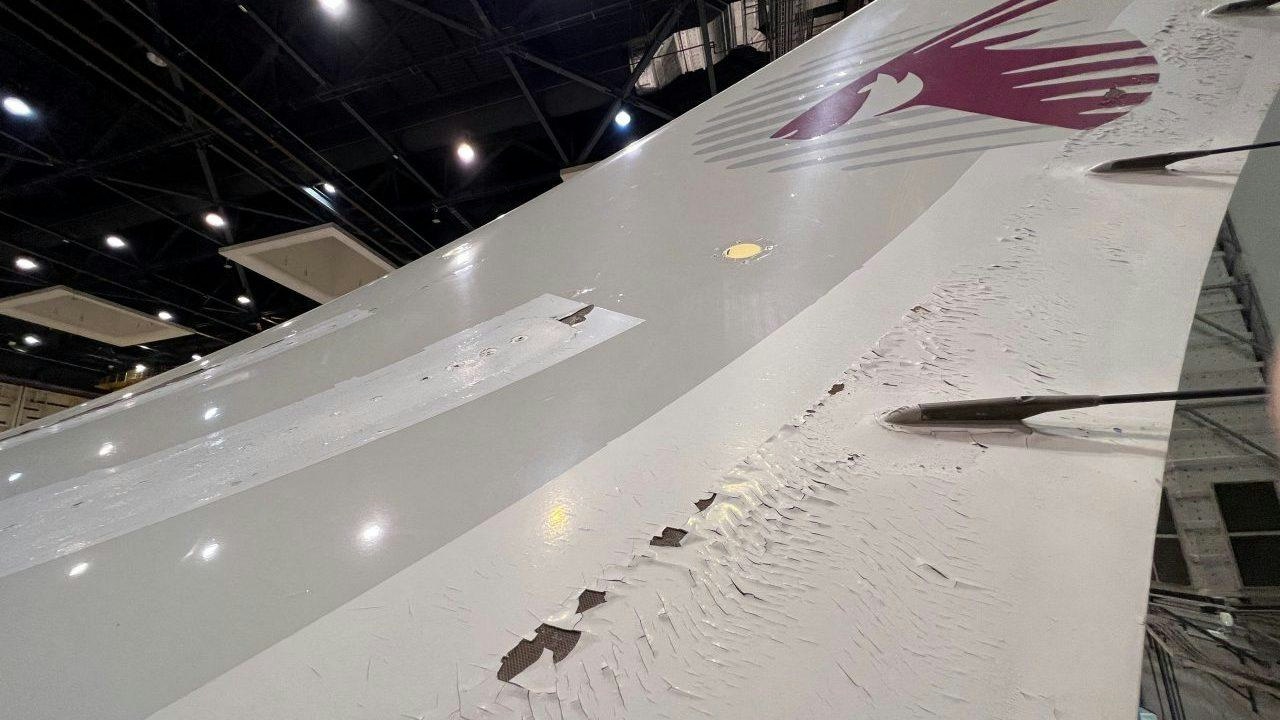
Qatar Airways Reactivates Retired Widebodies Amid Airbus A350 Grounding
Qatar Airways has confronted a significant operational challenge following the grounding of a substantial portion of its Airbus A350 fleet. The Doha-based carrier, which operates a hub-and-spoke model centered on Hamad International Airport, was compelled to reactivate several retired and stored widebody aircraft to mitigate the sudden capacity shortfall. This move underscores the airline’s strategic adaptability amid an unprecedented regulatory and technical crisis.
The A350 Grounding and Its Impact
The crisis originated in mid-2021 when Qatari aviation authorities detected accelerated paint cracking and peeling on the composite fuselages of the airline’s A350 aircraft. Subsequent inspections revealed exposed expanded copper foil, a critical anti-static mesh, raising serious airworthiness concerns, particularly given the region’s extreme temperature fluctuations. As a result, the Qatari Civil Aviation Authority mandated the immediate withdrawal of 13 A350s, a number that eventually increased to 29 grounded aircraft.
This abrupt loss of nearly 30 frontline widebodies severely disrupted Qatar Airways’ extensive network, which connects major global markets including North America, Europe, East Asia, and Australasia. The grounding threatened both passenger services and the airline’s substantial belly-freight operations, forcing reductions or cancellations of daily widebody frequencies. Narrowbody aircraft such as the Airbus A320 family were unable to compensate due to their limited range, cargo capacity, and premium seating configurations. Furthermore, the global backlog of new widebody deliveries precluded the immediate introduction of replacement aircraft.
Strategic Redeployment of Legacy Aircraft
In response, Qatar Airways reactivated legacy Airbus A330s and, notably, returned the Airbus A380 superjumbo to service in December 2021. The A380, previously retired and considered a financial liability during the pandemic, was reinstated as a critical asset to address the capacity gap. While this strategy provided a necessary stopgap, operating older, less fuel-efficient aircraft inevitably increased maintenance costs and reduced operational efficiency compared to newer models.
This reliance on legacy widebodies comes at a time when competitors are aggressively modernizing their fleets. Brazilian carrier Gol plans to double its widebody capacity with new Airbus A330-900s, Riyadh Air is expanding with Boeing 787 Dreamliners and Airbus A350-1000s, and Scandinavian Airlines (SAS) has ordered 18 A330neos as part of a broader fleet renewal strategy. These developments are poised to intensify competition on key international routes, exerting pricing pressure and challenging Qatar Airways’ market position.
Qatar Airways’ swift redeployment of retired widebodies highlights its operational resilience. However, as the aviation industry increasingly prioritizes fuel efficiency and innovation, the carrier’s dependence on older aircraft may represent a temporary measure in a rapidly evolving market landscape.

Etihad and Swissport Extend Global Partnership

Sepehran Airlines B737 Returns to Mashhad After Tyre and Engine Issues

Etihad Deploys Widebody Fleet to Meet Strong Demand

Korean Air Finalizes $36.2 Billion Deal with Boeing

Australia’s RFDS Queensland Section Orders Six King Air 260Cs

Korean Air Finalizes Order for 103 Boeing Jets and Engines

Embraer E195-E2 Features Distinctive Engine Placement Among Regional Jets

What Passengers Can Expect on Boeing’s New 777X Jet

How Ethiopian Airlines Became Africa’s Leading Carrier Amid Gulf Competition

Joby Aviation Extends Autonomous Flight Capabilities with Cross-Country Tour
