
AIによるインサイトを行動へとつなげる

現在のトレンド
Categories
Reviving Forgotten Airliner Designs
Reviving Forgotten Airliner Designs
Stand at the window of any modern airport terminal and attempt to distinguish one airliner from another by shape alone. It is an increasingly difficult task. Whether manufactured by Boeing or Airbus, regional jet or long-haul behemoth, nearly every contemporary airliner adheres to a uniform design: a sleek metal fuselage, two engines mounted beneath swept-back wings, and a tail assembly at the rear. This configuration represents a remarkable engineering achievement—efficient, reliable, and safe—but it has also contributed to a certain visual monotony in the skies.
A Time When Airliners Had Distinctive Character
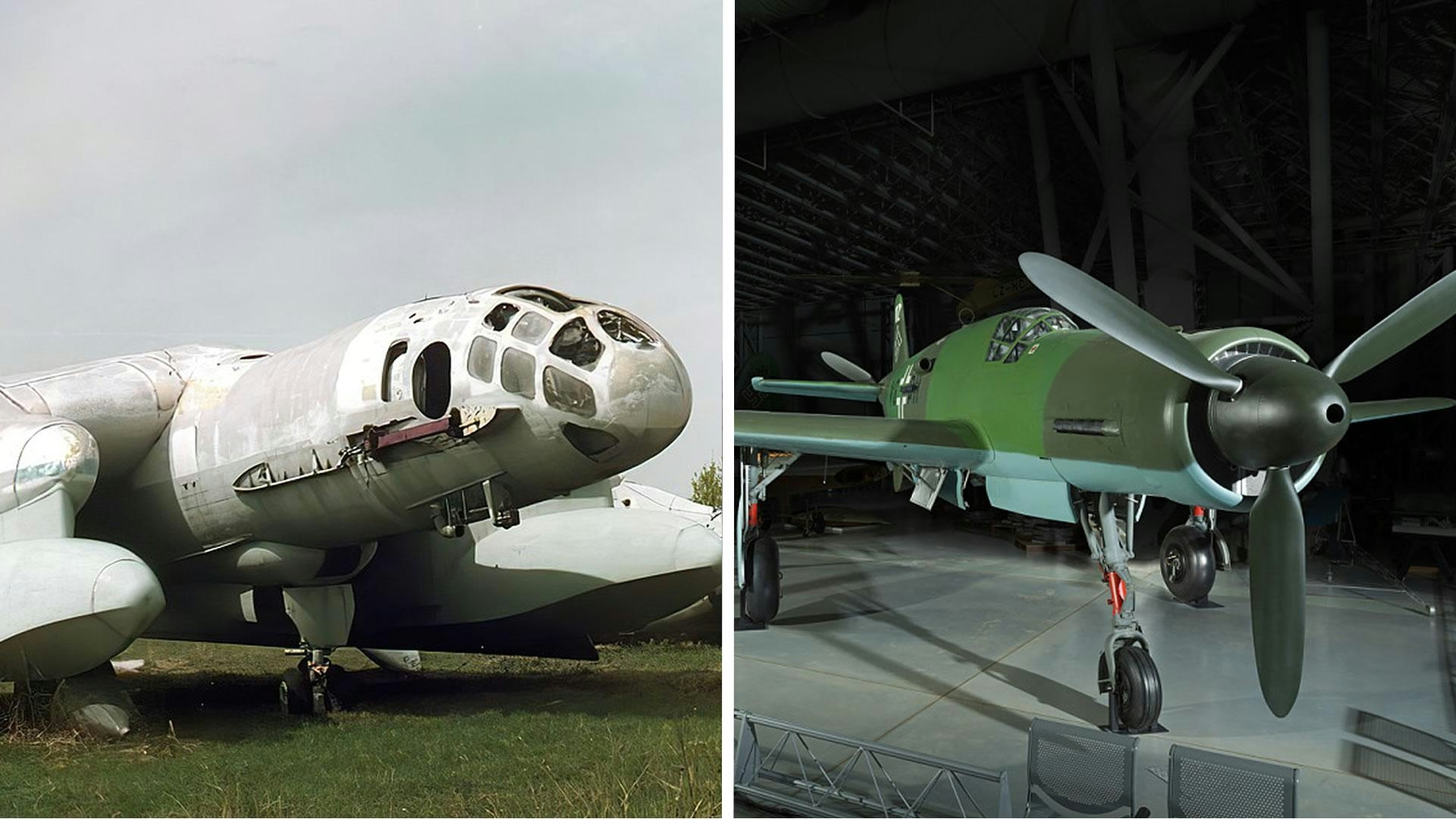
This uniformity contrasts sharply with the early jet age, a period characterized by remarkable diversity in aircraft design. In the 1950s, the French Sud Aviation Caravelle pioneered the placement of engines at the rear of the fuselage, a configuration that kept the wings clean and reduced cabin noise. This concept influenced subsequent models such as the Boeing 727, notable for its distinctive third engine fed through an S-duct and its tall T-tail, as well as the DC-9, Vickers VC10, and Soviet Il-62. The 727’s three engines clustered at the rear, with unobstructed wings, remain an iconic silhouette.
Vertical innovation was also a hallmark of earlier designs. The Boeing 377 Stratocruiser featured a downstairs cocktail lounge, while the 747 introduced the now-iconic upper-deck hump. Airbus pushed this further with the A380, which offered two full passenger decks extending from nose to tail. Some designs were even more unconventional: the German VFW-614 mounted its engines on pylons above the wings, and the earliest airliners were flying boats such as the Dornier Do X and Boeing 314 Clipper, capable of water landings. The 1930s Junkers G38 was particularly unusual, allowing a handful of passengers to sit inside the wing itself, peering out through windows embedded in the leading edge.
Ambitious Designs That Never Took Flight
For every airliner that entered service, many more remained confined to the drawing board. Among the most audacious was the Caproni Ca.60 of 1921, a nine-winged, eight-engined flying boat designed to carry a hundred passengers across the Atlantic. Although it was constructed and flown, the aircraft tragically broke apart on its second flight, preventing further development.
Challenges and Opportunities in Revival
The prospect of reviving these forgotten designs extends beyond mere nostalgia. The contemporary aviation industry confronts significant challenges, including lengthy regulatory approval processes. Airlines such as American, Lufthansa, Riyadh Air, and Singapore Airlines often endure waits of up to three years for certification of new premium aircraft models. This delay occurs in a fiercely competitive market where low-cost carriers are poised to capitalize on any gaps created by such postponements.
Any revival of unconventional designs must also align with pressing modern priorities, particularly decarbonization and zero-emission goals. Concepts once deemed radical, such as the blended wing body and truss-braced wing, are now being reconsidered for their potential to enhance fuel efficiency and reduce emissions.
After more than seventy years dominated by the tube-and-wing configuration, the industry’s pursuit of greater efficiency and sustainability may soon reintroduce some of aviation’s lost variety. The next generation of airliners could depart significantly from the familiar forms of today, embracing designs that are not only more efficient but also visually distinctive and, perhaps, a little unconventional.

Etihad Airways Suspends Airbus A380 Flights on Key Route

Aditya Birla Group Seeks Approval for Aircraft Leasing in GIFT City

Qatar Airways Highlights Innovation and Connectivity at Arabian Travel Market 2026

Hong Kong's Five-Year Plan Includes Andrew Fan's Aircraft Parts Processing Hub Proposal

ACIA Aero Leasing Delivers ATR72-600 to Air Nostrum

RTX Appoints Jill Albertelli as Head of Pratt & Whitney

TAT Technologies Joins Beyond Aero Hydrogen Aircraft Program

AURAK Study Highlights Barriers to Air Taxi Adoption in Emerging Economies

Xiamen Air Selects Altitude for 787 Maintenance at Heathrow

Etihad and Swissport Extend Global Partnership
