
AIによるインサイトを行動へとつなげる

現在のトレンド
Categories
Ryanair and Alaska Airlines Apply AI to Operational Decision-Making
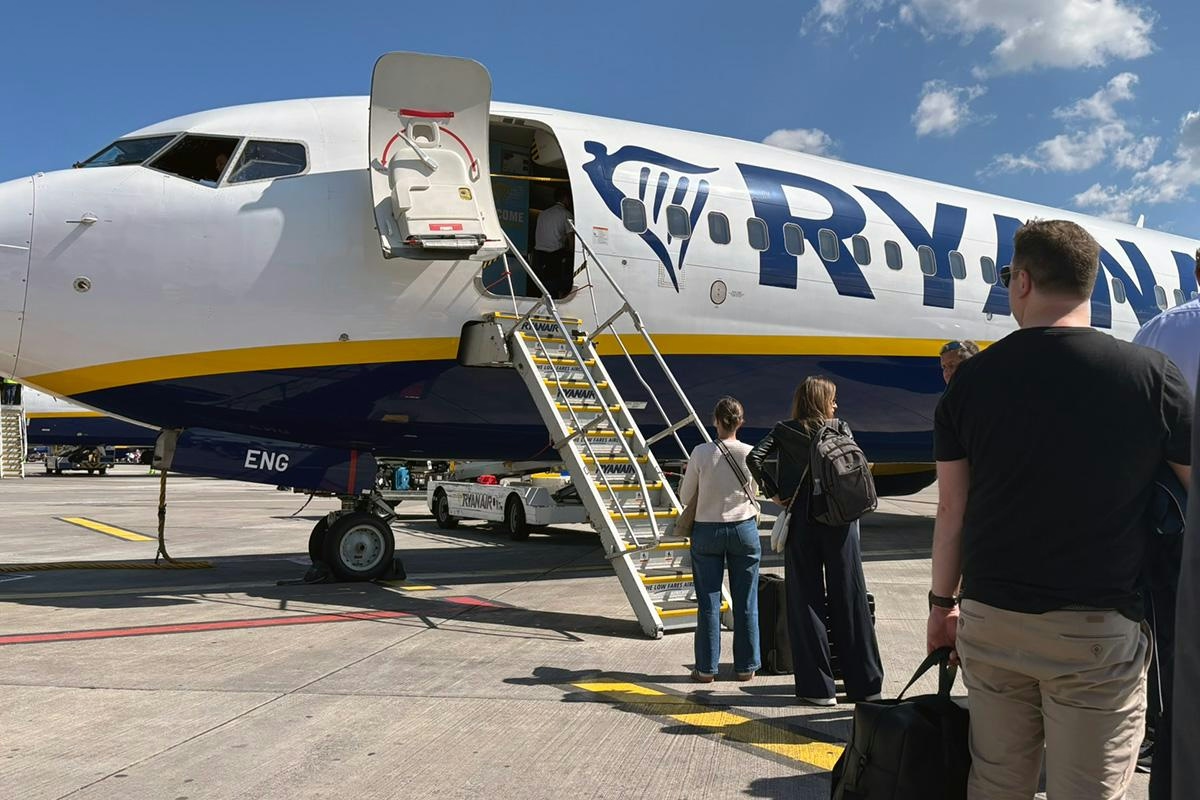
Ryanair and Alaska Airlines Embrace AI for Operational Decision-Making
The aviation industry has traditionally employed artificial intelligence as a predictive tool, with human operators retaining ultimate control over decisions. For instance, Cathay Pacific’s collaboration with Google uses AI to identify potential contrail formation, yet dispatchers continue to review and adjust flight routes before pilots receive them. This human-in-the-loop model has long been the standard approach. However, two prominent carriers, Ryanair and Alaska Airlines, are now entrusting AI systems with direct operational decisions, marking a significant shift in industry practice.
Ryanair’s Integration of AI in Crew Scheduling
In August 2026, Ryanair entered a five-year partnership with Google Cloud, deploying Google Workspace alongside Gemini Enterprise, Google’s agentic AI platform, across its workforce of approximately 35,000 employees. This initiative supports Ryanair’s ambitious target of transporting 300 million passengers annually by 2034. The most notable application of this technology is in crew logistics, where Gemini Enterprise automates the complex task of aligning crew availability with dynamic schedules and operational demands—a process that was previously managed manually.
Ryanair’s CEO, Eddie Wilson, emphasized the critical role of this partnership in sustaining the airline’s rapid expansion. Maureen Costello, Google’s Vice President for the UK, Ireland, and Sub-Saharan Africa, highlighted the potential for the collaboration to reduce operational costs while enabling secure scaling. Despite these advancements, Ryanair’s official communications clarify that AI’s current scope is focused on crew logistics and workflow automation. Claims regarding AI’s involvement in fleet operations or maintenance decisions remain unsubstantiated in primary sources, with maintenance cited only as a disruption factor to which the system must adapt, rather than a direct AI responsibility.
Alaska Airlines Automates Overbooking Management
Alaska Airlines has adopted a more narrowly focused but impactful AI application by automating decisions related to passenger rebooking and compensation on oversold flights. The airline implemented Volantio’s Re-Commerce platform, replacing a manual and rigid volunteer solicitation process that lacked comprehensive visibility into alternative flight options.
This automation has yielded measurable benefits. Volunteer rates for relinquishing seats on overbooked flights have doubled, allowing Alaska Airlines to overbook with greater confidence while minimizing the costly inefficiency of empty seats. Former Vice President of Pricing and Revenue Management Kevin Ger acknowledged that overbooking and involuntary denied boardings had long posed challenges. Chief Financial Officer Shane Tackett estimated the financial impact of these improvements at over $20 million annually, excluding additional savings from reduced denied boardings and decreased manual workload for gate staff.
Challenges and Industry Implications
The delegation of operational decisions to AI systems introduces a range of challenges. Both Ryanair and Alaska Airlines have invested heavily in technology and expertise to support these initiatives, and they may face resistance from employees accustomed to conventional procedures. Furthermore, the increased reliance on automated systems heightens concerns regarding data privacy and security, as sensitive information is processed and transmitted more extensively.
Reactions from the market and passengers have been mixed, with some expressing skepticism about AI’s capacity to enhance operational efficiency. Competitors may respond by adopting similar AI technologies or by leveraging existing strengths to maintain differentiation. Recent incidents, such as the midair loss of a door plug on an Alaska Airlines Boeing 737 Max 9, underscore the critical importance of rigorous testing and oversight in AI-driven decision-making to uphold safety and reliability standards.
Distinct Risk Profiles: Prediction Versus Decision
The risk profile associated with AI-driven decisions differs fundamentally from that of AI-powered predictions. In systems like Cathay Pacific’s contrail avoidance, human operators serve as the final checkpoint before action is taken. Conversely, in Alaska Airlines’ automated overbooking system, decisions regarding passenger rebooking and compensation are executed without human intervention, elevating the stakes for accuracy, transparency, and oversight. As airlines increasingly rely on AI for core operational choices, ensuring these qualities will be essential to maintaining trust and operational integrity.

Digital Payments, AI, and Aviation Strengthen Philippines-India Relations
PlaneSense Suspends PC-12 Jet Card Sales
How AI Could Transform Bird-Strike Prevention for Business Aviation
American Airlines and Boeing Complete First 737 MAX Landing Gear Swap

Vietjet and Thales sign major MRO and AI deals in Paris
Etihad CEO Cites Aircraft Capacity as Limiting Factor Amid Growth in China and Africa
Artificial Intelligence Enters the Cockpit

How Southwest Airlines is using technology, data and AI to strengthen CX while keeping the human touch
The SR-71 Blackbird Reached Mach 3.5 and 85,000 Feet Using Advanced Materials and Engines
Red Sea Airlines to Lease Two Boeing 737 MAX 8 Aircraft
