
AIによるインサイトを行動へとつなげる

現在のトレンド
Categories
Safran Expands Innovation Capabilities in UK Aerospace Sector
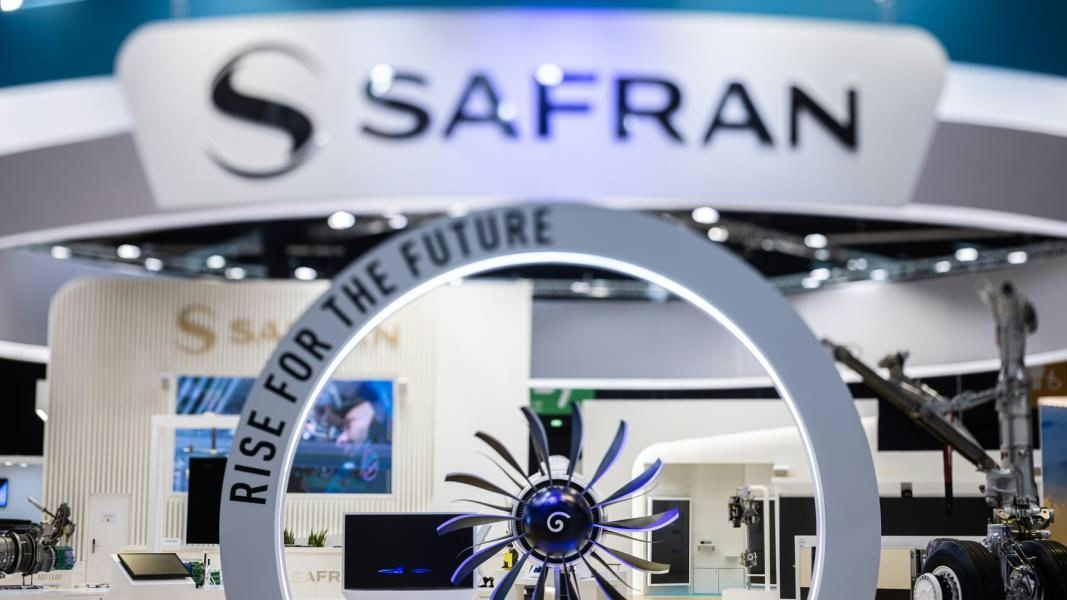
Safran Expands Innovation Capabilities in UK Aerospace Sector
Building on a distinguished 90-year legacy in the United Kingdom, Safran has significantly strengthened its position within the UK aerospace industry through the integration of actuation and flight control businesses acquired from Collins Aerospace in mid-2025. This strategic acquisition has elevated Safran to become the third-largest civil aerospace player in the UK, employing over 5,500 people across 14 sites and generating annual revenues of £1.5 billion.
Comprehensive UK Operations and Strategic Expansion
Safran’s UK operations now span a broad portfolio of products and services catering to both civil and military aviation markets. These include aircraft landing gear, seats, actuators and flight controls, nacelles, helicopter engines, and electrical equipment. The company’s principal sites cover the entire aerospace value chain, encompassing research and technology (R&T), design, engineering, manufacturing, maintenance, repair, and overhaul (MRO) services.
A landmark development in Safran’s UK expansion is the establishment of Safran Tech UK, the Group’s first research entity outside France. This new R&T centre reflects Safran’s commitment to harnessing the UK’s vibrant innovation ecosystem, particularly in addressing critical industry challenges such as the decarbonization of aviation. Notably, 75% of Safran’s R&T investment is dedicated to this objective. Safran Tech UK will focus on advancing technologies in two key areas: the electrification of propulsion and actuation systems for next-generation aircraft, and the development of high-performance composite materials.
Olivier Andriès, Chief Executive Officer of Safran, emphasized the significance of this initiative, stating, “Launching Safran Tech UK, our first research entity outside France, reflects our ambition to make the United Kingdom a catalyst for innovation for the decarbonization of aviation. As the UK’s third-largest civil aerospace player, we’re proud to contribute to the vitality of the country’s industry and research ecosystem.”
Industry Response and Operational Challenges
The market has responded positively to Safran’s expansion, particularly recognizing the company’s focus on electric systems and advanced composites as key drivers of future aerospace innovation. Nonetheless, Safran faces several challenges as it deepens its UK presence. These include navigating complex regulatory and market dynamics, integrating with local talent and infrastructure, and competing with well-established British aerospace firms. In reaction to Safran’s growing footprint, competitors are anticipated to increase their investments in research and development and pursue strategic partnerships to safeguard their market positions.
Operationally, Safran is managing a slower-than-expected ramp-up in turboshaft engine production. Concurrently, the company is expanding its global maintenance capabilities with the inauguration of a new MRO facility in Hyderabad. These developments underscore both the opportunities and complexities inherent in Safran’s ongoing growth strategy.
As Safran continues to invest in innovation and broaden its UK operations, it is positioned to play a pivotal role in shaping the future of aerospace technology and sustainability within the region.

Etihad Airways Suspends Airbus A380 Flights on Key Route

Aditya Birla Group Seeks Approval for Aircraft Leasing in GIFT City

Qatar Airways Highlights Innovation and Connectivity at Arabian Travel Market 2026

Hong Kong's Five-Year Plan Includes Andrew Fan's Aircraft Parts Processing Hub Proposal

ACIA Aero Leasing Delivers ATR72-600 to Air Nostrum

RTX Appoints Jill Albertelli as Head of Pratt & Whitney

TAT Technologies Joins Beyond Aero Hydrogen Aircraft Program

AURAK Study Highlights Barriers to Air Taxi Adoption in Emerging Economies

Xiamen Air Selects Altitude for 787 Maintenance at Heathrow

Etihad and Swissport Extend Global Partnership
