
AIによるインサイトを行動へとつなげる

現在のトレンド
Categories
Satellite IoT to Enable Routine Drone Delivery by 2027
Satellite IoT to Enable Routine Drone Delivery by 2027
Government Ambitions and Industry Roadmap
The UK government has articulated a clear and ambitious vision: by 2027, routine beyond visual line of sight (BVLOS) drone operations should become an established reality. This target is enshrined in the Department for Transport’s Future of Flight action plan, which identifies it as one of five strategic outcomes for the aviation sector. Complementing this policy direction, the Civil Aviation Authority’s roadmap, CAP3182, outlines the operational requirements necessary to achieve this milestone.
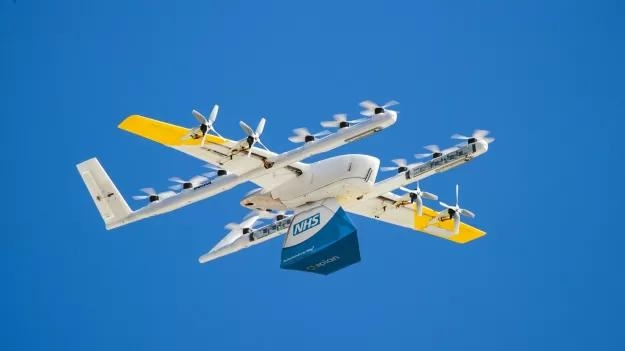
The shift from isolated drone trials to routine operations is poised to transform both the UK economy and public services. Drones have already demonstrated significant value in controlled environments. For instance, NHS trials on the Isle of Wight have successfully delivered chemotherapy drugs up to eight times faster than conventional methods. Additionally, drones are actively employed in real-time inspections of offshore wind farms and in monitoring extensive stretches of remote pipelines. Despite these successes, a considerable gap remains between these limited trials and the scalable, everyday use of drones. Current trials are typically time-bound and individually authorised, rendering them exceptions rather than the norm. Achieving routine operations will require the integration of dozens, eventually hundreds, of drones sharing UK airspace daily, supported by standardised procedures, predictable costs, and stringent regulatory oversight. Central to this vision is the establishment of resilient connectivity that ensures continuous command and control across entire operational routes.
Connectivity Challenges and the Critical Role of Satellite IoT
While terrestrial networks such as LTE and 5G provide robust coverage in urban centres and along major transport corridors, they fall short in rural, remote, and offshore environments—precisely where many priority drone use cases, including NHS deliveries and infrastructure inspections, are expected to take place. These missions often extend well beyond the reach of terrestrial communication infrastructure.
Resilience in connectivity is a critical safety consideration. BVLOS safety cases increasingly require operators to demonstrate the ability to maintain command and control even in the event of primary communications failure. This necessitates independent communication paths, and satellite connectivity emerges as a vital solution that does not depend on local infrastructure.
Satellite Internet of Things (IoT) technology is rapidly becoming a key enabler for routine BVLOS operations. It extends connectivity beyond the limits of terrestrial networks and provides an independent, reliable communications channel. The fundamental difference between early BVLOS trials and routine operations lies in the demands placed on the connectivity layer: while trials can be tightly controlled and closely supervised, routine operations require scalable, repeatable communications architectures capable of supporting large fleets.
A hybrid connectivity approach is gaining momentum, with operators utilising LTE networks where available and seamlessly switching to satellite connectivity in areas lacking terrestrial coverage. This model supports the scalability and resilience essential for widespread drone deployment.
Market Dynamics and Future Outlook
The journey toward routine drone delivery faces several challenges. Regulatory frameworks continue to evolve as authorities strive to ensure safety and foster public acceptance. Community concerns, particularly regarding noise pollution from increased drone traffic, may also impede adoption. Furthermore, technological limitations inherent in satellite IoT—such as latency and bandwidth constraints—must be addressed to guarantee reliable command and control.
Market responses are already evident. Major corporations like Amazon and Walmart are intensifying competition in this space, while others are forging strategic partnerships and investing heavily in satellite technology to enhance their delivery capabilities. Industry analysts at Omdia forecast a significant surge in satellite IoT connections, propelled by the rapid deployment of low Earth orbit (LEO) satellites. This expansion is expected to underpin the growth of drone delivery networks, supporting the UK’s objective of routine BVLOS operations by 2027.
As regulatory, technological, and market conditions continue to evolve, satellite IoT is positioned to play a pivotal role in realising the vision of routine drone delivery across the United Kingdom.

Etihad Airways Suspends Airbus A380 Flights on Key Route

Aditya Birla Group Seeks Approval for Aircraft Leasing in GIFT City

Qatar Airways Highlights Innovation and Connectivity at Arabian Travel Market 2026

Hong Kong's Five-Year Plan Includes Andrew Fan's Aircraft Parts Processing Hub Proposal

ACIA Aero Leasing Delivers ATR72-600 to Air Nostrum

RTX Appoints Jill Albertelli as Head of Pratt & Whitney

TAT Technologies Joins Beyond Aero Hydrogen Aircraft Program

AURAK Study Highlights Barriers to Air Taxi Adoption in Emerging Economies

Xiamen Air Selects Altitude for 787 Maintenance at Heathrow

Etihad and Swissport Extend Global Partnership
