
AIによるインサイトを行動へとつなげる

現在のトレンド
Categories
Ursa Major Reports Hadley Completed 10 Hypersonic Flights
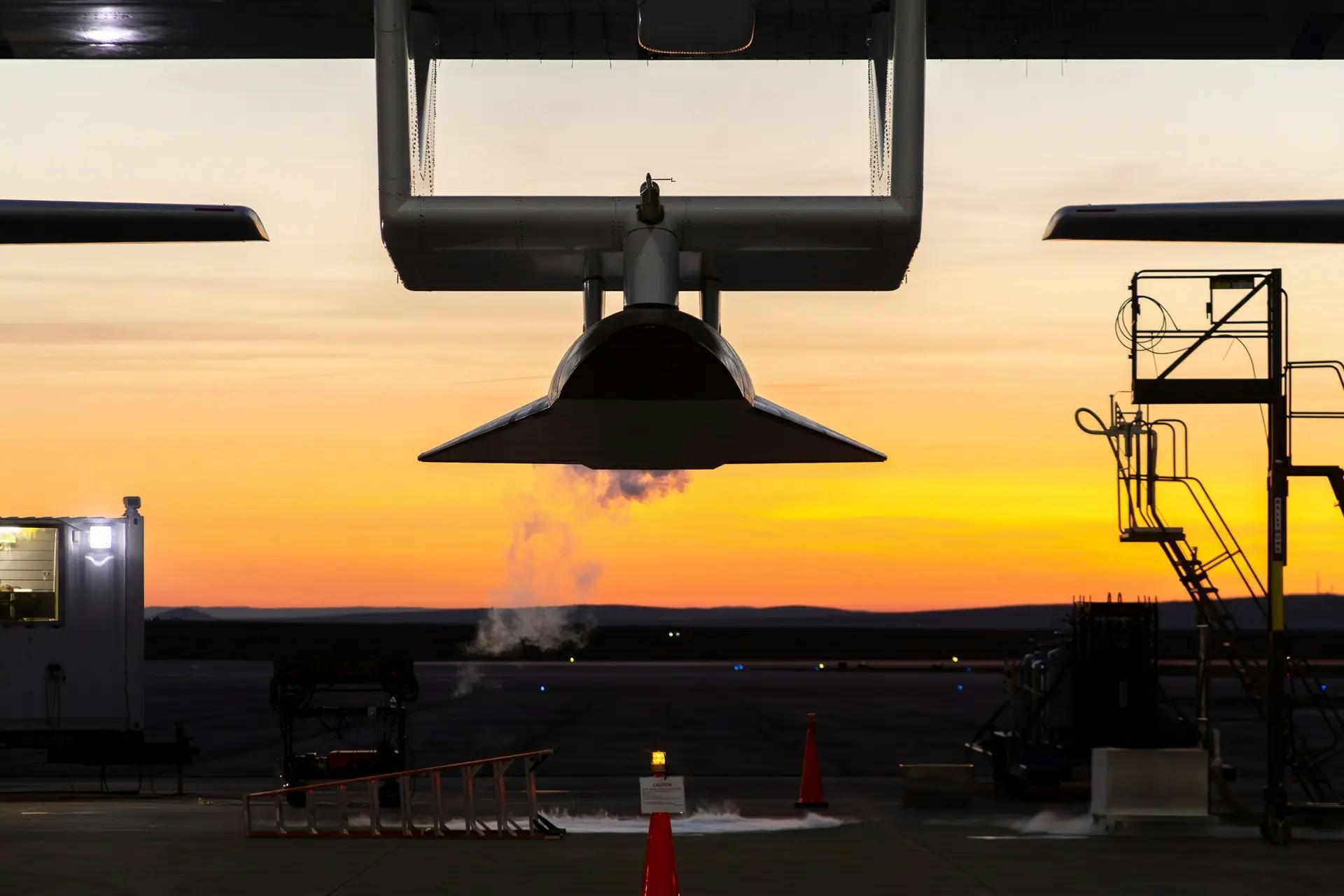
Ursa Major’s Hadley Engine Completes 10 Hypersonic Flights
Ursa Major announced on April 16, 2026, that its Hadley liquid rocket engine has successfully completed ten consecutive flights, including multiple missions sustained at hypersonic speeds. This achievement, realized in collaboration with Stratolaunch, highlights significant progress in reusable hypersonic technology and underscores the intensifying competition within the sector.
Advancements in Reusable Hypersonic Technology
The flights were conducted using Stratolaunch’s Talon-A test vehicle, which has now surpassed Mach 5 on at least two occasions and been recovered after each mission. Several flights involved the reuse of the same Hadley engines, demonstrating notable advancements in engine durability and reusability. Achieving and sustaining hypersonic speeds—defined as velocities exceeding Mach 5—poses considerable engineering challenges due to extreme thermal and aerodynamic stresses. Reliable, reusable propulsion systems are therefore critical for defense applications that demand repeated testing and operational readiness.
Stratolaunch’s Talon-A, powered by the Hadley engine, serves as a reusable hypersonic test platform designed to support U.S. defense customers by enabling real-world testing of payloads and emerging technologies. The vehicle is air-launched from Stratolaunch’s carrier aircraft and has completed multiple hypersonic flights with successful recoveries. This follows earlier milestones, including the Talon-A2’s second reusable hypersonic flight in March 2025, after its initial flight in December 2024.
Strategic Context and Market Competition
Ursa Major’s progress aligns with the Pentagon’s broader efforts to expand hypersonic testing capabilities, aiming to develop both offensive systems and countermeasures. The combination of reusable vehicles and reflown engines offers a cost-effective approach to repeated testing of propulsion systems, sensors, communications, and other payloads, thereby accelerating development cycles.
Nevertheless, Ursa Major faces mounting competition in the hypersonic propulsion market. Rocket Lab, for instance, recently secured contracts for 20 hypersonic test flights under the MACH-TB program, signaling a competitive race among propulsion suppliers to secure defense contracts and advance technological capabilities. This heightened competition is expected to drive further innovation and influence the distribution of future national security contracts.
Ursa Major characterizes the Hadley engine as a liquid oxygen-kerosene propulsion system manufactured using additive techniques, designed for both hypersonic and space launch applications. CEO Chris Spagnoletti emphasized that the recent flight achievements represent a transition from isolated demonstrations to operational test bed missions. “These flights aren’t demonstrations, they’re operational test bed missions,” Spagnoletti stated. “Ten successful flights is proof that hypersonic capability is here.”
As the hypersonic sector continues to evolve, industry leaders are poised to intensify efforts to secure additional contracts and push technological boundaries, shaping the future landscape of defense and national security applications.

Etihad Airways Suspends Airbus A380 Flights on Key Route

Aditya Birla Group Seeks Approval for Aircraft Leasing in GIFT City

Qatar Airways Highlights Innovation and Connectivity at Arabian Travel Market 2026

Hong Kong's Five-Year Plan Includes Andrew Fan's Aircraft Parts Processing Hub Proposal

ACIA Aero Leasing Delivers ATR72-600 to Air Nostrum

RTX Appoints Jill Albertelli as Head of Pratt & Whitney

TAT Technologies Joins Beyond Aero Hydrogen Aircraft Program

AURAK Study Highlights Barriers to Air Taxi Adoption in Emerging Economies

Xiamen Air Selects Altitude for 787 Maintenance at Heathrow

Etihad and Swissport Extend Global Partnership
