
AIによるインサイトを行動へとつなげる

現在のトレンド
Categories
Variable Cycle Engines Power Next-Generation Fighter Jets
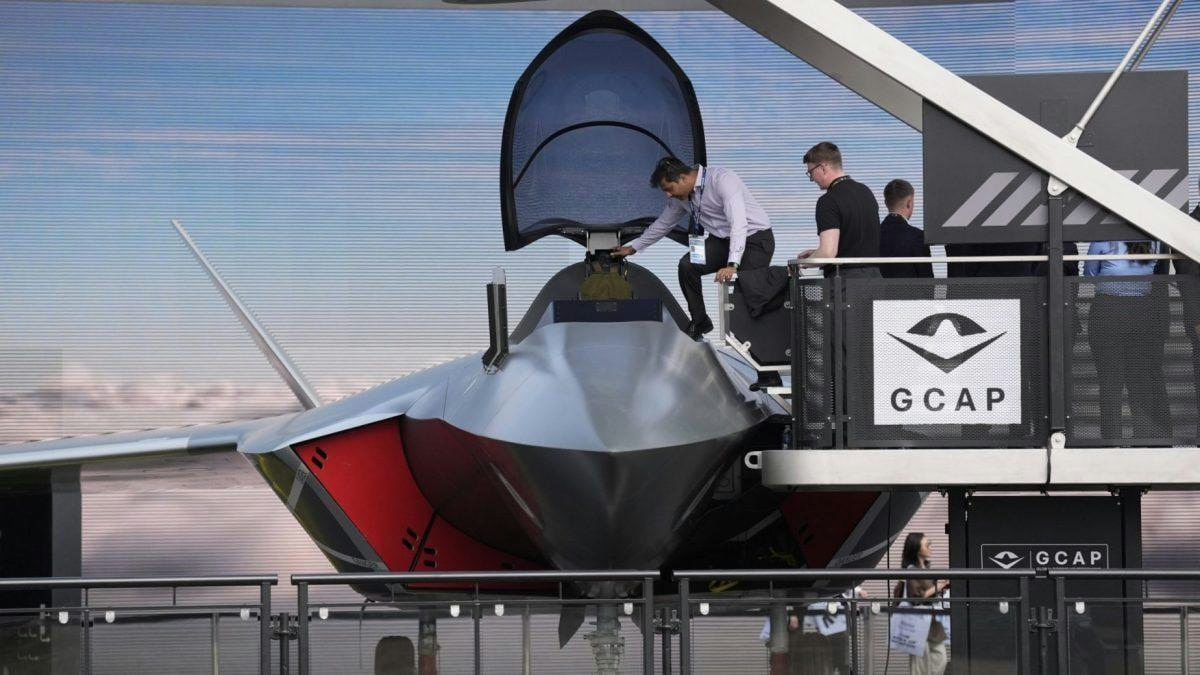
Variable Cycle Engines Power Next-Generation Fighter Jets
As air forces around the world prepare to deploy sixth-generation fighter jets, a range of cutting-edge technologies is emerging at the forefront of aerial combat innovation. Among these advancements, Variable Cycle Engines (VCEs) represent a pivotal breakthrough, promising to deliver unprecedented combinations of power and efficiency essential for future air superiority.
The Promise of Variable Cycle Engines
VCEs are engineered to resolve a longstanding challenge in military aviation: balancing the need for high thrust during combat with the fuel efficiency required for extended missions. This capability is particularly critical for stealth fighters, which must minimize reliance on large, vulnerable aerial refuelling operations that could compromise their tactical advantage. By dynamically adjusting their bypass ratio, VCEs enable aircraft to seamlessly transition between modes optimized for endurance and those designed for peak performance.
Conventional jet engines have traditionally been optimized for either fuel economy, as seen in commercial airliners, or raw thrust, characteristic of current fighter jets. In contrast, VCEs function as adaptable powerplants that integrate both attributes within a single engine. General Electric’s XA100, a leading example under development, incorporates a third airflow stream that enhances fuel efficiency and thermal management by cooling the engine during low-thrust operations. When maximum power is required, this additional airflow is redirected into the engine core, significantly boosting thrust. The integration of advanced materials such as ceramic composites, alongside sophisticated cooling systems and digital engineering, further elevates the performance and reliability of these engines.
Progress and Challenges in Development
Ground testing of the XA100 has demonstrated notable improvements in both thrust and fuel efficiency compared to existing fifth-generation engines. Enhanced fuel economy extends operational range, allowing fighter jets to loiter longer or penetrate deeper into contested airspace. Moreover, improved thermal management reduces the aircraft’s infrared signature, thereby enhancing stealth capabilities against advanced sensor systems.
Despite these promising developments, the path to operational VCEs faces significant hurdles. The U.S. Next Generation Adaptive Propulsion (NGAP) program, which forms the technological foundation for these engines, has encountered delays and currently trails behind other components of the Next Generation Air Dominance (NGAD) initiative. This lag has generated skepticism regarding the readiness of future platforms such as the F-47, particularly if adaptive cycle technology is not available on schedule. Concurrently, China is advancing its own efforts to develop similar engines for next-generation fighters, though it continues to confront substantial technical and developmental challenges.
Global Investments and Future Implications
European and Asian nations are also making substantial investments in VCE technology. Under the Future Combat Air System (FCAS) program, France’s Safran is developing adaptive propulsion systems featuring advanced fans, compressors, and thermal management solutions. The United Kingdom, Japan, and Italy are collaborating on a VCE for the Global Combat Air Programme (GCAP), with Rolls-Royce, Avio Aero, and IHI Corporation spearheading the initiative. Progress on the propulsion system for Britain’s Tempest fighter could potentially confer a technological advantage over competing platforms.
Beyond military applications, the innovations emerging from VCE development hold promise for civil aviation, potentially enabling engines that reduce fuel consumption while facilitating faster and more efficient air travel. As the competition to field next-generation fighters intensifies, propulsion technology remains a critical factor in securing and sustaining air dominance in the decades to come.

Etihad and Swissport Extend Global Partnership

Sepehran Airlines B737 Returns to Mashhad After Tyre and Engine Issues

Etihad Deploys Widebody Fleet to Meet Strong Demand

Korean Air Finalizes $36.2 Billion Deal with Boeing

Australia’s RFDS Queensland Section Orders Six King Air 260Cs

Korean Air Finalizes Order for 103 Boeing Jets and Engines

Embraer E195-E2 Features Distinctive Engine Placement Among Regional Jets

What Passengers Can Expect on Boeing’s New 777X Jet

How Ethiopian Airlines Became Africa’s Leading Carrier Amid Gulf Competition

Joby Aviation Extends Autonomous Flight Capabilities with Cross-Country Tour
