
Orchestrate AI insights into action

Trending
Categories
Ahmedabad Plane Crash: Details on the GEnx-1B Engine in Air India’s Boeing 787-8
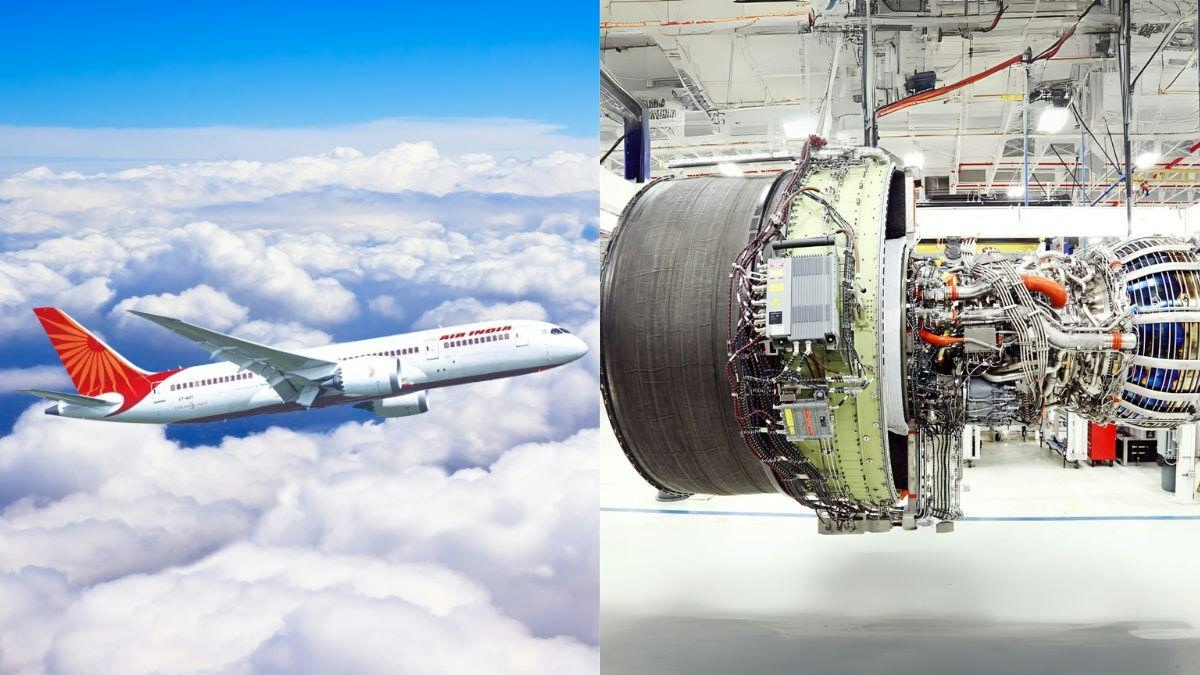
Ahmedabad Plane Crash: Details on the GEnx-1B Engine in Air India’s Boeing 787-8
A tragic aviation disaster unfolded near Sardar Vallabhbhai Patel International Airport in Ahmedabad when Air India flight AI-171, a Boeing 787-8 Dreamliner, crashed, resulting in the deaths of 241 of the 242 people onboard. This incident stands as one of the deadliest in recent Indian aviation history, prompting intense scrutiny of the aircraft’s systems and safety protocols.
The Boeing 787-8 and Its GEnx-1B Engine
The Boeing 787-8, commonly referred to as the Dreamliner, is renowned globally for its advanced technological features and enhanced safety measures. A key component of its design is the choice of engines, with operators able to select between the General Electric GEnx-1B and the Rolls-Royce Trent 1000. The ill-fated Air India flight was powered by the GEnx-1B engine, a high-bypass ratio turbofan known for its innovative engineering.
The GEnx-1B engine incorporates a dual rotor and axial flow design, integrating several cutting-edge technologies aimed at improving efficiency and safety. Among these are the Twin Annular Pre-Swirl (TAPS) system, which optimizes combustion efficiency while reducing emissions, and a carbon fibre fan case that decreases engine weight without compromising structural strength. The engine is also equipped with Full Authority Digital Engine Control (FADEC), allowing precise digital management of engine operations, and an Engine Monitoring Unit (EMU) that continuously tracks vibration and performance metrics to alert pilots to potential issues at an early stage.
These features have contributed significantly to the Dreamliner’s reputation for reliability. However, the recent crash has intensified examination of these systems and the broader maintenance and operational procedures associated with the aircraft.
Investigations and Industry Response
In response to the crash, Air India has launched comprehensive safety inspections across its Dreamliner fleet, resulting in flight delays and cancellations that have heightened passenger concerns. The Directorate General of Civil Aviation (DGCA), India’s regulatory authority, has mandated inspections focusing on Boeing fuel switches after preliminary findings indicated that the engine fuel switches on the crashed aircraft were turned off prior to impact. It was also noted that one of the aircraft’s engines was newly installed, while the other was not due for servicing until December.
On the international front, the Federal Aviation Administration (FAA) has stated that it has not identified any systemic issues within the Dreamliner fleet warranting regulatory intervention. Nevertheless, the crash presents a significant challenge for Boeing, which continues efforts to rebuild confidence following a series of safety and production setbacks in recent years.
As investigations proceed, authorities remain focused on uncovering the exact sequence of events that led to the crash and ensuring that all necessary safety measures are rigorously enforced to prevent future tragedies.

Etihad Airways Suspends Airbus A380 Flights on Key Route

Aditya Birla Group Seeks Approval for Aircraft Leasing in GIFT City

Qatar Airways Highlights Innovation and Connectivity at Arabian Travel Market 2026

Hong Kong's Five-Year Plan Includes Andrew Fan's Aircraft Parts Processing Hub Proposal

ACIA Aero Leasing Delivers ATR72-600 to Air Nostrum

RTX Appoints Jill Albertelli as Head of Pratt & Whitney

TAT Technologies Joins Beyond Aero Hydrogen Aircraft Program

AURAK Study Highlights Barriers to Air Taxi Adoption in Emerging Economies

Xiamen Air Selects Altitude for 787 Maintenance at Heathrow

Etihad and Swissport Extend Global Partnership
