
Orchestrate AI insights into action

Trending
Categories
AI and Technology: Future-Proofing Smart Airport Design
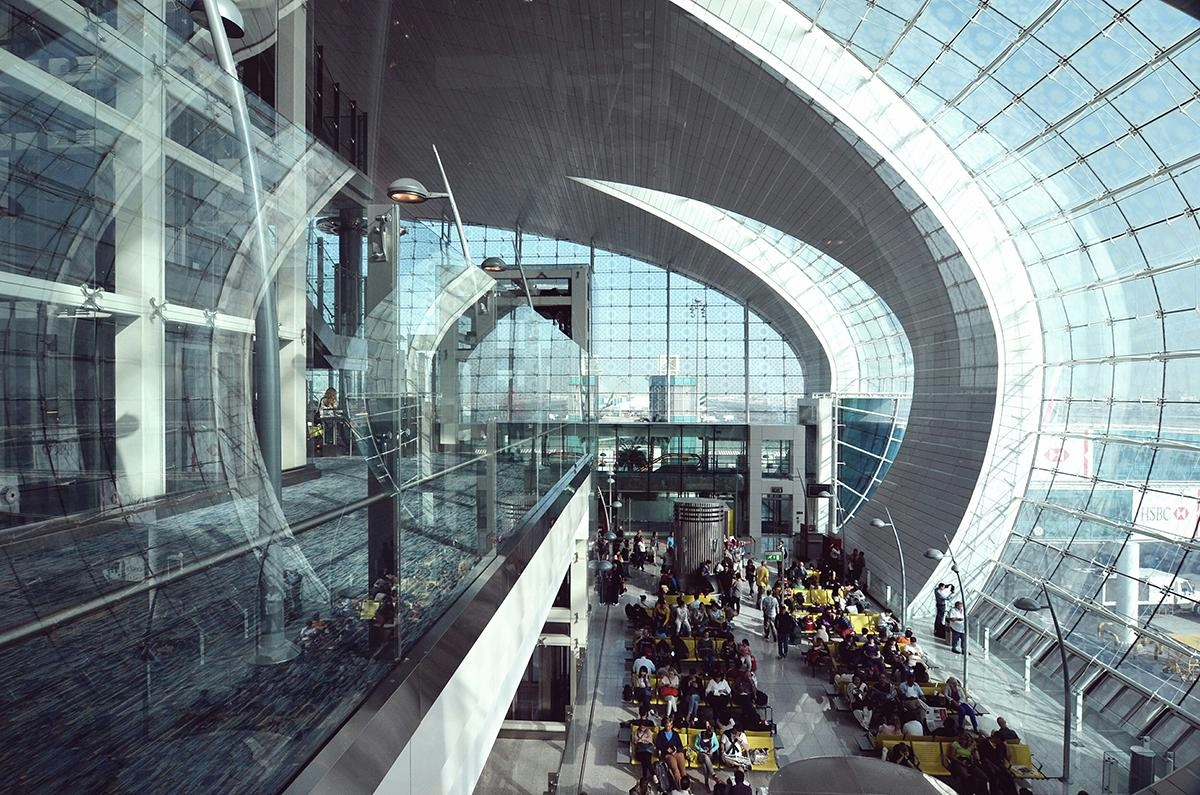
AI and Technology: Future-Proofing Smart Airport Design
Western Sydney International (Nancy-Bird Walton) Airport (WSI) is emerging as a pioneering model in airport innovation on the outskirts of Sydney. Conceived to alleviate congestion at Sydney Kingsford Smith Airport, WSI is designed to operate around the clock, accommodate up to 10 million passengers annually, and incorporate state-of-the-art sustainable infrastructure. This ambitious project represents a collaboration among leading firms including Bechtel, COX Architecture, Zaha Hadid Architects, Multiplex, and Woods Bagot.
Advancing Operational Efficiency and Passenger Experience
As Australia’s first greenfield airport in over fifty years, WSI integrates cutting-edge technology to enhance both operational efficiency and passenger convenience. The airport will deploy a next-generation Vanderlande baggage handling system, allowing passengers to drop off luggage well in advance of their flights. Additionally, a CAT III-B instrument landing system will ensure uninterrupted operations even in low-visibility conditions. Over seventy integrated technology systems will work in concert, facilitating everything from high-speed baggage tracking to sophisticated security screening.
Simon Hickey, CEO of WSI, highlights the airport’s innovative approach: “We have brought together the best elements of airports around the world at WSI, setting a new standard for Australian and international airports and giving customers and airlines alike the benefits of proven technologies and processes.” Notably, WSI will be the first Australian airport to operate without a traditional air traffic control tower, instead utilizing a digital aerodrome equipped with 20 high-resolution cameras and 3,000 aeronautical ground lights. This system is designed to support future “Follow the Greens” wayfinding technology, enhancing navigation and safety.
Sustainable Design and Flexible Infrastructure
Sustainability and adaptability are central to WSI’s design philosophy. The terminal’s midfield location facilitates modular expansion, while the co-location of international and domestic operations under one roof promotes efficient passenger transfers and shared facilities. The use of swing gates and adaptable security screening processes allows the airport to manage fluctuating passenger volumes effectively.
Hickey emphasizes the commitment to sustainability: “We’ve also taken advantage of our unique opportunity to incorporate sustainability into every aspect of design and operation, including the future use of 100 per cent renewable energy.” Key initiatives include infrastructure to support an all-electric ground services fleet, the capability to deliver sustainable aviation fuel (SAF), and an optimized airfield layout designed to reduce taxi times and associated emissions.
Challenges in Implementing Smart Airport Technologies
Despite WSI’s advanced technological framework, integrating AI and digital systems into airport operations presents significant challenges. Industry analyses, such as those from Forbes, identify cultural and organizational resistance as major barriers to AI adoption. Demonstrating clear, tangible benefits will be essential to overcoming skepticism among stakeholders and the broader market, particularly as the aviation sector transitions from cautious experimentation to structured AI integration.
As WSI sets a new benchmark, competitors are expected to adopt similar technologies, albeit with heightened attention to ethical considerations and data privacy concerns. Critics have voiced apprehension about profit-driven technology deployments, underscoring the need for transparent and responsible innovation. The broader aviation industry will be closely observing how WSI’s technological advancements translate into practical improvements for passengers and airlines alike.

Etihad Airways Suspends Airbus A380 Flights on Key Route

Aditya Birla Group Seeks Approval for Aircraft Leasing in GIFT City

Qatar Airways Highlights Innovation and Connectivity at Arabian Travel Market 2026

Hong Kong's Five-Year Plan Includes Andrew Fan's Aircraft Parts Processing Hub Proposal

ACIA Aero Leasing Delivers ATR72-600 to Air Nostrum

RTX Appoints Jill Albertelli as Head of Pratt & Whitney

TAT Technologies Joins Beyond Aero Hydrogen Aircraft Program

AURAK Study Highlights Barriers to Air Taxi Adoption in Emerging Economies

Xiamen Air Selects Altitude for 787 Maintenance at Heathrow

Etihad and Swissport Extend Global Partnership
