
Orchestrate AI insights into action

Trending
Categories
Air New Zealand Achieves 86% On-Time Arrivals in Auckland, June 2026
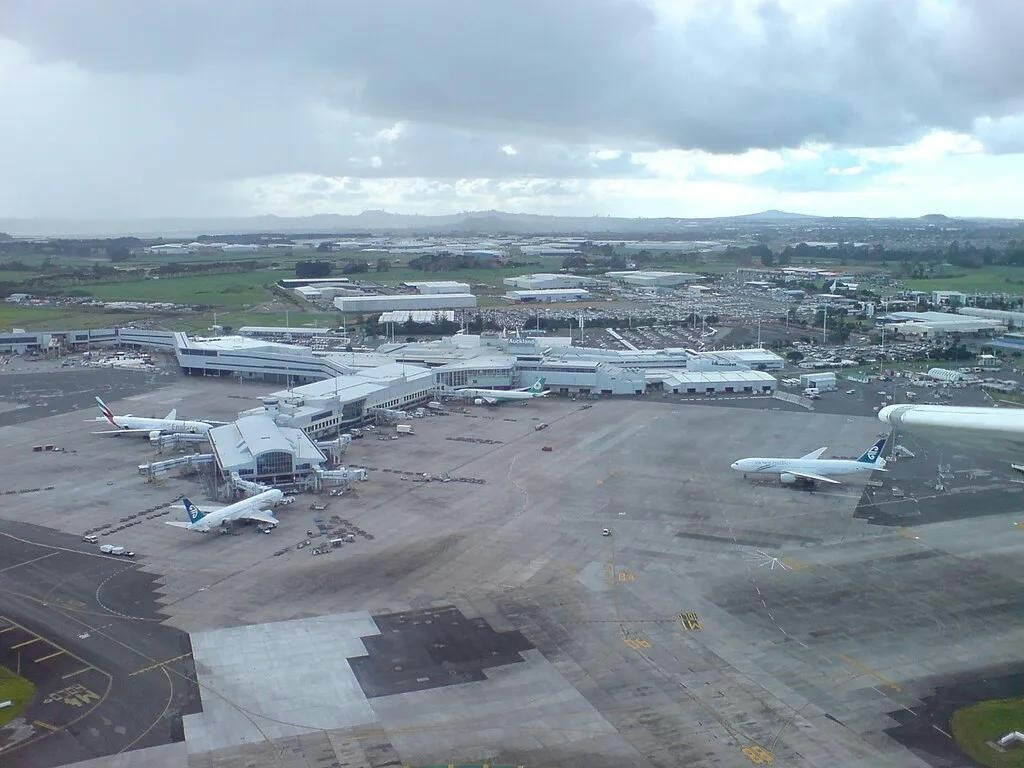
Air New Zealand Achieves 86% On-Time Arrivals in Auckland, June 2026
Air New Zealand has marked a significant improvement in its operational reliability, achieving an 86% on-time arrival rate at Auckland Airport in June 2026. This performance, defined by flights arriving within 15 minutes of their scheduled time, represents an 8% increase compared to the same period in 2025. The milestone underscores the airline’s dedication to punctuality amid a dynamic and challenging aviation environment.
Enhancing Punctuality Through Innovation
Traditionally, airlines have concentrated on expanding their fleets or increasing airport capacity to improve service. However, Air New Zealand’s recent success highlights a strategic shift towards leveraging predictive technologies, smarter scheduling, and real-time operational decision-making. This approach reflects a broader transformation within the aviation industry, moving away from reactive delay management toward proactive disruption mitigation.
Within its domestic network, Air New Zealand achieved an impressive 89% on-time arrival rate, while international services recorded approximately 78.8%. The lower punctuality in international operations is attributed to factors such as longer flight routes, complex aircraft rotations, global air traffic congestion, and weather-related disruptions. Despite these challenges, the airline’s improved performance has been met with positive market responses, bolstering passenger confidence and demonstrating consistent year-on-year operational progress. These gains are particularly noteworthy given the ongoing pressures of rising jet fuel prices and a significant portion of the fleet being temporarily grounded due to engine issues.
The Role of Artificial Intelligence in Operational Excellence
Central to Air New Zealand’s enhanced punctuality is the integration of artificial intelligence (AI) into its operational framework. While invisible to passengers, AI tools analyze vast amounts of data to predict potential delays before they escalate. These systems evaluate variables including late-arriving aircraft, crew availability, aircraft replacement requirements, airport operational conditions, and network scheduling pressures.
By forecasting disruptions, the airline’s operations teams can make timely decisions that minimize passenger inconvenience. AI also facilitates more efficient aircraft assignments, enabling rapid responses to unforeseen issues and supporting more resilient scheduling practices. This represents a significant evolution from traditional airline management, which relied heavily on human judgment and reactive measures. The introduction of AI adds a predictive layer, allowing the airline to anticipate and mitigate disruptions before they propagate through the network. Air New Zealand has previously piloted AI applications in ground operations to streamline aircraft turnaround times, further contributing to improved punctuality.
Industry Context and Competitive Implications
Air New Zealand’s advancements come at a time when punctuality is becoming an increasingly critical factor in airline competitiveness. Passengers now consider reliability alongside ticket pricing and onboard amenities when selecting carriers. While Air New Zealand focuses on operational resilience through technology, the wider industry continues to grapple with similar challenges. In Europe, for example, consolidation among major airlines such as Lufthansa and Air France-KLM persists as they navigate high fuel costs and fleet limitations.
The airline’s 86% on-time arrival rate in June 2026 not only represents a notable operational achievement but also signals a strategic pivot toward technology-driven management. As the aviation sector adapts to evolving challenges, the ability to anticipate and recover swiftly from disruptions may prove to be the defining competitive advantage, offering passengers more predictable and reliable travel experiences.

Etihad Deploys Widebody Fleet to Meet Strong Demand

Korean Air Finalizes $36.2 Billion Deal with Boeing

Australia’s RFDS Queensland Section Orders Six King Air 260Cs

Korean Air Finalizes Order for 103 Boeing Jets and Engines

Embraer E195-E2 Features Distinctive Engine Placement Among Regional Jets

What Passengers Can Expect on Boeing’s New 777X Jet

How Ethiopian Airlines Became Africa’s Leading Carrier Amid Gulf Competition

Joby Aviation Extends Autonomous Flight Capabilities with Cross-Country Tour
Strengthening Europe's Aviation Supply Chain Amid Uncertainty

The Evolution of the Aircraft Maintenance Engineer Role
