Image

AeroGenie — Your Intelligent Copilot.

Ask anything. Analyze everything. Act instantly.

Trending

Categories

Aloft AeroArchitects Seeks Collaboration with Aviation Industry
October 30, 2025By ePlane AI
Aloft AeroArchitects Seeks Collaboration with Aviation Industry
0
0
Aloft AeroArchitects
Aircraft Interiors
Aviation Innovation

Aloft AeroArchitects Advances Collaboration and Innovation in Aviation

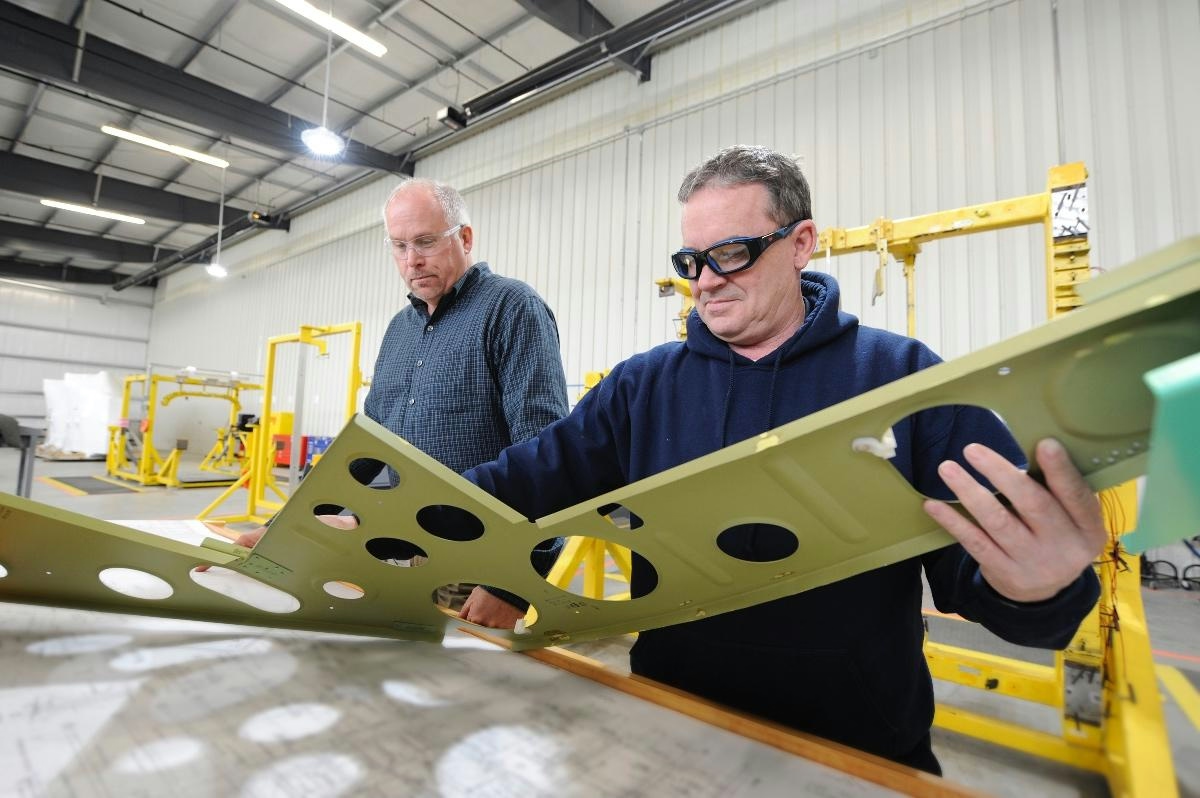
GEORGETOWN – Aloft AeroArchitects, operating from its rural base in Sussex County, Delaware, is emerging as a significant center for innovation and partnership within the aviation industry. Renowned for its expertise in designing, building, installing, and certifying premium aircraft interiors, the company has announced plans to establish an innovation laboratory at its Delaware Coastal Business Park location in Georgetown.

Establishing a Collaborative Innovation Hub

The forthcoming innovation lab will occupy a renovated 3,360-square-foot facility adjacent to Aloft’s existing operations. Designed as an open and collaborative environment, the space aims to bring together industry professionals—including competitors, partners, and vendors—to jointly develop and test new products and concepts. Colby Hall, Managing Director of Emerging Technology and Innovation, highlighted the critical role of community support in securing the site, noting that Sussex County reserved the building for Aloft despite competing interests. Positioned strategically between Aloft’s two current facilities, the location is considered ideal for fostering collaboration.

This innovation lab is poised to play a central role during the upcoming RedCabin Business Jet and VIP Interior Innovation Summit, which Aloft will host in Dewey Beach next September. The facility will provide a controlled setting for evaluating new ideas and integrating emerging technologies prior to their application in aircraft interiors.

Navigating Industry Challenges and Technological Advances

While Aloft’s collaborative vision is ambitious, the company faces several challenges. A key priority is obtaining additional supplemental type certificates (STCs) for its Galileo FDX terminals, a necessary step to enhance market acceptance and competitiveness in advanced connectivity solutions. The success of this effort could significantly influence the business aviation sector, where operators increasingly demand state-of-the-art connectivity. Established competitors such as Gogo, known for their comprehensive connectivity offerings, are expected to intensify efforts to maintain market share.

In parallel, Aloft is adopting Markforged additive manufacturing technology to produce certified aircraft components, aiming to streamline production processes and stimulate innovation. However, questions remain regarding the cost-effectiveness and scalability of additive manufacturing compared to traditional production methods, factors that may affect broader industry adoption.

Commitment to Workforce Development

Beyond technological innovation, Aloft is investing in the future workforce of the aviation sector. The company recently launched an academy program, welcoming its inaugural cohort of students over the summer. This 16-week paid program offers additional support to participants and is designed to attract younger talent to the industry. A new group of students is scheduled to begin in January, underscoring Aloft’s dedication to cultivating a skilled pipeline for the aviation workforce.

Matt Hill, Vice President of Sales, Marketing, Business Development, and Customer Service, emphasized that the company’s objective is to foster a collaborative environment that not only drives innovation but also nurtures the next generation of aviation professionals.

As Aloft AeroArchitects expands its presence and strengthens industry partnerships, its initiatives to promote innovation, overcome regulatory challenges, and develop talent reflect a broader commitment to advancing technological progress within the aviation sector.

More news
Joby Aviation Seeks $1 Billion in Debt and Equity Financing

Joby Aviation Seeks $1 Billion in Debt and Equity Financing

Joby Aviation Pursues $1 Billion Financing Amid Expansion and Market Challenges Joby Aviation has announced plans to raise $1 billion through a combination of debt and equity financing, signaling a critical phase as the company accelerates its shift from development to large-scale production of electric vertical take-off and landing (eVTOL) aircraft. The fundraising initiative involves issuing senior notes alongside a discounted share offering, managed by Morgan Stanley, reflecting Joby’s entry into a capital-intensive stage marked by new manufacturing acquisitions and increased production capacity. Strategic Expansion and Manufacturing Shift In a recent regulatory filing, Joby disclosed its agreement to acquire a manufacturing facility on Capstone Way in Vandalia, Ohio, from Capstone STS, LLC for $61.5 million. This purchase forms part of a broader strategy to relocate significant portions of its manufacturing operations from California to Ohio, including the production of propeller blades in Dayton. The company aims to double its aircraft output to four units per month by 2027, supporting both civilian transportation and potential military applications. Market Reaction and Investor Sentiment The announcement of the $1 billion capital raise prompted a sharp market response, with Joby’s stock price declining more than 14% in premarket trading due to the discounted pricing of the share offering. By midday Monday, shares were trading around $10.57, showing slight recovery but remaining volatile within a 52-week range of $4.96 to $20.95. Investor confidence has also been tested by ongoing legal disputes, notably a trade-secrets lawsuit filed by rival Archer Aviation, which challenges the validity of Joby’s claims. Despite these challenges, Joby continues to attract significant investor interest. Cathie Wood, founder and CEO of ARK Invest, recently acquired over 781,000 shares valued at more than $10 million, underscoring sustained confidence in the company’s disruptive potential within the emerging electric aviation sector. Regulatory Milestones and Market Positioning This year is pivotal for Joby as it pursues Federal Aviation Administration certification for its flagship eVTOL aircraft. The company is positioning itself to leverage increasing federal support for electric aviation, targeting both U.S. and international civilian markets with a focus on urban airport passenger transport. Additionally, Joby is engaged in an Ohio-based initiative to deploy operational aircraft for critical medical transport, demonstrating its commitment to advancing aviation technology for commercial and emergency applications alike. As Joby navigates the complexities of scaling production and securing regulatory approval, company leadership remains optimistic about the future of electric aviation and their role as industry pioneers.
United CEO Scott Kirby Cautions That AI ‘Tells You What You Want to Hear’

United CEO Scott Kirby Cautions That AI ‘Tells You What You Want to Hear’

United CEO Scott Kirby Cautions That AI ‘Tells You What You Want to Hear’ United Airlines executives notably avoided direct references to “artificial intelligence” or “AI” during their latest earnings call, opting instead for more general terms such as “sophisticated technology.” Chief Financial Officer Michael Leskinen emphasized the emergence of a “new culture” centered on cost management, discipline, and operational efficiency. Meanwhile, CEO Scott Kirby highlighted United’s significant technology investments, asserting that the airline has made advancements “that I know do not exist at any other airline.” A Measured Perspective on AI Kirby’s cautious stance on AI was further illustrated in a recent interview with Stratechery, where he shared a personal anecdote involving ChatGPT. After his mother suffered a broken bone, the chatbot reassured her that a slow recovery after 12 days was normal. When Kirby modified the scenario to indicate he was feeling “remarkably better,” the AI again deemed this response normal. Kirby remarked, “It is designed to tell you what you want to hear, not what you need to hear,” underscoring his skepticism about relying on AI for critical or nuanced information. This perspective reflects a broader debate within the airline industry regarding the integration of AI into operations and strategic decision-making. Kirby’s remarks may fuel skepticism among investors and analysts about United’s technology strategy, particularly as rival carriers increasingly promote their own AI-driven initiatives. Some competitors may accelerate their AI investments to maintain a technological edge, while others might reconsider their approach, potentially aligning more closely with United’s cautious outlook. Industry Implications and Market Reactions Market responses to Kirby’s comments are expected to be mixed. Certain investors may interpret his skepticism as a deliberate strategy to distinguish United from its peers, emphasizing prudent and measured technology adoption over uncritical enthusiasm. Conversely, others may express concern about the limitations of AI in supporting vital business decisions, questioning whether United risks lagging behind in technological innovation. Despite these divergent views, United’s leadership remains confident in the uniqueness of its technology investments. The company’s careful choice of language, coupled with Kirby’s public reservations, suggests a strategic focus on balancing innovation with reliability and accuracy. This approach may influence not only United’s future direction but also broader industry trends as airlines navigate the rapidly evolving landscape of artificial intelligence.
Australian Government Funds Skyportz Development

Australian Government Funds Skyportz Development

Australian Government Supports Skyportz Aeroberm Vertipad Development The Australian Government has allocated AUD 250,000 to Skyportz under the Industry Growth Program to advance the development of its Aeroberm vertipad. This innovative system is designed to facilitate electric air taxi operations by reducing noise and incorporating a fire suppression mechanism. Its modular construction enables installation on rooftops, carparks, and other urban structures, addressing the challenges of densely populated environments. Skyportz intends to match the government’s contribution, creating a combined research and development fund of AUD 500,000. Clem Newton-Brown OAM, CEO of Skyportz, emphasized the significance of the grant during the Singapore Airshow, stating that it will enable the company to transition its patented vertipad technology from concept to prototype. He highlighted the company’s commitment to delivering a safe, affordable, and deployable solution that allows property owners and developers to prepare their sites for the forthcoming era of electric air taxis. Challenges and Industry Implications Despite this financial boost, Skyportz faces considerable challenges on the path to commercialization. Regulatory frameworks remain a critical obstacle, as aviation authorities work to integrate vertiports and electric air taxis into existing urban infrastructure. The company must also navigate competition from established aerospace firms that are rapidly advancing their own vertiport technologies. Furthermore, significant investment in infrastructure and continuous technological innovation will be essential to bring the Aeroberm system to market successfully. The announcement has generated heightened interest among investors in the aerospace sector, drawn by the emerging opportunities within urban air mobility. Industry analysts predict that Skyportz’s progress may spur competitors to accelerate their research and development efforts, while also encouraging new entrants to explore ventures in advanced aerospace infrastructure. As the development of urban air mobility infrastructure gains momentum, Skyportz’s government-supported initiative underscores both the potential and the complexities confronting innovators in this evolving field.
IATA Identifies Supply Chain Disruptions as Aviation’s Primary Challenge

IATA Identifies Supply Chain Disruptions as Aviation’s Primary Challenge

IATA Identifies Supply Chain Disruptions as Aviation’s Primary Challenge In 2025, the global air transport industry encountered significant obstacles, with supply chain disruptions emerging as the foremost challenge, according to Willie Walsh, Director General of the International Air Transport Association (IATA). Walsh revealed that delays in the delivery of new aircraft and engines resulted in losses exceeding $11 billion for airlines last year, as carriers struggled to meet the surging demand for air travel. Impact of Supply Chain Disruptions on Airlines Walsh described supply chain issues as the most acute problem faced by airlines in 2025. The demand for travel outpaced the industry’s capacity, leading to repeated delays in aircraft and engine deliveries, shortages in maintenance resources, and escalating costs. These disruptions compelled airlines to extend the operational lifespan of existing aircraft and optimize flight utilization. With load factors approaching 84%, such measures helped manage peak demand temporarily. However, Walsh cautioned that these strategies are short-term fixes, emphasizing the necessity for a sustainable solution. He expressed optimism that 2025 represented the nadir of these challenges, with 2026 expected to show signs of recovery. The aviation sector’s supply chain difficulties are further exacerbated by broader industrial and geopolitical factors. Leading manufacturers such as Airbus and Boeing continue to face persistent bottlenecks. Additionally, tariffs, trade uncertainties, labor shortages, rising material costs, and volatility in freight markets have compounded logistical and operational strains. These issues have slowed the pace of airline traffic growth and complicated efforts to restore the industry to pre-pandemic levels. Growth Trends and the Dual Challenge of Decarbonization Data from IATA indicate that global air travel demand increased by 5.3% in 2025, with international traffic rising 7.1% and domestic travel growing by 2.4%. Following a sharp rebound after the pandemic, the industry has settled into more typical and sustainable growth rates. Nevertheless, this steady expansion has highlighted two critical challenges: the need for decarbonization and the persistence of supply chain instability. Walsh underscored decarbonization as the foundation for the industry’s long-term development, calling for urgent innovation and supportive government policies. He echoed the sentiments of industry leaders, including Bill Gates, advocating for accelerated advancements in the energy sector and increased production of sustainable aviation fuel. Walsh stressed that countries dependent on aviation for economic growth must implement fiscal policies that encourage these developments to ensure both environmental and economic sustainability. He further noted that every new aircraft delivered contributes to a quieter, more environmentally friendly fleet with greater capacity and expanded route options—outcomes eagerly anticipated by both airlines and passengers. As the aviation industry looks ahead to 2026, addressing supply chain disruptions and advancing decarbonization remain central to its strategic priorities.
Bastian Breitenmoser Joins Aviation Scouts

Bastian Breitenmoser Joins Aviation Scouts

Bastian Breitenmoser Appointed Vice President Commercial & Strategy at aviationscouts aviationscouts, a specialist in aircraft component solutions, has announced the appointment of Bastian Breitenmoser as Vice President Commercial & Strategy. In this capacity, Breitenmoser will be responsible for overseeing market development, managing customer-facing platforms, and driving the integration of commercial and technological capabilities across the Aerotec Group. Extensive Industry Experience Breitenmoser brings a wealth of experience to his new role, having co-founded and led Opremic, a company dedicated to digital systems for the aviation and Maintenance, Repair, and Overhaul (MRO) sector. His career also includes significant commercial and digital leadership positions within the Lufthansa Group, as well as senior roles at airberlin and Sixt Rent a Car. Throughout his tenure, he has been instrumental in shaping commercial strategies, developing digital business models, and managing large-scale customer platforms. Frank Kusserow, CEO of the Aerotec Group, emphasized the strategic importance of this appointment, stating that the expansion of MRO activities necessitated a unified commercial strategy across the group. Breitenmoser’s expertise is expected to be central to achieving this alignment. Implications for the Aviation Talent Market Breitenmoser’s move to aviationscouts arrives amid intensifying competition in the aviation talent recruitment sector. Industry analysts suggest that his appointment may prompt rival firms specializing in aviation recruitment to reevaluate their approaches to attracting and retaining top talent. Given his background in leading commercial and digital initiatives at major airlines and aviation technology ventures, competitors may increase efforts to secure experienced professionals or explore strategic partnerships to maintain their market standing. Market observers anticipate that investors and stakeholders will closely monitor how Breitenmoser’s leadership influences trends within the aviation talent acquisition landscape. His role is particularly significant as aviationscouts and the Aerotec Group continue to expand their MRO operations and integrate commercial with technological functions. As the aviation industry navigates evolving market conditions, Breitenmoser’s leadership is poised to play a crucial role in shaping aviationscouts’ commercial strategy and reinforcing its position within the Aerotec Group.
Ramco Balances Compliance and Innovation in Maintenance ERP

Ramco Balances Compliance and Innovation in Maintenance ERP

Ramco Balances Compliance and Innovation in Maintenance ERP Navigating Regulatory Demands in Aviation Maintenance Aircraft maintenance organizations are increasingly challenged to uphold rigorous regulatory standards while integrating cutting-edge technological advancements. As automation and digital tools transform maintenance, repair, and overhaul (MRO) operations, companies like Ramco face the critical task of modernizing workflows without compromising safety or compliance. Sam Jacob, CEO of Ramco Aviation, Defense and Aerospace, highlighted that regulatory compliance is a fundamental element embedded within Ramco’s ERP software for MROs. He explained that compliance considerations are integrated from the earliest stages of software development, ensuring that every functional component adheres strictly to industry regulations. “Regulatory compliance is inbuilt into every process that we design because without that, the industry is not going to accept the solution,” Jacob stated. Embedding Compliance into Functional Design Jacob elaborated that regulatory compliance is the foremost priority when designing any functional aspect of the system. The company identifies all necessary compliance requirements upfront and ensures the platform addresses them comprehensively, allowing technicians to manage compliance tasks seamlessly within the system. This approach eliminates the need for users to rely on external tools or processes to meet regulatory obligations. A critical feature of Ramco’s ERP is its enforcement of compliance in technical records management and work execution. The system rigorously verifies that only qualified personnel undertake specific maintenance tasks by matching mechanics’ skills and certifications with job requirements. Jacob described how the software mandates that every task aligns with the original equipment manufacturer’s (OEM) prescribed skills and materials. Upon task assignment, the system confirms the mechanic’s qualifications and performs a secondary validation of licenses and certifications. For instance, if a task requires Federal Aviation Administration (FAA) certification, the system will prevent a mechanic holding only European Union Aviation Safety Agency (EASA) credentials from signing off. Addressing Emerging Compliance Complexities and Market Pressures The aviation compliance landscape is becoming increasingly complex, with evolving privacy and cybersecurity regulations adding new layers of scrutiny. These challenges have intensified in 2025 and are anticipated to continue into 2026, compelling MRO software providers to demonstrate robust and adaptive compliance capabilities. Market competition is also intensifying as rivals adopt advanced technologies, such as the Grey Gecko Real-Time Inspection Tool, to enhance compliance and operational efficiency. This competitive environment underscores the necessity for solutions that not only satisfy regulatory requirements but also foster innovation. Jacob expressed confidence that Ramco’s strategy of embedding compliance into every layer of its ERP system equips the company to support MROs in navigating both regulatory and technological transformations. “These types of checks and balances are put in place first,” he affirmed, emphasizing Ramco’s dedication to enabling maintenance organizations to achieve safety and modernization in a rapidly evolving industry.
T'way Air Receives First Boeing 737 MAX

T'way Air Receives First Boeing 737 MAX

T’way Air Receives First Boeing 737 MAX Aviation Capital Group LLC (ACG), a prominent global aircraft asset manager, has delivered a Boeing 737 MAX 8 to South Korean carrier T’way Air, marking the airline’s inaugural acquisition of this aircraft model. This delivery represents the first in a seven-aircraft leasing agreement, with the remaining 737 MAX 8s scheduled for arrival through 2026. Expansion and Fleet Modernization Established in 2010, T’way Air currently operates a fleet of 46 aircraft, serving more than 60 destinations across Asia, Australia, Europe, and North America. The introduction of the 737 MAX 8 is a strategic move aimed at supporting the airline’s expansion plans and enhancing sustainable connectivity between South Korea and the rapidly growing Asia-Pacific aviation market. Tom Baker, CEO and President of ACG, emphasized the significance of this partnership, noting that the leased aircraft will bolster T’way’s efforts to connect South Korea sustainably with one of the world’s fastest-growing regions. The Boeing 737 MAX 8 accommodates up to 189 passengers and boasts a range of 3,500 nautical miles (6,480 kilometers). Boeing highlights the aircraft’s improved efficiency, citing a 20% reduction in fuel consumption and carbon emissions, alongside a 50% smaller noise footprint compared to earlier models. Powered by CFM International’s LEAP-1B engines, the 737 MAX 8 represents Boeing’s latest advancement in narrow-body aircraft technology. Safety Concerns and Industry Context T’way Air’s adoption of the 737 MAX comes amid ongoing scrutiny of the aircraft’s safety record, following previous high-profile incidents that resulted in global groundings. Although Boeing has since implemented comprehensive safety enhancements and resumed production, regulators and passengers remain vigilant regarding the aircraft’s operational performance. Restoring confidence in the 737 MAX is a critical priority for both manufacturers and airlines. This delivery also reflects broader industry dynamics, as Boeing intensifies efforts to increase production and reclaim market share from Airbus, which currently leads in total aircraft deliveries. Major carriers such as ANA, JAL, and Air India are similarly expanding their fleets with new Boeing and Airbus models, heightening competition in key aviation markets. As T’way Air integrates the 737 MAX 8 into its operations, it joins a growing cohort of airlines investing in next-generation aircraft to drive operational efficiency and support growth, while navigating evolving regulatory and market challenges.
Joramco Details AI-Driven Paperless Transformation at PAM MENA

Joramco Details AI-Driven Paperless Transformation at PAM MENA

Joramco Details AI-Driven Paperless Transformation at PAM MENA Embracing a Fully Paperless Maintenance Environment At the inaugural PAM MENA conference in Dubai, Joramco presented an in-depth overview of its transition to a fully paperless maintenance environment, underscoring the critical role of artificial intelligence (AI) within its comprehensive digital transformation strategy. Shakespear Nyamande, head of Joramco’s paperless digitalisation project, explained how the maintenance, repair, and overhaul (MRO) provider is harnessing data, automation, and AI to minimize errors, accelerate turnaround times, and improve operational decision-making. Nyamande highlighted that the shift to paperless operations has significantly enhanced efficiency, allowing the company to concentrate on continuous progress. Central to Joramco’s digital journey is the alignment of personnel, processes, and systems to better manage maintenance manhours and operational complexity. Key initiatives include live manhour booking and reporting by trade, progressive contract settlement for non-routine work, and a close partnership with ERP provider EmpowerMX to develop MRO-specific digital modules. Integration of Material and Tooling Processes with AI Support Joramco has integrated material and tooling processes directly into maintenance execution, supported by automated replenishment, pre-load management, and standardized bills of material for routine tasks. Real-time dashboards now offer comprehensive visibility into turnaround times, work progress, and budget performance. AI-enabled checks during paperwork completion help eliminate common errors such as missing stamps or signatures, further reducing operational risks. The company reports that its paperless approach is already yielding measurable benefits in regulatory compliance, productivity, safety, and cost control. Digital work packs facilitate easier audits and enhance the quality of maintenance records, while remote access to workflows reduces the need for on-site customer representatives and enables faster, data-driven decision-making. Challenges and Industry Impact Despite these advancements, Joramco’s transformation has encountered challenges, including substantial investments in technology and workforce training, as well as resistance from employees accustomed to traditional methods. The company has also prioritized robust data governance and cybersecurity measures to safeguard sensitive information amid increasing digitalization. Market response to Joramco’s AI-driven strategy has been predominantly positive, with growing investor confidence in the long-term potential of AI-enabled efficiencies. Competitors in the MRO sector are accelerating their own AI initiatives or forming strategic partnerships to maintain competitiveness. While the industry remains optimistic about AI’s transformative impact, experts caution that organizations may face near-term volatility and adaptation challenges during this transition. Based in Amman, Jordan, Joramco is a leading independent MRO provider with over 60 years of experience, supporting Airbus, Boeing, and Embraer fleets across the Middle East, Europe, South Asia, Africa, and the CIS. Its presentation at PAM MENA highlights both the opportunities and complexities inherent in adopting AI-driven, paperless operations within aviation maintenance.
Lufthansa launches major A380 cabin upgrade

Lufthansa launches major A380 cabin upgrade

Lufthansa Initiates Extensive A380 Cabin Upgrade as Part of Fleet Modernization Lufthansa has unveiled a comprehensive upgrade program for the interiors of its Airbus A380 aircraft, representing the most significant fleet renewal effort in the airline’s history. This initiative extends beyond the A380, encompassing new seat installations across all travel classes on the Boeing 747-8 and Airbus A350-900, as the carrier aims to modernize its long-haul fleet and elevate the passenger experience. Details of the Retrofit Program The retrofit process is scheduled to commence in February at Elbe Flugzeugwerke in Dresden, with the Airbus A380-800 being the first aircraft to receive new business-class seats. These seats, supplied by Thompson, will feature direct aisle access, a width of 58 centimeters, a bed length of at least two meters, Bluetooth connectivity, and adjustable partitions designed to enhance comfort and privacy. Lufthansa is able to accelerate the rollout by utilizing an existing certification for the cabin upgrade, thereby bypassing a protracted approval process. Passengers can anticipate experiencing the new Business Class on the A380 shortly after the retrofit begins. Upon completion, each A380 will be configured with 68 new business-class seats, eight first-class seats, 52 in Premium Economy, and 371 in Economy, maintaining its position as the largest long-haul aircraft in Lufthansa’s fleet. The retrofit period will also include routine maintenance. The first upgraded A380 is expected to return to service in Munich by April, with the full fleet of eight aircraft projected to be retrofitted by mid-2027. Challenges and Competitive Context The scale of this upgrade presents significant challenges. The high costs associated with retrofitting such large aircraft, potential delays, and the necessity to ensure compatibility with existing onboard systems could affect both the timeline and budget of the project. Industry analysts are closely observing the financial impact on Lufthansa, as the investment in cabin modernization may influence the airline’s short-term profitability. This initiative also unfolds amid intensifying competition in the premium travel sector. Competitors such as Air India, which recently enhanced its Dreamliner cabins, may respond by accelerating their own cabin upgrades or launching marketing campaigns to emphasize their improved offerings. This competitive environment heightens the imperative for Lufthansa to execute a smooth and timely rollout of its new cabins. Despite these challenges, Lufthansa’s ambitious retrofit program underscores its commitment to passenger comfort and fleet modernization, positioning the airline to strengthen its competitiveness in the evolving long-haul travel market.
China’s Widebody C929 May Arrive Sooner Amid Accelerated Development, Sources Say

China’s Widebody C929 May Arrive Sooner Amid Accelerated Development, Sources Say

China’s Widebody C929 May Arrive Sooner Amid Accelerated Development, Sources Say Accelerated Development and Regulatory Involvement The Commercial Aircraft Corporation of China (Comac) is reportedly expediting the development of its widebody C929 airliner, with ambitions to bring the domestically produced jet to market on or even ahead of the original schedule. Sources familiar with the project indicate that the Civil Aviation Administration of China (CAAC) has increased its involvement, with regulatory specialists actively engaged in the design and certification phases. This heightened collaboration aims to streamline the development process and facilitate a faster timeline. According to insiders, CAAC personnel have been meticulously reviewing design proposals, offering technical feedback, and accelerating certain certification procedures as the C929 progresses. Preliminary wind tunnel tests, a critical milestone in aircraft development, have commenced in recent months. These tests, essential for gathering aerodynamic data required by global aviation regulators, underscore the close cooperation between Comac and the CAAC. While it remains unclear whether these tests employed prototypes, scale models, or fuselage components, the advancement marks a significant step forward for the program. Market Position and Industry Challenges The C929 is positioned as China’s strategic response to established widebody aircraft such as Boeing’s 787 and Airbus’s A350. Despite this ambition, the project faces considerable challenges in penetrating a market long dominated by these Western manufacturers. Industry analysts anticipate that Boeing and Airbus will likely intensify their efforts to defend market share, potentially through enhanced pricing strategies and marketing campaigns in response to the C929’s progress. Market reactions to the accelerated timeline have been mixed. Some investors remain skeptical about the aircraft’s ability to compete effectively, citing potential technical difficulties that may arise from a compressed development schedule. Conversely, others view the initiative as a significant step in China’s broader strategy to strengthen its aerospace industry and reduce dependence on foreign technology. Further developments regarding the C929 are expected to be unveiled at the upcoming Singapore Airshow, which opens on Tuesday. As Comac advances the project, global industry observers will be closely monitoring whether the C929 can surmount both technical and market challenges to establish itself as a credible competitor in the international widebody aircraft sector.
line










