Image

Orchestrate AI insights into action

Join the AeroGenie waitlist today!

Trending

Categories

Automation and AI Drive Changes in Airport Baggage Handling Systems Through 2034
November 28, 2025By ePlane AI
Automation and AI Drive Changes in Airport Baggage Handling Systems Through 2034
0
0
Airport Baggage Handling
Automation
Artificial Intelligence

Automation and AI Drive Changes in Airport Baggage Handling Systems Through 2034

The global airport baggage handling system market is experiencing significant transformation, propelled by advancements in automation, RFID technology, and artificial intelligence (AI). As airports worldwide upgrade their infrastructure to accommodate increasing passenger volumes, the emphasis is shifting towards enhancing operational efficiency, minimizing baggage mishandling, and creating smarter, end-to-end baggage journeys.

Recent market analysis indicates that the airport baggage handling system market was valued at USD 9.1 billion in 2024 and is projected to nearly double to USD 18.6 billion by 2034, representing a compound annual growth rate (CAGR) of 7.4%. This expansion is driven by airport modernization efforts, rising traveler numbers, and the widespread adoption of intelligent automation solutions.

Market Overview and Technological Innovations

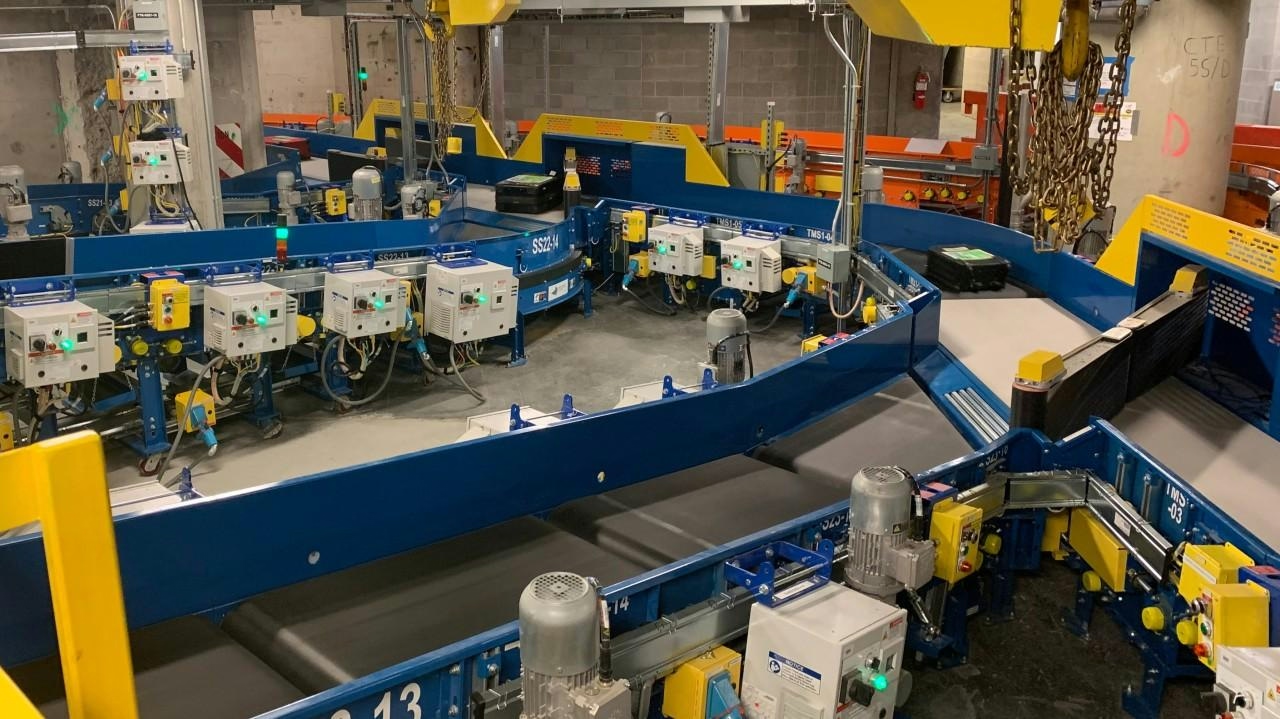
Modern baggage handling systems (BHS) integrate a variety of technologies, including automated conveyors, sorters, scanners, RFID readers, baggage carts, and centralized control systems. Increasingly, these systems incorporate Internet of Things (IoT) sensors, AI-powered analytics, and digital twin technologies to reduce errors, increase throughput, and improve the overall passenger experience.

Leading aviation hubs are deploying next-generation baggage solutions to manage growing traffic volumes, reduce operational delays, and comply with stringent International Air Transport Association (IATA) baggage tracking standards, such as Resolution 753. RFID-based tracking is expanding rapidly due to its superior accuracy and traceability, while AI-driven predictive analytics are being employed to anticipate and prevent system overloads.

Industry Leaders and Recent Developments

Prominent companies in the airport baggage handling market include Siemens Logistics, Vanderlande Industries, Daifuku Co. Ltd., BEUMER Group, Rapiscan Systems, Smiths Detection, SITA, Alstef Group, and Honeywell International. These firms specialize in automated sorting, baggage screening, airport IoT solutions, and smart tracking technologies.

Recent years have witnessed several notable advancements. The widespread adoption of RFID tracking has accelerated following IATA mandates. Autonomous trolleys and robot-assisted baggage transport systems are becoming more prevalent, alongside increased deployment of in-line baggage screening systems utilizing CT-based scanning technology. Self-service bag drop systems have expanded, facilitating contactless processing, while digital twin implementations enable real-time operational simulation. Major airport expansion projects across the Middle East, Asia-Pacific, and North America further underscore the sector’s growth.

A significant example is Melbourne Airport’s recent trial of a high-tech baggage system developed by BEUMER Group. This initiative has doubled the airport’s baggage handling capacity and introduced real-time tracking capabilities, exemplifying the broader industry trend toward advanced, integrated baggage handling solutions.

Market Segmentation and Growth Dynamics

Conveyor and sortation systems currently dominate the market by type, with RFID and barcode tracking systems experiencing rapid growth. Within solutions, baggage tracking and monitoring represent the fastest-growing segment, driven by ongoing digital transformation efforts. Technological innovation is led by RFID, IoT, AI, and robotics, which are reshaping baggage handling processes. Large and mega airports are at the forefront of adoption due to their higher baggage throughput and greater automation requirements. Among applications, departure baggage handling remains the most complex and dominant area.

Challenges and Industry Outlook

Despite the promising benefits of automation and AI, integrating new baggage handling systems with existing airport infrastructure poses considerable challenges. Ensuring real-time tracking accuracy and managing the transition for airline and airport personnel are critical concerns. Initial skepticism among stakeholders often arises due to cost implications and potential operational disruptions. Smaller airports may face financial constraints in implementing advanced systems, potentially widening the technological divide with larger hubs.

Nonetheless, the long-term advantages—improved efficiency, reduced delays, and enhanced passenger satisfaction—are expected to drive sustained adoption. As competition intensifies within the aviation sector, an increasing number of airports and service providers are likely to embrace these technologies to maintain their competitive edge in an evolving landscape.

More news
Qantas Weighs Order for 20 Wide-Body Jets from Boeing or Airbus

Qantas Weighs Order for 20 Wide-Body Jets from Boeing or Airbus

Qantas Considers Order for 20 Wide-Body Jets from Boeing or Airbus Qantas is reportedly engaged in advanced discussions with major aircraft manufacturers regarding a potential order for approximately 20 wide-body jets. The Australian airline is evaluating options between additional Boeing 787s and the main variant of Airbus’ A350 as part of its ongoing fleet renewal strategy. Both Airbus and Boeing have declined to comment on the confidential negotiations. A spokesperson for Qantas emphasized that the airline maintains regular contact with manufacturers as part of its fleet planning process and will provide updates when there is an official announcement. Currently, no new orders or updates have been disclosed. Context of the Potential Order This prospective acquisition occurs amid intensified competition within the global aviation sector. Other prominent carriers, including Singapore Airlines and Ethiopian Airlines, are also reportedly negotiating significant wide-body aircraft purchases. Singapore Airlines, for instance, is in talks to acquire at least 50 of the industry’s largest jets to support its expansion plans over the next decade. This surge in demand coincides with robust market activity, as recent data indicates increased deliveries of commercial narrow-body aircraft from both Airbus and Boeing in April 2026, highlighting the strength of the current aviation market. Qantas operates a fleet of approximately 128 aircraft and is midway through an extensive renewal program involving 200 jets. The airline currently holds outstanding orders for 12 Boeing 787s and 24 Airbus A350-1000s, including 12 of the new “Ultra-Long Range” (ULR) variant. These ULR aircraft are integral to Qantas’ ambitious “Project Sunrise,” which aims to launch non-stop flights from Australia’s east coast to destinations such as London and New York. However, the delivery of the first A350-1000ULR has been delayed by about four months to April 2027 due to supply chain challenges. Strategic Implications and Historical Context Qantas has also disclosed existing options to purchase additional jets, evenly divided between Airbus and Boeing. Industry sources suggest that some of these options may be exercised as part of the current evaluation process. Historically, Qantas has been a significant battleground for Airbus and Boeing. The airline’s decision two decades ago to select Boeing’s then-new composite 787 influenced Airbus to redesign its original A350. Today, lightweight wide-body jets such as the 787 and A350 remain central to the market, although Qantas has yet to place an order for the main A350-900 variant. The airline’s deliberations take place amid ongoing geopolitical uncertainties, yet global carriers continue to expand their wide-body fleets to address industry shortages and position themselves for future growth. The outcome of Qantas’ decision is likely to have notable implications for market dynamics, potentially affecting competitors and suppliers alike.
Lufthansa Boeing 787-9 suffers nose gear collapse at Frankfurt Airport

Lufthansa Boeing 787-9 suffers nose gear collapse at Frankfurt Airport

Lufthansa Boeing 787-9 Experiences Nose Gear Collapse at Frankfurt Airport On June 4, 2026, a Lufthansa Boeing 787-9 Dreamliner encountered a nose landing gear collapse while parked at a gate at Frankfurt Airport. The incident involved aircraft D-ABPQ, named *Herne*, one of Lufthansa’s newest widebody jets delivered earlier this year in January. As a result, the scheduled flight LH450 to Los Angeles was cancelled. Details of the Incident Lufthansa reported that the nose landing gear unexpectedly retracted during pre-flight preparations. Video footage circulating on social media captured the Dreamliner stationary at the gate, surrounded by catering, loading, and ground service vehicles, when the nose gear suddenly gave way. The aircraft’s nose dropped onto the apron while airport personnel were working nearby. Several staff members sustained injuries, although Lufthansa confirmed that no passengers were on board at the time of the collapse. An investigation has been launched in cooperation with relevant authorities to determine the cause of the failure. The affected aircraft, registered D-ABPQ, was built in 2025, completed its maiden flight in April of that year, and entered commercial service with Lufthansa in February 2026. Context and Ongoing Investigation This event has drawn comparisons to a similar incident in June 2021, when a British Airways Boeing 787-8 suffered a nose gear collapse at London Heathrow Airport during pre-departure preparations, causing the forward fuselage to strike the ground. The cause of the Frankfurt incident remains unclear. Aviation investigators and Lufthansa’s technical teams are currently examining the aircraft to establish whether the collapse resulted from mechanical failure, maintenance activity, or another factor. The Boeing 787 family, which has been in service since 2011 and accumulated millions of flight hours, rarely experiences nose gear collapses. Following the incident, the aircraft was immediately withdrawn from service pending thorough inspection and recovery operations. While the broader market reaction and competitor responses have not yet been disclosed, such incidents typically lead to heightened scrutiny and may influence operational strategies within the aviation industry.
Can Boeing’s Commercial Aircraft Deliveries Boost Its Performance?

Can Boeing’s Commercial Aircraft Deliveries Boost Its Performance?

Can Boeing’s Commercial Aircraft Deliveries Boost Its Performance? Progress Amidst Production and Delivery Gains The Boeing Company is demonstrating signs of recovery as it advances its turnaround strategy, supported by positive trends in commercial aircraft production and deliveries. In the first quarter of 2026, Boeing delivered 143 commercial airplanes, marking a 10% increase compared to the same period last year. This growth was primarily driven by higher output and deliveries across key programs, particularly the 737 and 787 families. Consequently, Boeing Commercial Airplanes (BCA) reported a 13% year-over-year revenue increase, reaching $9.2 billion. Production rates have stabilized, with the 737 program maintaining a pace of 42 aircraft per month and the 787 program producing eight per month. Boeing anticipates certification for the 737-7 and 737-10 variants within 2026, with initial deliveries expected in 2027. Meanwhile, the 777X program is progressing through certification testing, targeting its first deliveries in 2027. These developments are poised to support future production growth and strengthen Boeing’s competitive standing in the global aviation market. Challenges and Competitive Pressures Despite these advances, Boeing’s recovery faces significant challenges. Production quality concerns have attracted considerable scrutiny, notably following a midair panel blowout incident involving a 737 MAX in January 2024. This event intensified regulatory oversight, particularly from the Federal Aviation Administration (FAA), and raised concerns among customers. Although Boeing’s backlog expanded sharply in April with substantial new orders for both narrowbody and widebody jets—including a major contract from China—its stock price declined after April deliveries slightly missed expectations. Competition remains intense. Airbus, Boeing’s principal rival, has leveraged Boeing’s production delays to increase its own deliveries in April 2026, maintaining a robust order backlog across its A320neo, A350, and A220 families. Additionally, Embraer is expanding its market presence, with its firm order backlog reaching $32.1 billion in the first quarter, a 22% increase year over year, driven by a 50% rise in its Commercial Aviation segment. Financial Performance and Outlook Global demand for air travel continues to underpin the aerospace sector, benefiting major manufacturers including Boeing. During the quarter, Boeing secured 140 net commercial aircraft orders, predominantly for the 737 and 787 programs. The BCA segment closed the quarter with a backlog exceeding 6,100 aircraft, valued at nearly $576 billion, providing substantial long-term revenue visibility. Financially, Boeing reported a 14% year-over-year increase in first-quarter revenues to $22.2 billion, accompanied by a significant improvement in operating cash flow. These results were largely driven by higher commercial aircraft deliveries and enhanced operational execution. Looking forward, consensus estimates indicate further improvement. The Zacks Consensus Estimate projects Boeing’s earnings per share to increase by 98.6% in 2026 and surge by 2,813.2% in 2027, reflecting expectations of continued recovery. Nevertheless, Boeing’s ability to sustain this momentum will depend on resolving production quality issues, meeting delivery targets, and effectively navigating competitive pressures in a rapidly evolving market.
Trade-Offs in Emirates’ Redesigned Airbus A380s

Trade-Offs in Emirates’ Redesigned Airbus A380s

Trade-Offs in Emirates’ Redesigned Airbus A380s On May 20, 2026, Emirates inaugurated its newly reconfigured Airbus A380 on a commercial flight from Dubai International Airport (DXB) to Birmingham International Airport (BHX). This event marked a pivotal moment in the airline’s approach to cabin design and fleet management. Far from a routine operation, the flight symbolized a strategic shift as Emirates introduced a premium economy cabin and adjusted its seating configuration to better align with evolving market demands. From High-Density to Premium Comfort Historically, Emirates’ A380s were optimized for maximum passenger capacity, configured as high-density “people-movers” on popular leisure routes. The previous two-class layout accommodated 615 seats, with 557 in economy class, enabling the airline to maintain highly competitive seat-mile costs on key routes between Dubai and major European and UK destinations. However, changing travel preferences have prompted Emirates to reconsider this model. Modern travelers increasingly prioritize comfort and are willing to pay a premium for enhanced cabin experiences, driving sustained demand for upgraded seating options. The reconfiguration of airframe A6-EUX, the first of 15 A380s scheduled for this transformation, embodies this strategic realignment. The total seat count has been reduced from 615 to 569, reflecting the introduction of a dedicated premium economy section on the upper deck alongside an expanded business class, which now offers 76 seats—an increase of 18. The new premium economy cabin comprises 56 seats, directly addressing the growing market for mid-tier comfort. Although this adjustment reduces overall capacity, it is expected to generate higher revenue per available seat-mile, a critical advantage at slot-constrained airports where increasing flight frequency is not feasible. Engineering Challenges and Industry Implications The retrofit of the world’s largest passenger aircraft presented significant engineering challenges. Emirates Engineering teams undertook the complex task of removing entire rows of economy seats—eliminating 120 seats in the initial conversion—and reconstructing the aircraft’s interior infrastructure to accommodate the new cabin classes. This extensive overhaul forms part of what Emirates describes as the largest cabin retrofit program in commercial aviation history. The initiative responds not only to shifting consumer preferences but also to global supply chain delays that have hindered the delivery of next-generation widebody aircraft. Emirates aims to complete the reconfiguration of all 15 targeted A380s by the end of the year. The airline’s investment in premium economy is positioned to strengthen its competitive standing in this expanding market segment and may influence broader industry trends. While the long-term effects on the market and competitor strategies remain uncertain, Emirates’ move highlights a growing emphasis within the aviation sector on enhancing passenger experience and financial efficiency rather than maximizing capacity alone.
Airbus Delivers 81 Jets in May Following Resolution of China Dispute

Airbus Delivers 81 Jets in May Following Resolution of China Dispute

Airbus Delivers 81 Jets in May Following Resolution of China Dispute Airbus reported a substantial increase in aircraft deliveries in May, delivering 81 jets to customers compared to 51 in the same month last year. This marked improvement follows the resolution of a regulatory impasse with Chinese authorities that had previously delayed shipments. Resolution of Regulatory Standoff with China Industry insiders attribute the surge in deliveries to the release of approximately 20 aircraft that had been held up by Chinese regulators. Initially described by Airbus as an "administrative topic," French media later revealed the delay was politically motivated. Beijing reportedly withheld deliveries to exert pressure on European regulators to certify China’s domestically produced passenger jet, the COMAC C919. The European Union Aviation Safety Agency has since confirmed that validation efforts for the C919 are now "progressing with full cooperation," enabling Airbus to proceed with the previously stalled deliveries. Market Context and Ongoing Challenges The delivery increase occurs amid intensifying competition in the global aviation sector. Boeing recently announced a potential agreement with China for 200 jets, with the possibility of expanding the order to 750 aircraft. Concurrently, Airbus secured a record $19 billion order from AirAsia for 150 A220 aircraft, highlighting strong demand for fuel-efficient models. Despite the positive momentum in May, Airbus continues to face significant operational challenges. Persistent supply chain disruptions, including delays in engine and cabin equipment shipments, have affected production schedules. Additionally, bottlenecks at a U.S. facility supplying parts for the widebody A350 have contributed to delivery delays. These issues have notably postponed the delivery of 12 A350-1000s to Qantas, forcing the Australian airline to delay its plans for nonstop flights to London and New York. Market reactions have mirrored these concerns, with Airbus shares declining following reports of further A350 delivery delays. This has raised doubts about the company’s ability to meet its ambitious target of 870 deliveries for the year. Airbus has declined to comment on the latest delivery figures ahead of its scheduled monthly data release on Friday.
Germany Aerospace and Defense Market Outlook, 2025–2033

Germany Aerospace and Defense Market Outlook, 2025–2033

Germany Aerospace and Defense Market Outlook, 2025–2033 Germany’s aerospace and defense industry is set to undergo substantial transformation over the coming decade, driven by escalating security concerns, rapid technological advancements, and increased investment in military modernization. According to Renub Research, the German Aerospace and Defense Market is forecasted to expand from US$60.55 billion in 2024 to US$89.76 billion by 2033, representing a compound annual growth rate (CAGR) of 4.47% between 2025 and 2033. As Europe confronts evolving geopolitical challenges and security threats, Germany is intensifying efforts to strengthen its defense capabilities while enhancing its leadership in aerospace. The nation’s dedication to fulfilling NATO commitments, modernizing military infrastructure, and developing next-generation aerospace technologies is propelling growth across manufacturing, engineering, maintenance, military and civil aviation, and space systems. Strategic Role and Economic Impact Germany’s aerospace and defense sector plays a critical role in both national security and economic development. The industry encompasses the design, production, and maintenance of aircraft, spacecraft, satellites, and military systems, serving as a significant contributor to exports, innovation, and employment. Hosting some of the world’s leading aerospace and defense firms, Germany possesses one of Europe’s most advanced industrial ecosystems. This is underpinned by world-class engineering expertise, a highly skilled workforce, robust research institutions, and strong governmental support for innovation. Rising Defense Spending and Market Drivers A principal driver of market growth is Germany’s increased defense expenditure. In response to heightened geopolitical tensions and global security challenges, the government has accelerated efforts to modernize its armed forces, aiming to meet NATO’s target of allocating 2% of GDP to defense. This commitment has unlocked substantial funding for procurement programs and military upgrades, facilitating acquisitions of advanced fighter jets, missile defense systems, armored vehicles, cybersecurity solutions, and next-generation surveillance technologies. Nonetheless, the market faces potential challenges. Much of the recent procurement spending has been front-loaded, drawing heavily from a special fund that is anticipated to be depleted in the near future. This raises concerns regarding future budget constraints and the sustainability of current acquisition levels. Market reactions have been mixed, with European defense stocks experiencing cooling amid procurement delays and increased scrutiny of individual company performance. Technological Innovation and Industry Shifts Germany’s aerospace and defense sector benefits from a highly advanced technological foundation. Leading companies are investing heavily in research and development focused on next-generation aircraft systems, propulsion technologies, autonomous platforms, and advanced defense electronics. The integration of artificial intelligence, robotics, additive manufacturing, digital twins, and advanced materials is accelerating digital transformation across military and aerospace applications. The government’s strong commitment to AI research is fostering the development of intelligent avionics, autonomous drones, predictive maintenance solutions, and sophisticated battlefield management platforms. Sustainability considerations are also influencing the sector, with an emphasis on greener propulsion systems and fuel-efficient aircraft technologies. Simultaneously, the industry is navigating a period of consolidation. Firms such as Rheinmetall are concentrating on multi-year state procurement programs and leveraging increased NATO defense spending to drive long-term growth. The sector is also transitioning from traditional artillery systems to advanced technologies like drones, reflecting broader shifts in defense strategy and capability requirements. Outlook Despite uncertainties surrounding budgets and market fluctuations, Germany’s aerospace and defense industry remains a cornerstone of Europe’s security and technological leadership. Ongoing investment in modernization, innovation, and strategic partnerships is expected to sustain growth and reinforce Germany’s position at the forefront of the global aerospace and defense landscape through 2033.
Magnetic MRO Expands Pratt & Whitney Engine Support for A320neo Operators

Magnetic MRO Expands Pratt & Whitney Engine Support for A320neo Operators

Magnetic MRO Expands Pratt & Whitney Engine Support for A320neo Operators Magnetic MRO has extended its maintenance approval for Pratt & Whitney (P&W) engines, now encompassing a broader range of PW1000G-series powerplants that equip Airbus A320neo-family aircraft. This expanded certification enhances Magnetic MRO’s competitive standing within the European maintenance, repair, and overhaul (MRO) market, enabling the company to support a more diverse array of airlines, particularly those operating mixed-engine fleets. Strengthening Service Capabilities for A320neo Operators The PW1000G engine family is among the most prevalent in Europe’s A320neo fleet. As airlines increasingly prioritize flexibility and efficiency in fleet management, comprehensive maintenance capabilities have become a decisive factor in selecting MRO partners. Magnetic MRO’s enhanced approval allows it to offer a wider suite of services through a single provider, thereby streamlining maintenance planning and reducing administrative burdens for operators. Marko Männiste, Managing Director of Magnetic MRO, highlighted the strategic importance of this development, stating that the expanded capability enables the company to support a significant and growing segment of the regional fleet. He noted, “Our customers will benefit from access to a wider range of maintenance services from a single provider, helping to streamline fleet support and reduce operational challenges.” Navigating a Shifting Market Landscape This expansion occurs amid evolving market dynamics. The aging fleet of CFM Leap engines is generating increased maintenance demand, potentially leading to an oversupply of spare engines. Such conditions may prompt airlines to seek more competitive pricing for maintenance services, especially as demand for current-generation engines—including the CFM Leap, Pratt & Whitney GTF, and GEnx—faces additional pressure from rising fuel costs. In response, airlines are expected to scrutinize MRO offerings with greater rigor, favoring providers that can deliver both cost efficiency and operational reliability. Meanwhile, competitors such as HAECO are broadening their support for Airbus components, which could divert attention from Magnetic MRO’s Pratt & Whitney engine services and intensify competition within the sector. Despite these challenges, Magnetic MRO’s latest approval extension positions the company to address evolving customer requirements and assist airlines in maintaining high operational reliability. By offering a more comprehensive range of services, Magnetic MRO aims to simplify fleet management for A320neo operators and reinforce its role as a key maintenance partner in the region.
Singapore Airlines Considers Widebody Aircraft Order Amid Fleet Renewal

Singapore Airlines Considers Widebody Aircraft Order Amid Fleet Renewal

Singapore Airlines Considers Widebody Aircraft Order Amid Fleet Renewal Evaluating Options for Long-Haul Fleet Modernization Singapore Airlines is engaged in preliminary discussions with Airbus and Boeing regarding a potential order for at least 50 large widebody aircraft, according to industry sources cited by Reuters. The airline is assessing the Airbus A350-1000 and Boeing 777X models as part of its strategy to renew its long-haul fleet, with negotiations reportedly including options for additional aircraft beyond the initial order. This prospective acquisition would represent a significant advancement in Singapore Airlines’ ongoing efforts to modernize its fleet. Currently, the airline operates 65 Airbus A350-900s, 22 Boeing 777-300ERs—averaging over 16 years in service—and 12 Airbus A380s. While the A380 remains integral to its network, Singapore Airlines has previously indicated plans to phase out the type eventually, underscoring the need for suitable replacements. Challenges and Strategic Considerations Singapore Airlines is already a major customer for the Boeing 777X, having placed orders for 20 Boeing 777-9s in 2017 and an additional 11 in 2021, totaling 31 aircraft. However, the 777X program has encountered ongoing certification delays. Initially expected to enter service in 2020, the aircraft’s certification is now anticipated in early 2027, according to recent statements by FAA Administrator Bryan Bedford. In contrast, the Airbus A350-1000 is currently in commercial operation and offers operational commonality with Singapore Airlines’ existing A350-900 fleet. Nevertheless, Airbus has cautioned about delivery delays across several programs due to persistent supply-chain challenges. The decision between these aircraft will significantly influence Singapore Airlines’ long-haul operations throughout the 2030s. Both the A350-1000 and 777X fall within the 350- to 400-seat category and are capable of servicing the airline’s longest routes to Europe, North America, and Australia. Competitive Landscape and Future Initiatives Singapore Airlines’ fleet renewal occurs amid intensifying competition in the global aviation market. Leading carriers such as Lufthansa have recently committed to widebody orders from both Airbus and Boeing, increasing competition for delivery slots and favorable contract terms. Regional competitors, including Ethiopian Airlines, are also negotiating substantial Airbus orders, highlighting the competitive pressures Singapore Airlines faces. Market analysts are closely monitoring how Singapore Airlines balances its financial position with strategic fleet decisions in this challenging environment. Meanwhile, the airline’s low-cost subsidiary, Scoot, is reportedly considering expanding its fleet with additional Airbus A320neo aircraft, a move that could reshape its market positioning and operational approach. In an effort to enhance passenger experience, Singapore Airlines plans to introduce Starlink satellite connectivity across its long-haul fleet starting in the first quarter of 2027. This initiative aims to establish a new standard for in-flight connectivity in the region and may prompt competitors to upgrade their own services. As of this writing, Singapore Airlines, Airbus, and Boeing have not issued public statements regarding the reported negotiations.
United CEO Says 900 Jets Grounded Due to Engine Shortage, Impact to Last Years

United CEO Says 900 Jets Grounded Due to Engine Shortage, Impact to Last Years

United CEO Highlights Severe Engine Shortage Grounding 900 Jets Worldwide United Airlines CEO Scott Kirby has disclosed that a critical shortage of aircraft engines and essential components has led to between 800 and 900 jets being grounded or placed in storage globally. Speaking at Bernstein’s 42nd Annual Strategic Decisions Conference, Kirby described the situation as unprecedented, with disruptions expected to persist for several years, significantly impacting airline operations, manufacturing schedules, and passenger services. Strained Supply Chains and Operational Challenges Kirby emphasized the ongoing strain on the global aviation supply chain, noting that the shortage extends beyond grounded aircraft to delayed deliveries and rising operational costs. The most acute difficulties involve Pratt & Whitney’s PW1000G geared turbofan (GTF) engines, which power widely used models such as the Airbus A320neo, Airbus A220, and Embraer E2 jets. While some aircraft like the A320neo and Boeing 787 Dreamliner have alternative engine options, others—including the A220 and E2—lack such flexibility, forcing operators to ground affected planes. Additional engine families, including CFM International’s LEAP series and Rolls-Royce’s Trent engines, are also experiencing reliability and availability challenges. This shortage has triggered a cascade of operational disruptions. Airlines face the difficult choice of grounding significant portions of their fleets, which threatens flight cancellations and reduced passenger capacity. Maintenance demands have increased in complexity, driving up costs as carriers seek alternative parts or engines. Furthermore, manufacturing and delivery timelines for new aircraft are being extended, complicating future fleet planning and expansion. Industry Implications and Leadership Controversies The ongoing crisis presents both challenges and opportunities within the competitive airline landscape. While United and other carriers contend with grounded jets and schedule disruptions, rival airlines may leverage the situation to expand their market share. Kirby’s recent personal travel choices, including flying first class on American Airlines rather than United, have attracted scrutiny and sparked debate regarding his leadership priorities amid the crisis. Additionally, Kirby dismissed speculation about a potential merger with JetBlue, citing the unprofitable nature of JetBlue’s routes and reaffirming United’s commitment to independently managing the current challenges. The engine shortage highlights the fragility of the aviation supply chain and underscores the complex hurdles airlines must overcome to maintain reliable service. With no immediate resolution anticipated, industry leaders warn that the repercussions will continue to shape airline operations and competitive dynamics for years to come.
Azorra Delivers First ATR Aircraft to JSX

Azorra Delivers First ATR Aircraft to JSX

Azorra Delivers First ATR Aircraft to JSX, Expanding Regional Connectivity Azorra has officially delivered the first of two ATR 42-600 aircraft to JSX, a Dallas-based public charter carrier. This milestone marks the commencement of a new partnership and reinforces Azorra’s growing presence in the North American aviation leasing market. The ATR 42-600’s operational capabilities are expected to enable JSX to expand its public charter network significantly, providing access to thousands of additional airports across the United States, including many that are underserved by major commercial airlines. Enhancing JSX’s Network and Customer Experience Michael Davis, Chief Marketing Officer at Azorra, emphasized the strategic importance of this delivery, stating, “As JSX builds on the momentum of its tenth anniversary, the airline continues to innovate by connecting underserved airports across the United States and enabling travellers to avoid congested airport hubs.” He highlighted that the addition of the ATR 42-600 aircraft will offer customers more travel options while maintaining JSX’s commitment to a seamless flying experience. Davis also expressed optimism about the partnership’s potential, underscoring Azorra’s support for JSX’s vision. JSX’s Chief Financial Officer, Jeff Simmons, noted the growing demand for the airline’s public charter services and the role the ATR 42-600 will play in meeting this demand. He remarked, “Balancing customer experience with fuel efficiency is more important than ever, and we appreciate Azorra’s support as JSX helps shape the future of regional air travel.” The introduction of these aircraft aligns with JSX’s strategy to enhance operational efficiency while expanding its service footprint. Operational and Market Implications The integration of the ATR 42-600 into JSX’s existing fleet is expected to present certain operational challenges, including adjustments in maintenance protocols, crew training, and scheduling logistics. These factors will require careful management to ensure a smooth transition and sustained service quality. Additionally, the financial aspects of expanding the fleet are likely to attract scrutiny from industry analysts, as both carriers and lessors navigate the complexities of evolving market demands. Azorra’s recent acquisition of eight Airbus A220 aircraft from Dubai Aerospace Enterprise (DAE), which have also been delivered to JSX, further illustrates the competitive dynamics within the aviation leasing sector. As Azorra adapts to technological advancements and shifting customer requirements, competitors may respond by expanding their own fleets or investing in next-generation aircraft to maintain market relevance. The delivery of the ATR 42-600s not only strengthens the collaboration between Azorra and JSX but also reflects broader trends in the evolution of regional air travel in the United States. Carriers are increasingly focused on enhancing connectivity and operational efficiency amid a rapidly changing industry landscape.
line









