
Orchestrate AI insights into action

Trending
Categories
Boeing Trades Its Air Taxi Bet For Archer Stock
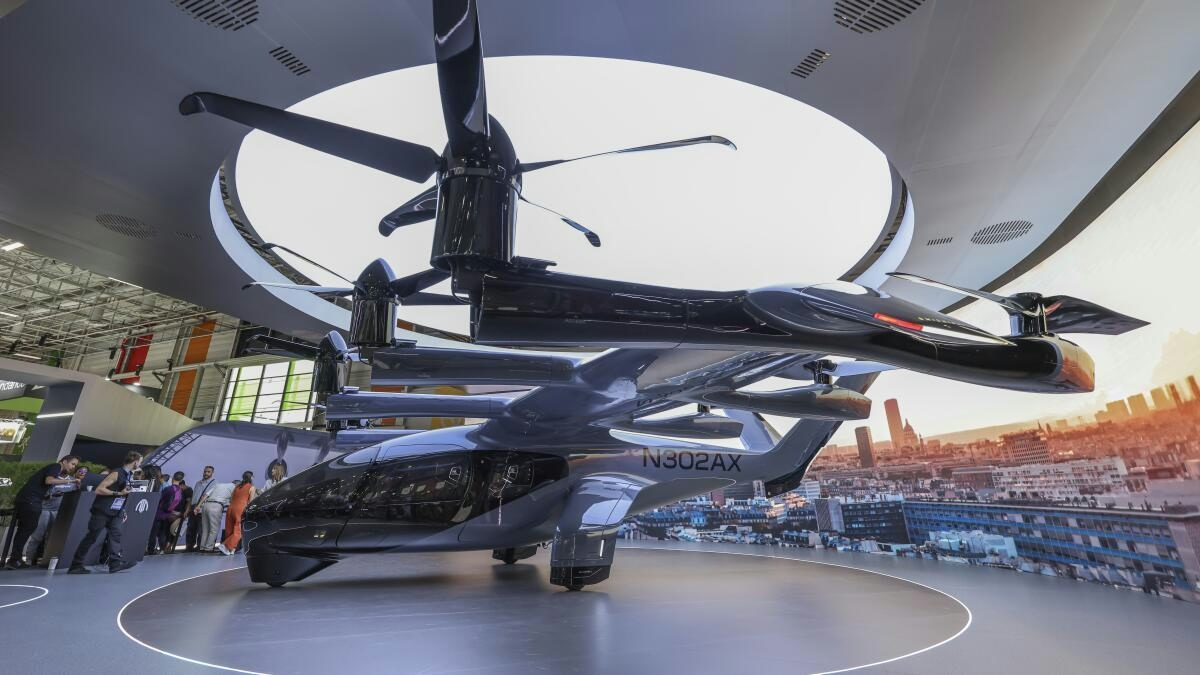
Boeing Trades Its Air Taxi Bet for Archer Stock
Boeing is recalibrating its strategy in the urban air mobility sector by divesting several non-core businesses, including Wisk Aero, drone manufacturer Insitu, and airspace-services firm SkyGrid. In exchange, the aerospace giant will acquire a nearly 20% equity stake in Archer Aviation. Rather than receiving cash, Boeing will be compensated with Archer shares valued at just over $1 billion, based on the closing price on Thursday, once the transaction is completed.
Strategic Refocus and Financial Streamlining
This transaction aligns with Boeing’s broader objective to streamline its operations and reinforce its financial stability by concentrating on its primary business of manufacturing and delivering commercial aircraft. The move follows the recent $10.6 billion cash sale of its Jeppesen navigation-data unit, further demonstrating Boeing’s commitment to divesting non-essential assets and sharpening its corporate focus.
The market has reacted favorably to the deal with Archer. The company’s market capitalization has risen from $4.8 billion to levels approaching that of its main competitor, Joby Aviation, which currently stands at $8.0 billion. This increase is largely driven by Archer’s diversified revenue streams, particularly from defense contracts and autonomous technology. These factors have helped reposition Archer from a speculative, cash-burning air taxi startup into a more stable and attractive investment.
Challenges and Opportunities for Archer
Archer’s strategic pivot towards defense and autonomous software has mitigated the risk of depleting funds before its electric vertical takeoff and landing (eVTOL) aircraft achieve commercial viability. In contrast, competitors such as Joby Aviation remain heavily invested in infrastructure development for their air taxis but lack the financial cushioning provided by defense-related revenue.
Nonetheless, Archer faces significant challenges ahead. The company must secure regulatory certification for its eVTOL aircraft and successfully integrate the three acquired businesses—Wisk Aero, Insitu, and SkyGrid—into a unified and efficient operation. The complexity of merging these entities presents operational and strategic hurdles that could influence Archer’s future trajectory.
If Archer manages to overcome these obstacles, it could establish itself as a dominant force in the eVTOL market. Conversely, failure to achieve certification or integration could jeopardize its recent stock gains and market standing.
For Boeing, the deal signifies a calculated shift from direct involvement in air taxi development to holding a substantial stake in a company with growing momentum and diversified revenue streams. As the urban air mobility sector continues to evolve, both Boeing and Archer are wagering that this strategic realignment will prove advantageous in the race to commercialize next-generation flight.

Etihad Airways Suspends Airbus A380 Flights on Key Route

Aditya Birla Group Seeks Approval for Aircraft Leasing in GIFT City

Qatar Airways Highlights Innovation and Connectivity at Arabian Travel Market 2026

Hong Kong's Five-Year Plan Includes Andrew Fan's Aircraft Parts Processing Hub Proposal

ACIA Aero Leasing Delivers ATR72-600 to Air Nostrum

RTX Appoints Jill Albertelli as Head of Pratt & Whitney

TAT Technologies Joins Beyond Aero Hydrogen Aircraft Program

AURAK Study Highlights Barriers to Air Taxi Adoption in Emerging Economies

Xiamen Air Selects Altitude for 787 Maintenance at Heathrow

Etihad and Swissport Extend Global Partnership
