
Orchestrate AI insights into action

Trending
Categories
China Develops New J-20 Engine Surpassing F-22 Raptor’s Power
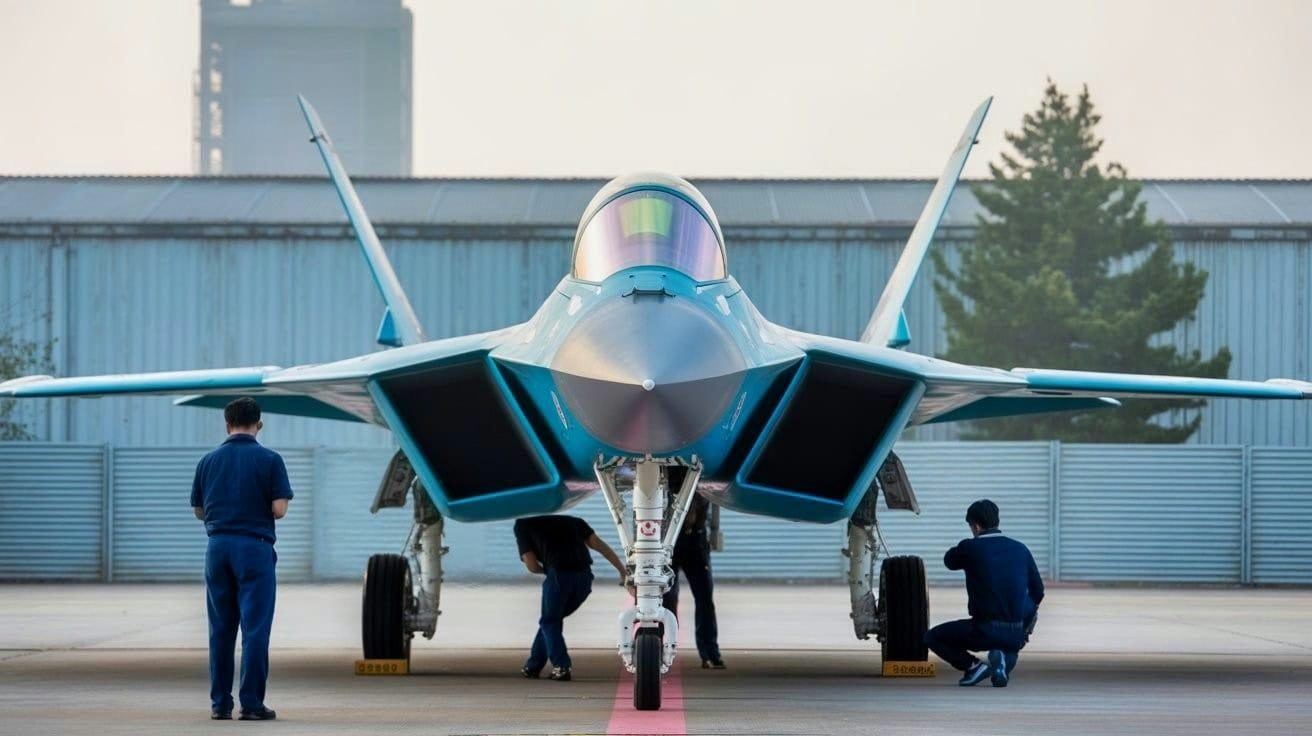
China’s J-20 Fighter Now Powered by Advanced Engine Surpassing F-22 Raptor
Overcoming Early Limitations
Since its introduction into frontline service with the People’s Liberation Army Air Force in 2017, China’s J-20 “Mighty Dragon” stealth fighter has faced a significant challenge: while its airframe rivaled the most advanced jets globally, its engines lagged behind. Initially, the J-20 relied on Russian-made Saturn AL-31F engines, which, although reliable, were originally designed for older, non-stealth aircraft. This dependence on foreign propulsion technology limited the fighter’s ability to fully exploit its fifth-generation design capabilities, effectively giving it a “borrowed heart.”
In 2019, China made strides by replacing the Russian engines with the domestically produced WS-10C. This marked an important step toward self-reliance, but the WS-10C still fell short of enabling true supercruise—the capacity to sustain supersonic flight without afterburners. This shortcoming constrained the J-20’s operational range, stealth profile, and maneuverability, leaving it at a disadvantage compared to competitors such as the U.S. F-22 Raptor.
The WS-15 Engine: A Technological Breakthrough
The turning point arrived in early 2026 with the introduction of the WS-15 engine. Developed over several decades as a clean-sheet indigenous design, the WS-15 is estimated to produce more thrust than the Pratt & Whitney F119 engine that powers the F-22. This advancement grants the J-20 the ability to sustain supersonic cruise speeds and significantly enhances its overall performance, marking a critical milestone in China’s aerospace development.
The WS-15’s development overcame formidable technical challenges, particularly in metallurgy. The production of single-crystal turbine blades capable of withstanding temperatures exceeding 1,600 degrees Celsius was a key hurdle—one that has impeded advanced engine programs worldwide. China’s success in this area underscores the sophistication of its aerospace engineering capabilities.
Strategic and Global Implications
The integration of the WS-15 engine not only secures China’s full control over the J-20’s propulsion system but also distinguishes the fighter as a rare example of a major program that has escaped reliance on foreign engines. Unlike other advanced fighters such as Turkey’s Kaan, India’s Tejas, or Sweden’s Gripen, which continue to depend on imported powerplants, the J-20 now operates with a fully indigenous engine.
This technological achievement carries significant implications for the global aerospace and defense landscape. The enhanced capabilities of the J-20 could alter the regional military balance, raising concerns among rival powers. In response, aerospace firms and defense sectors worldwide are likely to accelerate research and development efforts, increase investment in advanced engine technologies, and seek new partnerships to bridge the emerging technological gap. This competitive pressure is expected to drive innovation and collaboration as nations strive to maintain or regain their strategic edge.
China’s success with the WS-15 highlights the critical role of engine technology in modern air combat. As the J-20 enters a new phase of operational capability, the global race for next-generation propulsion systems is poised to intensify.

Etihad Airways Suspends Airbus A380 Flights on Key Route

Aditya Birla Group Seeks Approval for Aircraft Leasing in GIFT City

Qatar Airways Highlights Innovation and Connectivity at Arabian Travel Market 2026

Hong Kong's Five-Year Plan Includes Andrew Fan's Aircraft Parts Processing Hub Proposal

ACIA Aero Leasing Delivers ATR72-600 to Air Nostrum

RTX Appoints Jill Albertelli as Head of Pratt & Whitney

TAT Technologies Joins Beyond Aero Hydrogen Aircraft Program

AURAK Study Highlights Barriers to Air Taxi Adoption in Emerging Economies

Xiamen Air Selects Altitude for 787 Maintenance at Heathrow

Etihad and Swissport Extend Global Partnership
