
Orchestrate AI insights into action

Trending
Categories
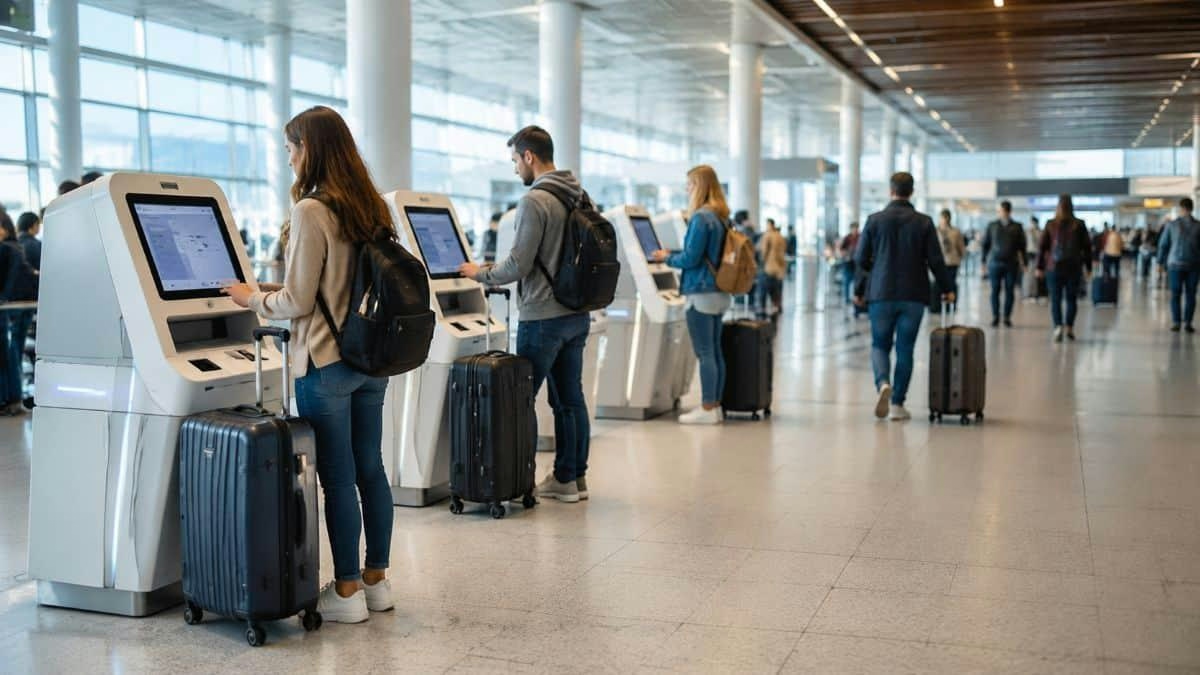
Corendon Airlines Expands Use of Self-Service Kiosks at Airports
Corendon Airlines Expands Use of Self-Service Kiosks at Airports
Advancing Digital Transformation in Passenger Services
Corendon Airlines is intensifying its digital transformation efforts by broadening the deployment of self-service check-in kiosks across multiple airports. This initiative aims to provide passengers with a faster, more convenient, and contactless travel experience. The newly introduced kiosks enable travelers to complete check-in procedures, select seats, pay for ancillary services, and drop off baggage without the need to visit traditional check-in counters.
Passengers can retrieve their flight information by scanning passports or entering their PNR numbers, after which they may choose preferred seats or opt for automatic seat assignment. The kiosks feature an integrated payment system that accepts Turkish Lira (TRY), Euro (EUR), US Dollar (USD), and British Pound (GBP), facilitating swift and secure transactions for additional services. The Self Bag Drop functionality further enhances efficiency by automatically verifying baggage details and activating baggage tags, allowing passengers to complete baggage drop-off with minimal delay.
Currently, Corendon Airlines’ self-service kiosks and Self Bag Drop solutions are operational at Antalya, Manchester, and Amsterdam airports, with pilot programs underway at Düsseldorf, Warsaw, and Nuremberg airports.
Operational Challenges and Industry Context
Atılay Batu, Chief Operating Officer of Corendon Airlines, underscored the company’s dedication to innovation, stating, “We continue to invest in digitalisation to enable our passengers to complete their airport procedures faster and more comfortably. With our self-check-in kiosks, we are making check-in and baggage drop processes more efficient while further strengthening our operational capabilities. We will continue to improve our service quality with innovative solutions that enhance the overall guest experience.”
Despite the clear benefits, the expansion of self-service technology presents several challenges. Passenger acceptance remains a critical factor, as some travelers may prefer traditional check-in methods or require additional assistance. Integrating these automated systems into existing airport operations also poses complexities, necessitating seamless coordination to avoid disruptions. Furthermore, the shift toward automation may encounter resistance from traditional check-in staff concerned about job security.
The broader European aviation sector is currently grappling with rising operating costs, ongoing consolidation among major airline groups, and geopolitical uncertainties. In this environment, Corendon’s investment in automation could generate significant efficiency improvements and cost savings. While some competitors may adopt similar technologies to maintain competitiveness, others might emphasize personalized, staff-driven services to distinguish themselves in the market.
As Corendon Airlines continues to expand its self-service offerings, it positions itself at the forefront of digital innovation, navigating the opportunities and challenges inherent in a rapidly evolving industry landscape.

Etihad Deploys Widebody Fleet to Meet Strong Demand

Korean Air Finalizes $36.2 Billion Deal with Boeing

Australia’s RFDS Queensland Section Orders Six King Air 260Cs

Korean Air Finalizes Order for 103 Boeing Jets and Engines

Embraer E195-E2 Features Distinctive Engine Placement Among Regional Jets

What Passengers Can Expect on Boeing’s New 777X Jet

How Ethiopian Airlines Became Africa’s Leading Carrier Amid Gulf Competition

Joby Aviation Extends Autonomous Flight Capabilities with Cross-Country Tour
Strengthening Europe's Aviation Supply Chain Amid Uncertainty
The Evolution of the Aircraft Maintenance Engineer Role
