
Orchestrate AI insights into action

Trending
Categories
Could an in-house MRO make Atlas Air more valuable?
Could an In-House MRO Make Atlas Air More Valuable?
Atlas Air has strategically expanded its presence in the large widebody freighter market over recent years, notably acquiring a 49 percent stake in Air Atlanta and, through its Titan Aviation Holdings division, purchasing aircraft from Air Atlanta to lease back. Both Atlas and its owner, Apollo Global Management, regard the widebody freighter sector as structurally constrained, with the Boeing 747 identified as a “strategic asset.” Their recent transactions reflect this outlook, yet another critical and increasingly scarce element of the cargo ecosystem is gaining prominence: the maintenance infrastructure essential to keeping these aircraft operational.
The Strategic Importance of Maintenance Infrastructure
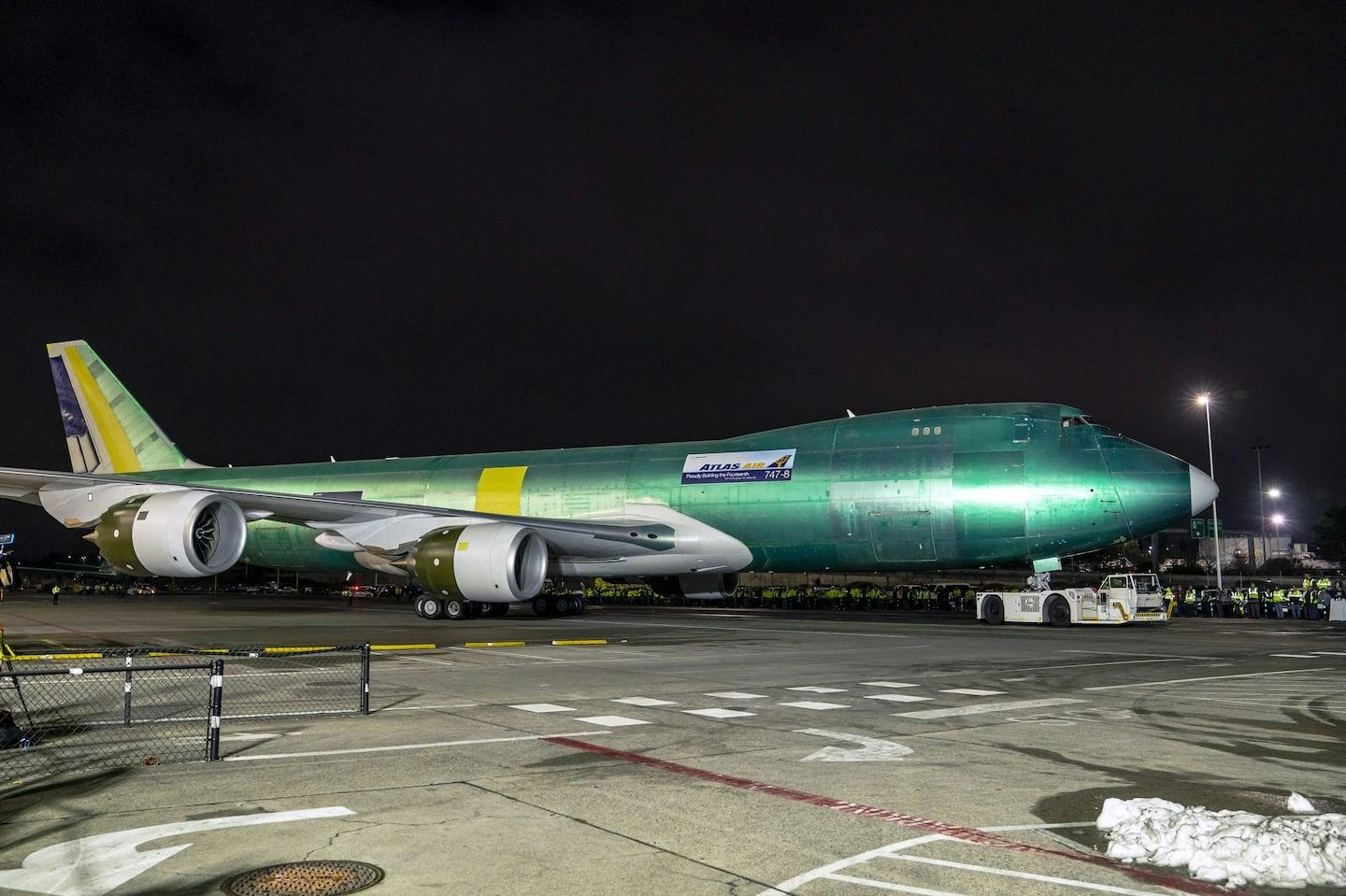
Atlas Air operates the world’s largest fleet of Boeing 747 freighters, a model whose production ceased in 2023 with the final aircraft delivered to Atlas itself. Despite the global 747 fleet contracting, demand for these aircraft is expected to remain robust well into the next decade, driven by sustained global trade requirements. However, the maintenance network supporting these aircraft is shrinking. As fleets age and experienced specialists retire, maintenance capacity is becoming increasingly constrained and often booked years in advance. For instance, HAECO, a leading 747 maintenance provider, has reserved ten Boeing 747 maintenance slots for SF Airlines spanning 2026 to 2030. Atlas has also extended its partnership with HAECO, securing line-maintenance support through 2030 and base maintenance for its 747s from 2028 to 2030.
These developments highlight a new reality: access to hangar space, skilled labor, specialized tooling, engineering expertise, and parts support have themselves become “strategic assets.” Operators with secured access to these resources benefit from greater certainty regarding aircraft availability, maintenance costs, and the ability to meet customer commitments, compared to those competing for limited capacity on the open market.
Potential Benefits and Challenges of an In-House MRO
In light of these dynamics, Atlas Air could explore the establishment of an integrated in-house maintenance, repair, and overhaul (MRO) platform. This initiative might take the form of an acquisition, joint venture, controlling investment, or dedicated capacity agreements with established providers. The existing 747 fleet would provide a stable base demand, while servicing third-party customers could enhance scale and operational efficiency. Over time, such a platform could expand to support other aircraft types, including the 777 freighter and the Airbus A350F, of which Atlas has ordered 20 units with deliveries commencing in 2029, alongside options for an additional 20 aircraft.
Nonetheless, launching an in-house MRO presents significant challenges. According to the Aeronautical Repair Station Association (ARSA), supply chain constraints are already limiting the expansion of aerospace maintenance capabilities. The 2026 Global Fleet and MRO Market Forecast indicates that while an in-house MRO could improve operational efficiency and reduce costs, Atlas would face intense competition from established independent MRO providers. These competitors may respond by developing their own internal maintenance capabilities or strengthening partnerships with third-party providers to preserve their cost advantages.
Beyond maintenance services, parts management poses an additional challenge for aging 747 fleets. Although the end of aircraft production does not immediately halt parts manufacturing or technical support, it complicates inventory planning, component repair, and access to specialist suppliers. Integrating airframe maintenance with parts management and engineering functions could afford Atlas greater control over its supply chain and potentially generate value for other 747 operators.
Atlas Air’s consideration of an in-house MRO reflects a strategic response to evolving market conditions, balancing potential operational and financial benefits against the complexities of supply chain constraints and a competitive maintenance landscape.
Comments

Etihad Airways Suspends Airbus A380 Flights on Key Route

Aditya Birla Group Seeks Approval for Aircraft Leasing in GIFT City

Qatar Airways Highlights Innovation and Connectivity at Arabian Travel Market 2026

Hong Kong's Five-Year Plan Includes Andrew Fan's Aircraft Parts Processing Hub Proposal

ACIA Aero Leasing Delivers ATR72-600 to Air Nostrum

RTX Appoints Jill Albertelli as Head of Pratt & Whitney

TAT Technologies Joins Beyond Aero Hydrogen Aircraft Program

AURAK Study Highlights Barriers to Air Taxi Adoption in Emerging Economies

Xiamen Air Selects Altitude for 787 Maintenance at Heathrow

Etihad and Swissport Extend Global Partnership
