
Orchestrate AI insights into action

Trending
Categories
Curtiss Model 51 Fledgling: A Vintage Profile
Curtiss Model 51 Fledgling: A Vintage Profile
The Curtiss Model 51 Fledgling represents a significant chapter in early American aviation, embodying both historical importance and enduring craftsmanship. Developed by the Curtiss Aeroplane and Motor Company, the Model 51 served as the civilian counterpart to the U.S. Navy’s N2C trainer, which itself was derived from Curtiss’s Model 48. While the Navy’s N2C was equipped with Wright Whirlwind radial engines—specifically the J-5 (R-790) and J-6-7 (R-760) models—the Model 51 was powered by the Curtiss Challenger, a six-cylinder, twin-row radial engine.
Role and Design
Primarily, the Fledgling functioned as a flight trainer for the Curtiss Flying School and operated as an air taxi for the Curtiss Flying Service, transporting paying passengers during the golden age of aviation. Its robust biplane configuration and dependable performance earned it favor among early aviators and instructors alike. The aircraft’s design combined reliability with practicality, making it a staple in pilot training and commercial aviation services of its era.
Preservation and Legacy
In the contemporary aviation market, the Fledgling faces considerable challenges due to its advanced age and the specialized maintenance it requires. While it remains highly valued by aviation enthusiasts and collectors for its historical significance and craftsmanship, questions persist regarding its cost-effectiveness compared to modern aircraft. The market for vintage planes such as the Fledgling is therefore mixed; although competitors have modernized similar designs with updated technology, the Fledgling’s authentic historical value continues to distinguish it.
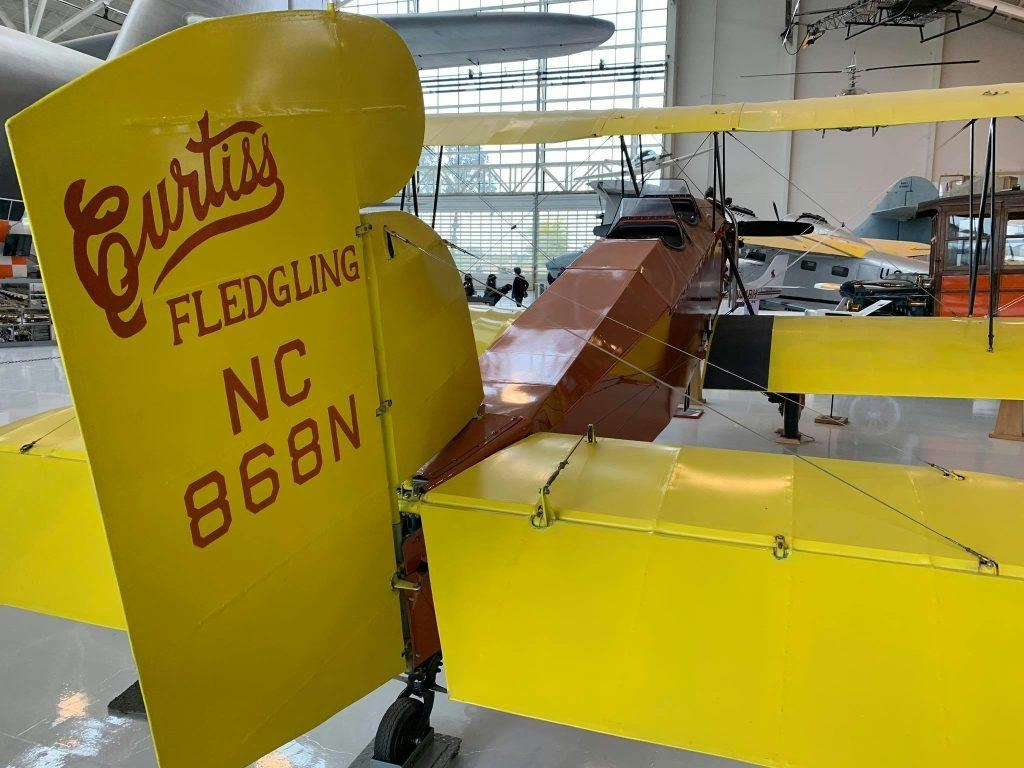
A prominent example of the Model 51’s enduring legacy is the aircraft displayed at the Evergreen Aviation and Space Museum in McMinnville, Oregon. This particular Fledgling, identified as the 51st of 109 produced and bearing the construction number B-51, was registered as NC868N. It initially operated around St. Louis, Missouri, before a brief stint in Alaska. In the 1960s, pilot Eugene Burrill of Medford, Oregon, acquired and restored the aircraft to airworthy condition. Following Burrill’s death in 2008, his widow, Gladys, donated the Fledgling to the Evergreen Museum, where it was reassembled and remains on public display.
The Curtiss Model 51 Fledgling’s story is deeply intertwined with the broader narrative of American aviation heritage. Its preservation underscores both the challenges and rewards associated with maintaining vintage aircraft in an industry characterized by rapid technological advancement. While modern innovations offer greater efficiency and convenience, the Fledgling’s lasting appeal lies in its unique historical significance—a testament to the pioneering spirit that shaped the early days of flight.

Etihad Airways Suspends Airbus A380 Flights on Key Route

Aditya Birla Group Seeks Approval for Aircraft Leasing in GIFT City

Qatar Airways Highlights Innovation and Connectivity at Arabian Travel Market 2026

Hong Kong's Five-Year Plan Includes Andrew Fan's Aircraft Parts Processing Hub Proposal

ACIA Aero Leasing Delivers ATR72-600 to Air Nostrum

RTX Appoints Jill Albertelli as Head of Pratt & Whitney

TAT Technologies Joins Beyond Aero Hydrogen Aircraft Program

AURAK Study Highlights Barriers to Air Taxi Adoption in Emerging Economies

Xiamen Air Selects Altitude for 787 Maintenance at Heathrow

Etihad and Swissport Extend Global Partnership
