
Orchestrate AI insights into action

Trending
Categories
F-35 and F-22 Pilot Salaries Compared in 2026
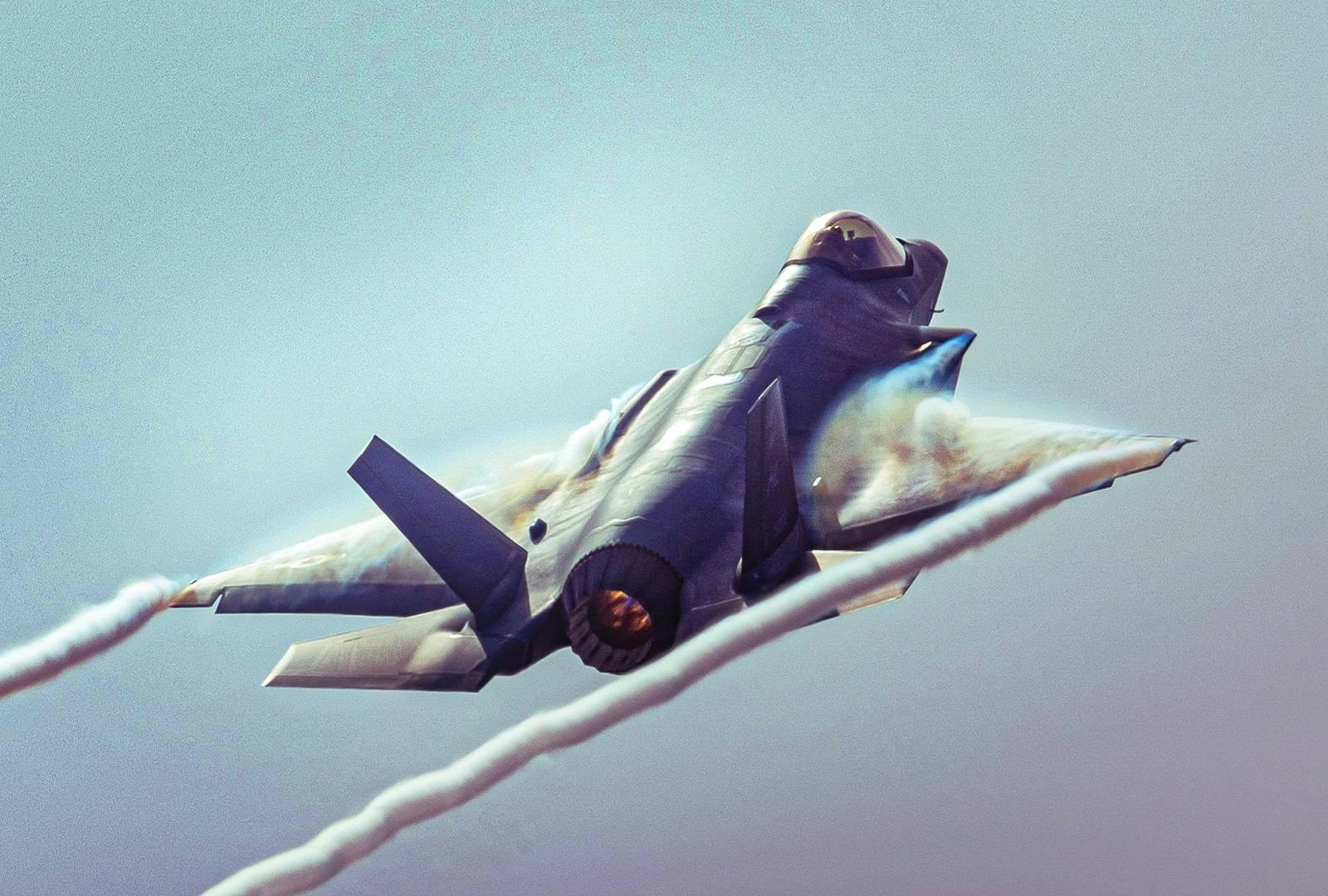
F-35 and F-22 Pilot Salaries Compared in 2026
All United States Air Force fighter pilots hold commissioned officer status, a standard consistent with the US Navy, Marine Corps, and many allied air forces such as the Royal Air Force. This contrasts with the Army, where helicopter pilots may serve as warrant officers. Fighter pilots bear significant responsibility, often making independent, high-stakes decisions with strategic or political implications. Their roles require leadership, advanced education—including at least a bachelor’s degree—and extensive technical expertise, particularly for those operating sophisticated aircraft like the F-35 and F-22.
Determination of Fighter Pilot Salaries
In the US Air Force, pilot compensation is not influenced by the specific aircraft flown. Instead, salaries are structured according to rank and years of service. This approach is somewhat analogous to commercial aviation, where pay depends on seniority and position rather than the type of aircraft. However, unlike commercial pilots who may progress to flying larger or more complex jets, Air Force fighter pilots do not advance through aircraft types as part of their career trajectory. An F-35 pilot and an F-22 pilot holding the same rank and service duration receive equivalent base pay, assuming comparable deployment histories. While cross-training on different aircraft is possible, it remains uncommon, and pilots typically remain assigned to a single platform for much of their careers.
Operational Context and Program Challenges
Although base pay is uniform, differences arise in deployment frequency, quality of life, and the cultural environment associated with flying particular jets. Certain aircraft may require more frequent combat deployments, which can affect total compensation through deployment-related pay.
In 2026, the operational landscape for F-35 and F-22 pilots is shaped by broader program challenges. The F-35 program faces escalating sustainment costs and readiness issues. According to the Government Accountability Office (GAO), only one in four F-35s is fully mission capable, resulting in increased expenses and scrutiny regarding the jet’s cost-effectiveness. To address these challenges, the Air Force has initiated measures such as the Global Support Solution Reset aimed at improving readiness.
Conversely, the F-22, though no longer in production, maintains higher readiness rates and is frequently recognized for its advanced capabilities. This has drawn attention from competitors and defense analysts who emphasize the Raptor’s operational reliability as the F-35 program works to overcome its difficulties. While these factors influence perceptions and strategic considerations, they do not affect pilot salaries, which remain strictly tied to rank and service time.
Future Outlook
Looking ahead, the Air Force is developing the next-generation F-47, anticipated to begin replacing the F-22 in the early 2030s. Some current Raptor pilots may have the opportunity to transition to this new platform in the coming years.
In essence, while F-35 and F-22 pilots receive equal compensation based on rank and experience, the differing operational demands and programmatic challenges associated with each aircraft shape the daily experiences and future prospects of these elite aviators.

Etihad Airways Suspends Airbus A380 Flights on Key Route

Aditya Birla Group Seeks Approval for Aircraft Leasing in GIFT City

Qatar Airways Highlights Innovation and Connectivity at Arabian Travel Market 2026

Hong Kong's Five-Year Plan Includes Andrew Fan's Aircraft Parts Processing Hub Proposal

ACIA Aero Leasing Delivers ATR72-600 to Air Nostrum

RTX Appoints Jill Albertelli as Head of Pratt & Whitney

TAT Technologies Joins Beyond Aero Hydrogen Aircraft Program

AURAK Study Highlights Barriers to Air Taxi Adoption in Emerging Economies

Xiamen Air Selects Altitude for 787 Maintenance at Heathrow

Etihad and Swissport Extend Global Partnership
