
Orchestrate AI insights into action

Trending
Categories
How AI Could Transform Bird-Strike Prevention for Business Aviation
How AI Could Transform Bird-Strike Prevention for Business Aviation
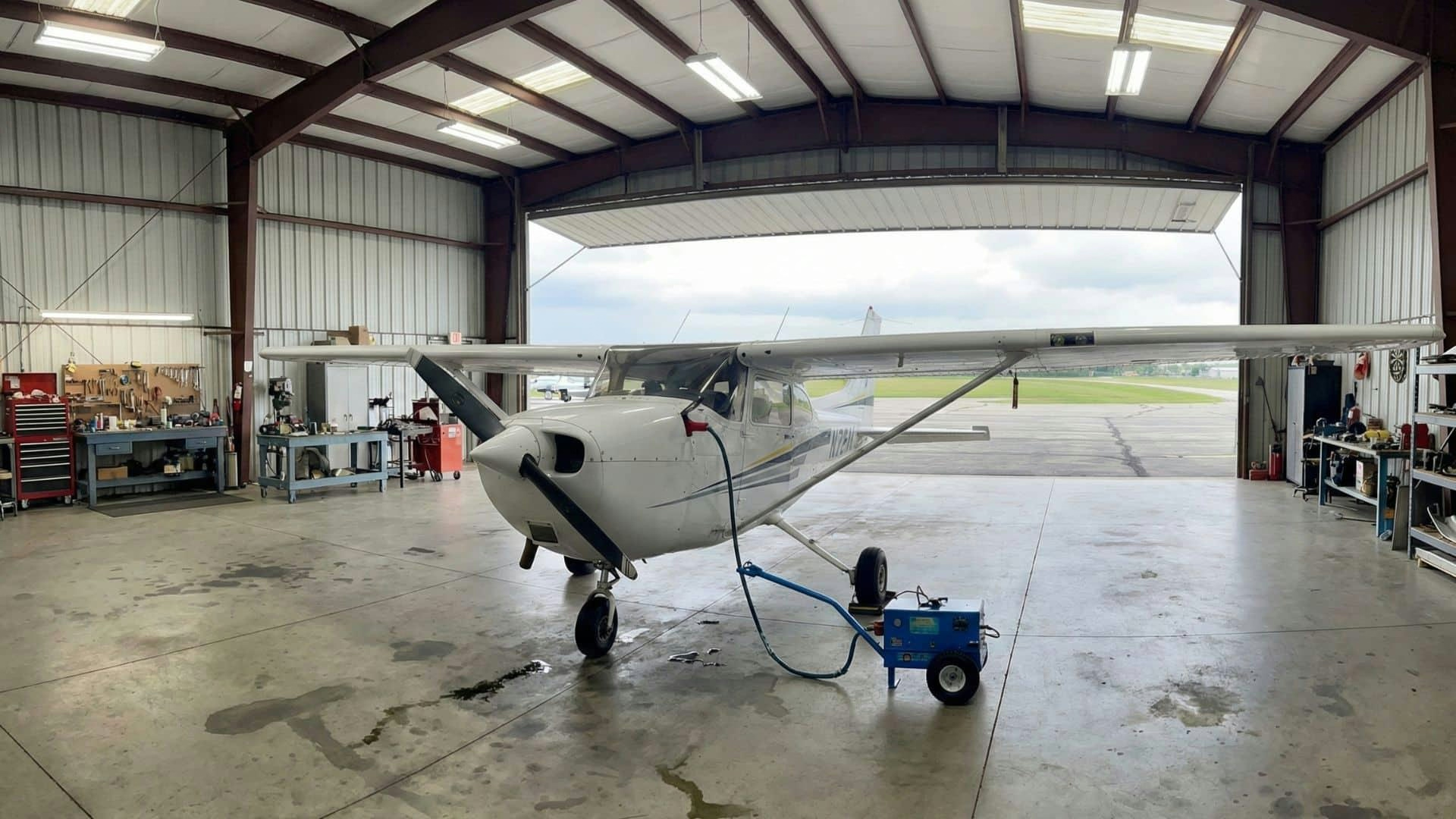
For decades, business aviation has depended on vigilance, wildlife management, and pilot reports to mitigate the risks posed by bird strikes. These incidents remain among the most unpredictable hazards in aviation, particularly affecting helicopters, turboprops, and business jets operating at airports worldwide. Recent data from the National Business Aviation Association (NBAA) underscores the significance of this threat: bird strikes accounted for 18% of 66 reported incidents and accidents between April and June of this year, making them the most common event type in the study.
Advancements in Detection and Prediction
Traditional wildlife management programs have gradually evolved, but the emergence of artificial intelligence (AI) offers new possibilities for enhancing operational awareness. AI technologies can detect and predict bird activity with greater precision, potentially providing earlier warnings before flight operations are compromised. Kevin Singh, an instructor pilot for Bombardier’s Global Vision program and president of Icarus Jet, emphasizes the persistent need for vigilance, especially during critical phases such as takeoff and landing. He notes that while bird strikes are often considered low-probability events, their consequences demand constant attention.
Singh points out that current reporting methods, such as Notices to Airmen (NOTAMs), have seen little innovation in terms of real-time bird detection. Although technological efforts to deter birds from airport environments have advanced, Singh remains cautious about AI’s practical application. He questions how AI-generated data could be effectively integrated into the flight deck, stating, “Unless there is a way to see a flock of birds displayed in real time on the flight deck, I am not sure how AI will come into play here.”
Addressing this challenge, developers of next-generation wildlife detection systems are focusing on delivering actionable intelligence to airport operators. Cristobal Esteban, founder of Aerial Guard—a real-time wildlife monitoring platform powered by Cambrian Intelligence—explains that AI is designed to complement, not replace, existing wildlife management practices. He highlights the particular benefits for smaller airports, which often lack dedicated personnel and resources for wildlife control. “AI can provide continuous monitoring and help airport teams focus their time and attention on the moments and areas where the risk is greatest,” Esteban said.
Challenges and Industry Response
Despite its promise, integrating AI into bird-strike prevention presents several challenges. Effective deployment requires extensive data collection and rigorous analysis to ensure the accuracy and reliability of AI algorithms. Moreover, incorporating new technology into established aviation systems can be complex, and operators may initially express skepticism due to concerns about costs and potential operational disruptions. Regulatory approval and compliance with stringent aviation safety standards will also be essential for widespread adoption.
Market reactions to AI-driven bird-strike prevention are expected to be mixed. Some operators may hesitate, wary of the investment and complexity involved, while others could view AI as a competitive advantage and move swiftly to adopt or collaborate with AI developers. In response, competitors may enhance their own bird-strike prevention measures or form strategic alliances to keep pace with technological advancements.
Ultimately, for AI to have a meaningful impact, it must align with the operational realities faced by pilots. While AI can predict migration patterns and alert crews to potential risks, the final responsibility often rests with pilots to detect and avoid hazards in real time. As these technologies continue to evolve, there is hope that AI will become an indispensable tool, enabling business aviation to stay one step ahead of one of its most persistent threats.
American Airlines and Boeing Complete First 737 MAX Landing Gear Swap

Vietjet and Thales sign major MRO and AI deals in Paris
Etihad CEO Cites Aircraft Capacity as Limiting Factor Amid Growth in China and Africa
Artificial Intelligence Enters the Cockpit

How Southwest Airlines is using technology, data and AI to strengthen CX while keeping the human touch
Red Sea Airlines to Lease Two Boeing 737 MAX 8 Aircraft
Su-30 and Su-34 Fighter Jets' Engines Contribute to Urban Heat
Airlines Urge Increased Competition in Used Jet Engine Parts Market
Future Developments Planned for NWF Beaches Airport
airBaltic Files for Chapter 11 Bankruptcy Protection
