
Orchestrate AI insights into action

Trending
Categories
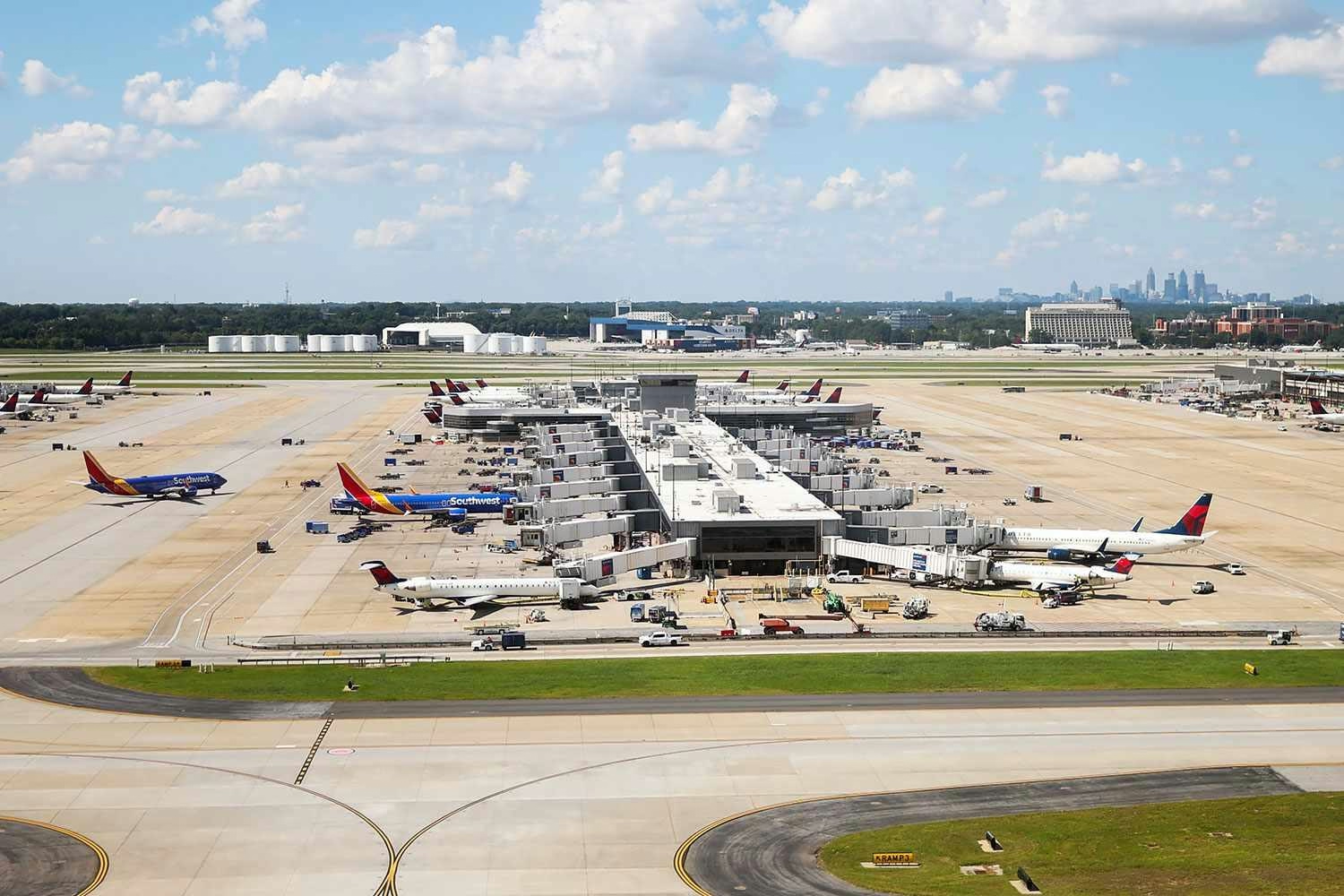
How Delta Manages 100,000 Bags Daily at Atlanta’s Hartsfield-Jackson Airport
How Delta Manages 100,000 Bags Daily at Atlanta’s Hartsfield-Jackson Airport
Coordinating a Complex Operation
At Hartsfield-Jackson Atlanta International Airport, the world’s busiest by passenger volume, Delta Air Lines handles an extraordinary volume of luggage each day. Before a plane even reaches the gate, ramp agents like Mike Davis are already in motion, navigating the busy space between terminal and taxiway. Driving baggage tugs and equipped with handheld scanners, these agents verify each bag’s barcode to ensure it is routed correctly for its next destination. On an average day, Delta manages over 100,000 bags in Atlanta alone, with approximately 75 percent of those connecting to other flights. Each piece of luggage is touched by an average of nine employees during its journey, underscoring the complexity and scale of the operation.
Leveraging Artificial Intelligence for Efficiency
To manage this immense logistical challenge, Delta has developed a proprietary artificial intelligence system designed to optimize baggage handling. The AI functions similarly to a ridesharing algorithm, assigning tasks to tug drivers by prioritizing which bags require immediate attention and calculating the most efficient routes between gates. Paul Buckley, Delta’s director of operations in Atlanta, explained that the new system has brought consistency to the process. “In our old dispatching system, we gave the drivers the bags they were to handle, and they would choose the order. Some were better than others,” he said. “Now we have consistency, because we know exactly what order we’re delivering them in.”
For ramp agents like Davis, the AI system simplifies their workload by eliminating the need to plan routes or prioritize bags manually. “I don’t have to focus on crunching numbers and trying to figure out my own route. It does all that for me,” Davis said. “It tells me which gate. All I got to do is just get there.”
Challenges and Industry Implications
Despite its advantages, the AI system is not without challenges. Davis noted that the algorithm sometimes assigns him tight connections that push the limits of feasibility. “There’s been times where I knew that I wasn’t going to make a connecting flight. However, I still took the chance and went to that gate and the plane was still there. So lucky for me, lucky for the customer,” he recalled. Maintaining the system’s high efficiency is critical, especially as passenger volumes fluctuate and technical issues occasionally arise.
Delta’s investment in AI-driven baggage handling reflects a broader trend within the airline industry, as carriers seek to enhance operational efficiency and reduce costs. Market analysts have observed Delta’s approach closely, with competitors exploring similar technologies to improve their own baggage operations.
As the summer travel season intensifies, Delta’s ability to process more than 100,000 bags daily through Atlanta’s intricate network remains a significant logistical achievement—one increasingly reliant on artificial intelligence and the commitment of frontline employees like Mike Davis.

Etihad Airways Suspends Airbus A380 Flights on Key Route

Aditya Birla Group Seeks Approval for Aircraft Leasing in GIFT City

Qatar Airways Highlights Innovation and Connectivity at Arabian Travel Market 2026

Hong Kong's Five-Year Plan Includes Andrew Fan's Aircraft Parts Processing Hub Proposal

ACIA Aero Leasing Delivers ATR72-600 to Air Nostrum

RTX Appoints Jill Albertelli as Head of Pratt & Whitney

TAT Technologies Joins Beyond Aero Hydrogen Aircraft Program

AURAK Study Highlights Barriers to Air Taxi Adoption in Emerging Economies

Xiamen Air Selects Altitude for 787 Maintenance at Heathrow

Etihad and Swissport Extend Global Partnership
