
Orchestrate AI insights into action

Trending
Categories
How The Airline That Invented Lie-Flat Seats Continues To Innovate In Luxury Travel
How the Airline That Invented Lie-Flat Seats Continues to Innovate in Luxury Travel
The evolution of modern premium air travel owes much to British Airways’ pioneering efforts in redefining the transatlantic flight experience. In 1995, the airline introduced the first horizontal sleeping surfaces in its first class cabins, establishing a new benchmark for elite travel. The greater challenge lay in adapting this ultra-luxury concept into a commercially viable business class product without compromising aircraft economics.
Revolutionizing Business Class Seating
To address this, British Airways collaborated with London-based design firm Tangerine in 1998. Traditional forward-facing rows could not accommodate fully flat beds without significantly reducing seating capacity. Tangerine’s solution was a patented yin-yang layout that alternated forward- and rear-facing seats, maximizing cabin width and enabling lie-flat beds to fit within the same footprint as older reclining seats. This innovative configuration debuted in March 2000 on flagship Boeing 747 routes between London and New York, igniting a global competition among airlines to introduce their own horizontal business class products.
This breakthrough transformed business class from a modest upgrade over economy into a genuinely premium experience, shifting the industry’s focus toward maximizing comfort and revenue per square inch. Consequently, airlines worldwide expanded their premium offerings, incorporating lie-flat business class cabins and enhanced premium economy seats. This trend also pushed economy passengers further back in the cabin as carriers prioritized luxury experiences to attract high-yield travelers.
Meeting Evolving Passenger Expectations
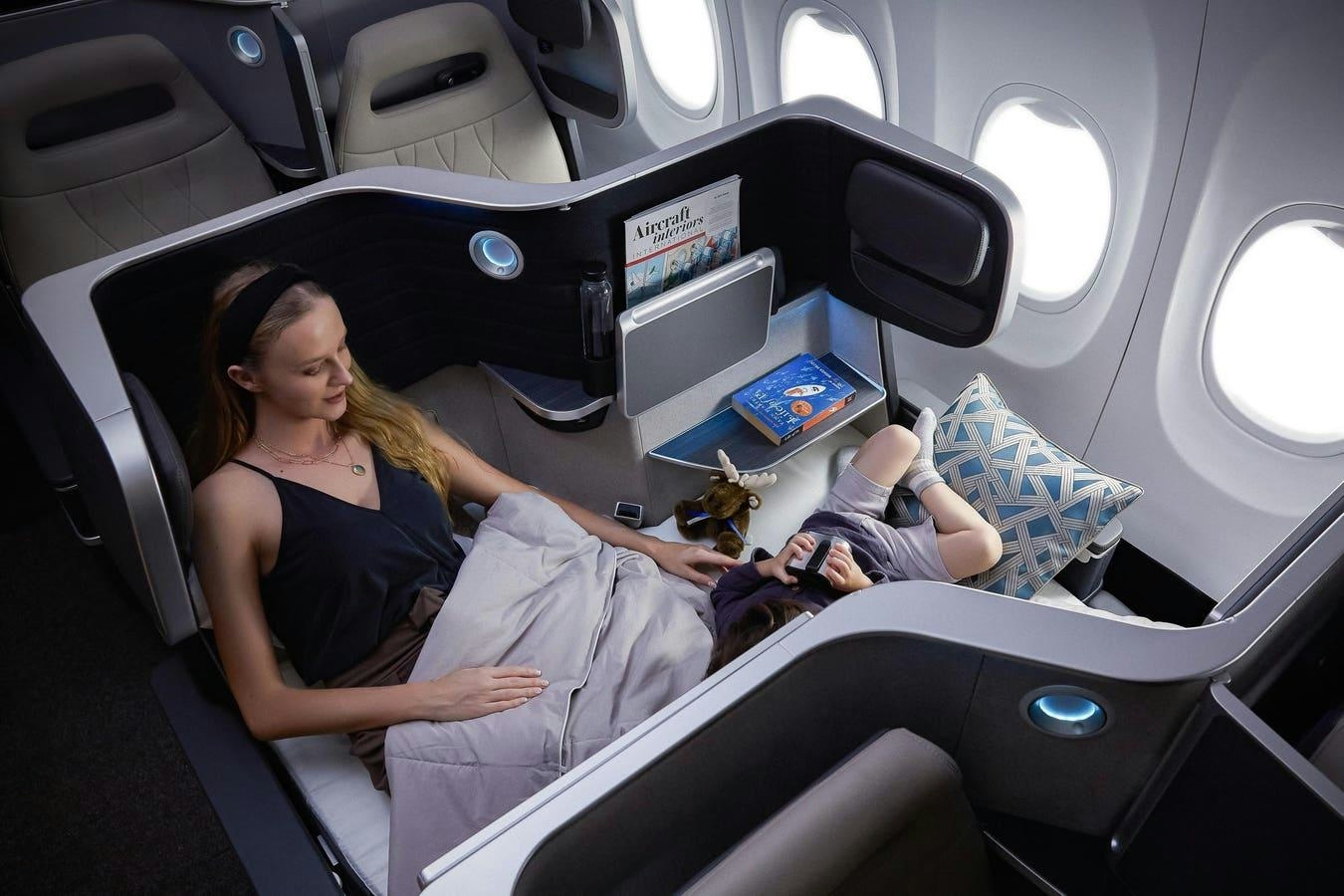
Over the following two decades, passenger expectations evolved beyond comfortable sleeping surfaces to include privacy and personal space. British Airways responded with the launch of the Club Suite, its next-generation business class product, introduced on the Airbus A350-1000. Departing from the interlocking layout, the Club Suite features a 1-2-1 configuration that guarantees direct aisle access for every passenger, eliminating the inconvenience of stepping over neighbors. The suite offers a 79-inch (200.6 cm) fully flat bed, 40% more personal storage than its predecessor, and a sliding privacy door to enhance seclusion.
British Airways’ innovations have set a high standard, prompting competitors to elevate their premium services. American Airlines, for instance, has emphasized its Flagship Suite business class with lie-flat seats, while carriers such as Emirates and Airbus are pushing luxury boundaries further with plans for en-suite bathrooms in first class.
Challenges and Market Resilience
Despite these advancements, the pursuit of luxury air travel is not without challenges. Customer dissatisfaction can arise when premium services fail to meet expectations, including issues with malfunctioning lie-flat seats or inadequate compensation. Nevertheless, the luxury travel market remains resilient. Europe’s luxury travel sector, in particular, continues to flourish even as mass market bookings slow, underscoring the sustained demand for elevated in-flight experiences.
British Airways’ legacy of innovation continues to influence the future of luxury air travel, as airlines worldwide strive to meet the evolving demands of discerning travelers.

Etihad Airways Suspends Airbus A380 Flights on Key Route

Aditya Birla Group Seeks Approval for Aircraft Leasing in GIFT City

Qatar Airways Highlights Innovation and Connectivity at Arabian Travel Market 2026

Hong Kong's Five-Year Plan Includes Andrew Fan's Aircraft Parts Processing Hub Proposal

ACIA Aero Leasing Delivers ATR72-600 to Air Nostrum

RTX Appoints Jill Albertelli as Head of Pratt & Whitney

TAT Technologies Joins Beyond Aero Hydrogen Aircraft Program

AURAK Study Highlights Barriers to Air Taxi Adoption in Emerging Economies

Xiamen Air Selects Altitude for 787 Maintenance at Heathrow

Etihad and Swissport Extend Global Partnership
