
Orchestrate AI insights into action

Trending
Categories
Inside Turkish Airlines’ vision for contextual, AI-ready retailing: Rethinking how offers are created, priced and managed end-to-end
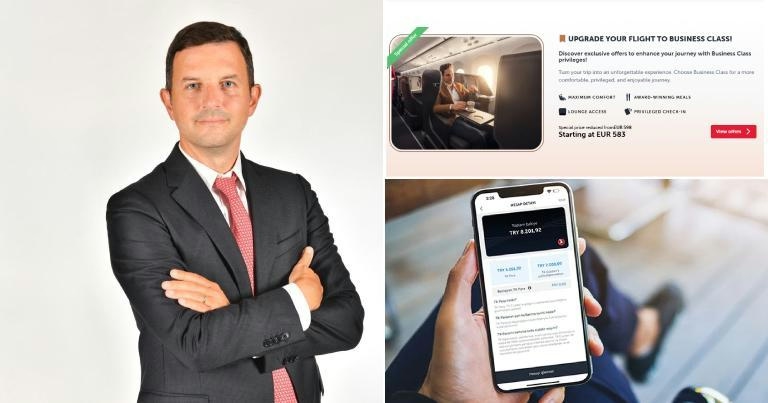
Inside Turkish Airlines’ Vision for Contextual, AI-Ready Retailing
Airline retailing is experiencing a profound transformation, with Turkish Airlines emerging as a key innovator in this evolving landscape. Historically, airline products have been defined indirectly through fares, booking classes, and rigid rules, which constrained flexibility and differentiation. The advent of new offer and order models now allows airlines to explicitly define and manage prices and offers in real time, tailoring them to the specific context of each customer interaction.
Yılmaz Goralı, Vice President of Airline Retailing – Product Development at Turkish Airlines, will elaborate on this evolution at the forthcoming APEX FTE EMEA and APEX FTE Ancillary & Retailing events in Dublin. Goralı underscores that Turkish Airlines, through its technology-focused subsidiary Turkish Technology, approaches this shift not as a mere upgrade but as a fundamental structural overhaul. He explains, “We operate a large technology landscape across the group, from passenger systems to cargo, MRO, and ground operations. When we talk about retailing, we are looking at it as a system-level question. We are building a Modern Airline Retailing platform that moves decision-making closer to the customer.”
This platform, while currently being refined within Turkish Airlines, is conceived with broader industry ambitions. The objective is to “productise” these capabilities for the wider aviation sector, enabling airlines to respond more dynamically to customer needs and preferences.
The Shift Toward Modular, Contextual Retailing
Ancillary revenue, once considered a supplementary income stream, has evolved into a core growth driver for airlines. However, as Goralı notes, the effort to sell differentiated services has revealed the limitations of legacy systems. Traditional fare construction logic, inventory controls, and distribution standards were not designed for a marketplace where products vary depending on who is buying, when, and through which channel. This has prompted a shift toward modular product design, contextual pricing, and continuous engagement beyond the initial booking. Goralı emphasizes that “the interaction does not end at purchase—it continues through the journey, at check-in, at the airport, and inflight. Each of these becomes a retailing opportunity.”
Despite the promise of this new approach, Turkish Airlines’ vision for contextual, AI-ready retailing faces significant challenges. Elevated fuel costs and geopolitical disruptions in the Middle East have dampened growth prospects across the industry. At the same time, competition is intensifying as travel technology companies such as Amadeus expand their offerings into retailing, biometric identity, artificial intelligence, hospitality, and payments. These competitors increasingly leverage AI for smarter e-commerce pricing and dynamic revenue management, seeking to mitigate the impact of rising operating costs.
Adoption of AI within the travel and retail sectors remains limited. Research from the Global Business Travel Association (GBTA) reveals that 58% of corporate travel buyers report minimal impact from AI on their programs, underscoring the nascent stage of industry-wide transformation.
As Turkish Airlines advances its retailing capabilities by structuring offers based on passenger profiles, travel segments, and service context, it exemplifies a broader industry shift from traditional fare construction to offer construction. In this emerging paradigm, the fundamental unit of commerce is no longer a fare alone but a tailored offer, managed end-to-end and primed for AI-driven personalization.

Etihad Airways Suspends Airbus A380 Flights on Key Route

Aditya Birla Group Seeks Approval for Aircraft Leasing in GIFT City

Qatar Airways Highlights Innovation and Connectivity at Arabian Travel Market 2026

Hong Kong's Five-Year Plan Includes Andrew Fan's Aircraft Parts Processing Hub Proposal

ACIA Aero Leasing Delivers ATR72-600 to Air Nostrum

RTX Appoints Jill Albertelli as Head of Pratt & Whitney

TAT Technologies Joins Beyond Aero Hydrogen Aircraft Program

AURAK Study Highlights Barriers to Air Taxi Adoption in Emerging Economies

Xiamen Air Selects Altitude for 787 Maintenance at Heathrow

Etihad and Swissport Extend Global Partnership
