
Orchestrate AI insights into action

Trending
Categories
Korean Air Presents AI-Driven Aviation Technologies at Startup Expo
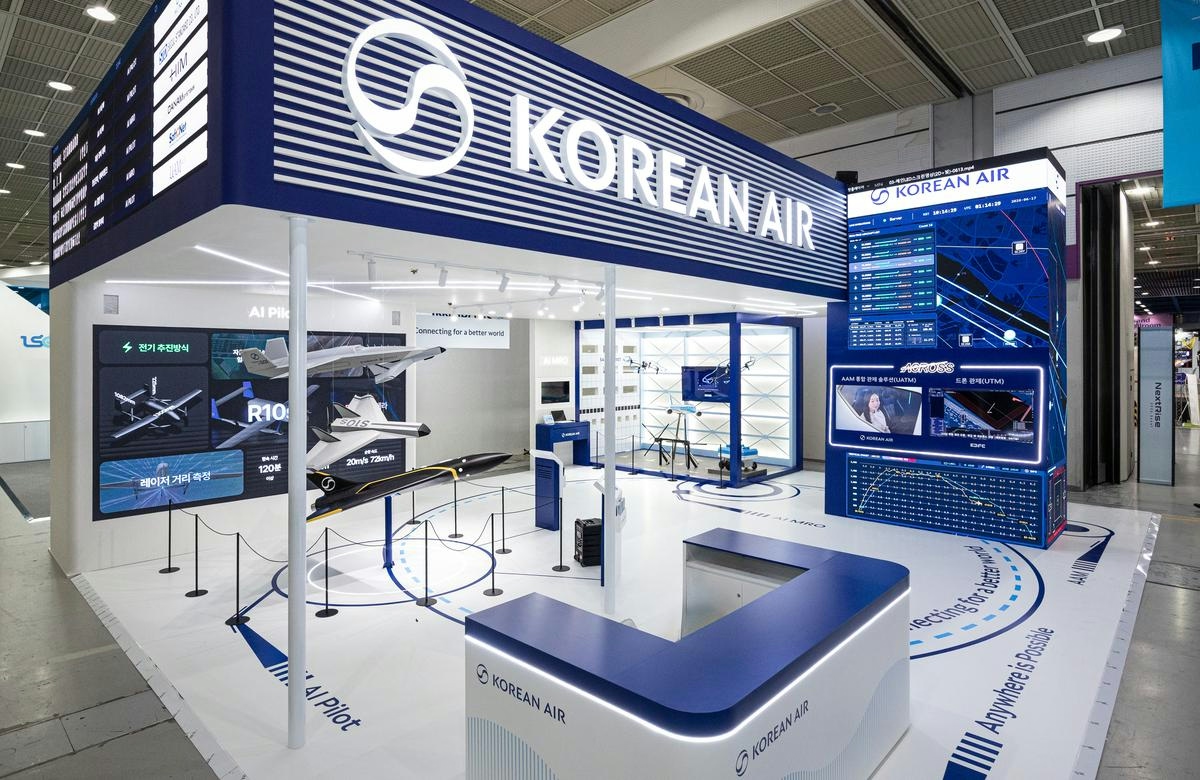
Korean Air Showcases AI-Driven Aviation Innovations at NextRise 2026
Korean Air (003490.KS) is set to participate in NextRise 2026, a prominent startup and technology exposition taking place over two days at COEX in Seoul’s Gangnam district. The airline announced on Wednesday that it will use the platform to present a range of advanced aviation technologies centered on artificial intelligence and automation.
Intelligent Air Traffic Control and Advanced Air Mobility
At the expo, Korean Air will highlight its intelligent air traffic control system known as "ACROSS." This technology aims to pave the way for an air traffic management framework capable of supporting Advanced Air Mobility (AAM), a rapidly evolving sector focused on integrating new types of aerial vehicles into existing airspace. The company emphasized that ACROSS represents a strategic direction for future air traffic systems, enhancing efficiency and safety in increasingly complex operational environments.
AI-Enabled Combat Systems and Unmanned Aircraft
In addition to air traffic innovations, Korean Air will unveil a future combat system that leverages artificial intelligence to autonomously make decisions and coordinate battlefield command. The company plans to showcase two unmanned aerial vehicles currently under internal development: a low-observable unmanned wingman aircraft and a subsonic unmanned target drone. Notably, Korean Air will also present, for the first time, test flight footage of an AI-powered drone developed in collaboration with the U.S. defense firm Anduril, underscoring its commitment to advancing military aviation technologies.
Smart Maintenance, Repair, and Overhaul (MRO) Technology
Korean Air will further demonstrate its "Smart MRO" technology, which integrates robotics and AI to revolutionize aircraft maintenance procedures. This system employs drones and a ground rover to capture detailed images of an aircraft’s exterior, both upper and lower surfaces. The collected data is then analyzed by AI to identify even the smallest defects, promptly alerting maintenance personnel. The company highlighted that this innovation can reduce inspection times dramatically—from the conventional 10 hours down to just one hour. Korean Air is actively pursuing commercialization of this maintenance technology in partnership with global aerospace manufacturer Boeing, signaling a significant step toward more efficient and automated aircraft servicing.

Hong Kong's Five-Year Plan Includes Andrew Fan's Aircraft Parts Processing Hub Proposal

ACIA Aero Leasing Delivers ATR72-600 to Air Nostrum

RTX Appoints Jill Albertelli as Head of Pratt & Whitney

TAT Technologies Joins Beyond Aero Hydrogen Aircraft Program

AURAK Study Highlights Barriers to Air Taxi Adoption in Emerging Economies

Xiamen Air Selects Altitude for 787 Maintenance at Heathrow

Etihad and Swissport Extend Global Partnership

Sepehran Airlines B737 Returns to Mashhad After Tyre and Engine Issues

Etihad Deploys Widebody Fleet to Meet Strong Demand

Korean Air Finalizes $36.2 Billion Deal with Boeing
