
Orchestrate AI insights into action

Trending
Categories
Lockheed Martin Secures Contract for F-16 Software Upgrade
Lockheed Martin Secures Contract for F-16 Software Upgrade
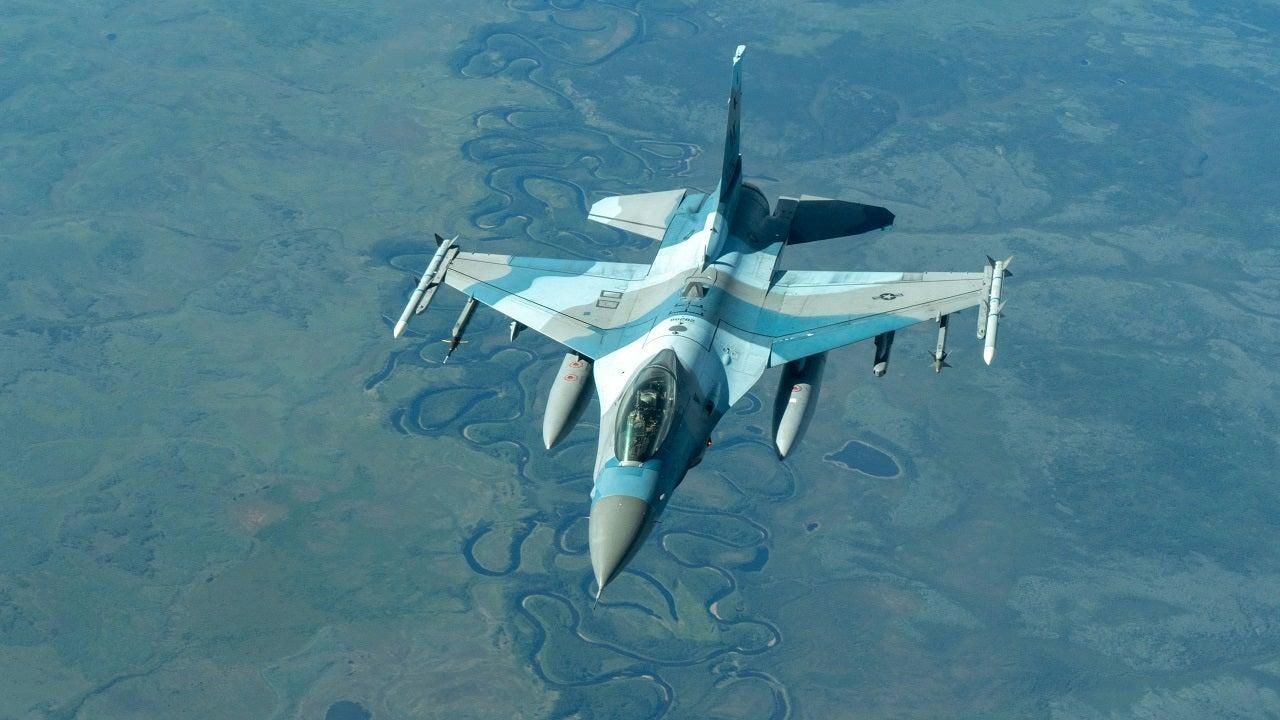
Lockheed Martin (NYSE: LM) has been awarded a contract to upgrade the Republic of Korea Air Force’s F-16 Block 52 flight simulators, bringing them in line with the advanced capabilities of the F-16 Viper (F-16V) aircraft. This modernization effort is designed to enhance mission readiness by delivering high-fidelity simulated environments that closely replicate real-world flight conditions, thereby improving pilot training and safety.
Enhancing Training Realism and Operational Readiness
Todd Morar, vice president of Air and Commercial Solutions at Lockheed Martin, emphasized the importance of accuracy and realism in ground-based flight training. He stated that as the original manufacturer of all F-16 variants, Lockheed Martin leverages the aircraft’s design and software data to create training experiences that are nearly identical to actual flight. This approach ensures that the simulators remain concurrent with the evolving technology of the aircraft, thereby supporting pilot proficiency and mission success.
Under the contract, Lockheed Martin will provide new equipment and integrate systems to modernize nine F-16 flight simulators located at Seosan and Chungju Air Bases. These simulators will be upgraded to the F-16V configuration, with Lockheed Martin also offering contractor logistics support over a six-year period to maintain operational effectiveness.
Competitive Landscape and Market Considerations
The contract award comes amid heightened competition in the global defense simulation and upgrade market. L3 Harris, a significant competitor, recently secured a contract to upgrade the electronic warfare systems of Polish F-16s, signaling intensified rivalry for similar projects worldwide. Industry analysts suggest that Lockheed Martin’s latest contract may prompt competitors like L3 Harris to capitalize on their capabilities and aggressively pursue additional upgrade opportunities in the region.
Market observers are also scrutinizing the cost-effectiveness of such upgrades, particularly as air forces weigh investments in emerging sixth-generation platforms such as Boeing’s F-47 NGAD. The decision to modernize existing F-16 fleets rather than transition to next-generation aircraft is expected to attract attention, especially as defense budgets face increasing pressure from competing priorities.
Despite these challenges, Lockheed Martin’s proprietary use of design and software data is anticipated to deliver a high degree of realism and concurrency in training. This capability is critical to meeting the Republic of Korea Air Force’s operational requirements as technological advancements continue to shape the future of aerial combat.

Etihad Airways Suspends Airbus A380 Flights on Key Route

Aditya Birla Group Seeks Approval for Aircraft Leasing in GIFT City

Qatar Airways Highlights Innovation and Connectivity at Arabian Travel Market 2026

Hong Kong's Five-Year Plan Includes Andrew Fan's Aircraft Parts Processing Hub Proposal

ACIA Aero Leasing Delivers ATR72-600 to Air Nostrum

RTX Appoints Jill Albertelli as Head of Pratt & Whitney

TAT Technologies Joins Beyond Aero Hydrogen Aircraft Program

AURAK Study Highlights Barriers to Air Taxi Adoption in Emerging Economies

Xiamen Air Selects Altitude for 787 Maintenance at Heathrow

Etihad and Swissport Extend Global Partnership
