
Orchestrate AI insights into action

Trending
Categories
LODD Autonomous Completes First Test Flight of Hili Aircraft in Al Ain
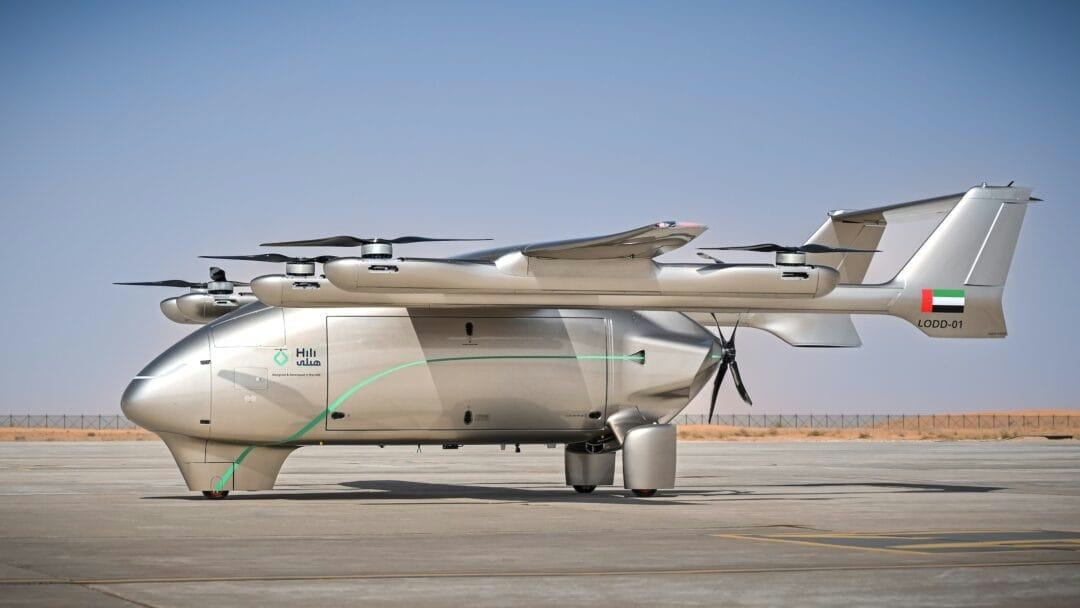
LODD Autonomous Completes First Test Flight of Hili Aircraft in Al Ain
LODD Autonomous has successfully conducted the inaugural test flight of Hili, a hybrid heavy-lift cargo aircraft developed and manufactured entirely in Abu Dhabi. The demonstration took place at Emirates Falcons Aviation’s flight testing facility in Al Ain during Abu Dhabi Autonomous Week. The event was attended by His Highness Sheikh Zayed bin Mohamed bin Zayed Al Nahyan, highlighting the emirate’s dedication to advancing autonomous aviation and logistics technologies.
Innovative Design and Capabilities
Hili is engineered to carry payloads of up to 250 kilograms over distances approaching 700 kilometres. It employs a hybrid propulsion system that integrates electric and internal combustion technologies within a modular design. This approach aims to enhance operational efficiency, safety, and sustainability in aerial cargo transport, positioning the aircraft as a pioneering solution in the evolving field of autonomous logistics.
Strategic Vision and Leadership Support
His Highness Sheikh Zayed bin Mohamed bin Zayed Al Nahyan underscored that the successful flight of Hili exemplifies Abu Dhabi’s leadership in autonomous aviation and advanced logistics. He emphasized the emirate’s commitment to transforming innovative concepts into practical applications that stimulate economic and technological growth. The role of the Smart and Autonomous Systems Council was also highlighted as instrumental in accelerating progress within advanced air mobility, alongside a continued focus on empowering national talent and fostering local innovation.
His Excellency Faisal Abdulaziz Al Bannai, Advisor to the UAE President for Strategic Research and Advanced Technology Affairs and Secretary-General of the Advanced Technology Research Council, praised the milestone as a reflection of Abu Dhabi’s strategic vision and sustained investment in cultivating globally competitive innovation.
Rashid Al Manai, CEO of LODD Autonomous, affirmed the company’s alignment with the UAE’s ambitions for advanced air mobility and autonomous systems. He expressed gratitude for the leadership’s ongoing support, which is vital to positioning the nation as a global hub for emerging technologies.
Challenges and Industry Implications
While the successful test flight marks a significant advancement, the journey toward commercial deployment remains complex. Critical challenges include securing regulatory approvals, validating safety protocols, and integrating the aircraft within existing defense and airspace frameworks. Industry analysts anticipate that this achievement will attract heightened interest from defense contractors and investors, as the market for autonomous cargo solutions continues to expand. Competitors are expected to accelerate their own development efforts or pursue strategic partnerships to strengthen their positions in the autonomous aviation sector.
The Hili project exemplifies Abu Dhabi’s strategic approach of fostering public-private collaboration, investing in advanced engineering capabilities, and nurturing national talent. This multifaceted strategy aims to establish the emirate as a global leader in sustainable air mobility and autonomous technologies. As the sector evolves, Abu Dhabi’s emphasis on innovation and regulatory preparedness will be crucial to sustaining its competitive advantage in this rapidly advancing field.

Etihad Airways Suspends Airbus A380 Flights on Key Route

Aditya Birla Group Seeks Approval for Aircraft Leasing in GIFT City

Qatar Airways Highlights Innovation and Connectivity at Arabian Travel Market 2026

Hong Kong's Five-Year Plan Includes Andrew Fan's Aircraft Parts Processing Hub Proposal

ACIA Aero Leasing Delivers ATR72-600 to Air Nostrum

RTX Appoints Jill Albertelli as Head of Pratt & Whitney

TAT Technologies Joins Beyond Aero Hydrogen Aircraft Program

AURAK Study Highlights Barriers to Air Taxi Adoption in Emerging Economies

Xiamen Air Selects Altitude for 787 Maintenance at Heathrow

Etihad and Swissport Extend Global Partnership
