
Orchestrate AI insights into action

Trending
Categories
New EDM Tool Enhances Fastener Removal in Aerospace Maintenance
New EDM Tool Enhances Fastener Removal in Aerospace Maintenance
Removing fasteners from aircraft has long been a routine yet demanding aspect of aerospace maintenance. The process is often complicated by corroded bolts and flush rivets that resist conventional removal techniques. Traditionally, technicians have relied on drills, sometimes spending up to five minutes on a single stubborn fastener—a time-consuming inefficiency that multiplies across components containing hundreds of rivets.
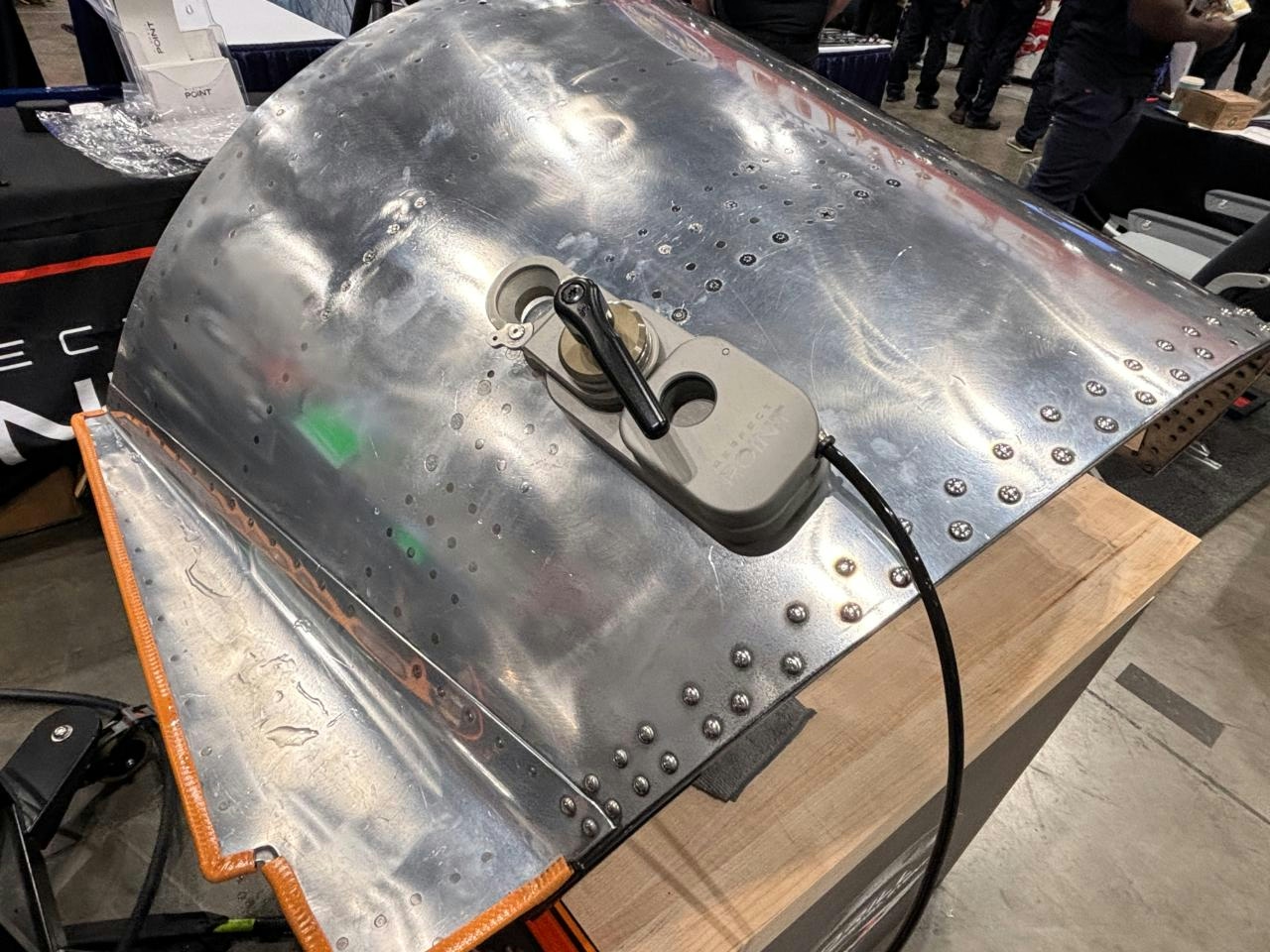
Perfect Point seeks to transform this process with its E-Drill system, a handheld electrical discharge machining (EDM) device specifically designed for aerospace fastener removal. Unlike traditional drills that physically bore through metal, the E-Drill employs electrical discharge technology to cut a precise circle in the center of the fastener. This method produces no shavings, heat, or debris and typically completes the task in mere seconds per fastener.
Precision and Efficiency in Operation
The E-Drill operates with remarkable simplicity and precision. A technician aligns the tool over the fastener, where a vacuum system secures it firmly in place. A built-in magnifying glass assists with accurate alignment, and the device is pre-programmed for specific fastener types to ensure precise cutting depth. Once positioned, the operator initiates the cut via a trigger. A green light signals completion, and the resulting cut creates a weak point that allows an air punch to remove the fastener cleanly in two pieces.
Nils Besvold, Perfect Point’s Marketing Manager, highlighted the advantages of the E-Drill at MRO Americas in April, stating, “If you’re using a drill, the bit can walk off-center, elongate the hole, or damage the surrounding structure. [The E-Drill] is quick, clean, and there’s much less damage because it’s so accurate and controllable.”
Integration and Industry Adoption
The E-Drill is compatible with a variety of fastener types, including aluminum, titanium, Hi-Loks, and standard rivets commonly found on both commercial and military aircraft. Several major industry players and maintenance training institutions, such as Tulsa Tech, have already incorporated the system into their operations and curricula.
Introducing new technology into established maintenance routines, however, presents challenges. Integrating the E-Drill with existing workflows, training personnel to adapt to the new tool, and ensuring consistent performance across diverse fastener types and conditions remain critical hurdles. Some maintenance crews, accustomed to traditional drilling methods, may initially approach the device with skepticism. Nonetheless, the promise of increased efficiency and reduced aircraft downtime is expected to encourage broader adoption.
Market Context and Industry Response
Perfect Point’s innovation emerges amid an aviation industry grappling with rising fuel prices, which exert pressure on maintenance budgets and demand. The potential for faster, cleaner fastener removal offers operators a means to mitigate these pressures by reducing labor hours and turnaround times.
Competitors are anticipated to respond by developing their own advanced removal tools or enhancing existing products to maintain market share. Meanwhile, Perfect Point continues to expand its product line, including the S-Blaster for spot coating removal, alongside comprehensive training programs through its E-Drill Academy.
For an industry long reliant on traditional drilling, the E-Drill represents a significant advancement—transforming a five-minute task into a seven-second operation and establishing a new benchmark for efficiency in aerospace maintenance.

Etihad Airways Suspends Airbus A380 Flights on Key Route

Aditya Birla Group Seeks Approval for Aircraft Leasing in GIFT City

Qatar Airways Highlights Innovation and Connectivity at Arabian Travel Market 2026

Hong Kong's Five-Year Plan Includes Andrew Fan's Aircraft Parts Processing Hub Proposal

ACIA Aero Leasing Delivers ATR72-600 to Air Nostrum

RTX Appoints Jill Albertelli as Head of Pratt & Whitney

TAT Technologies Joins Beyond Aero Hydrogen Aircraft Program

AURAK Study Highlights Barriers to Air Taxi Adoption in Emerging Economies

Xiamen Air Selects Altitude for 787 Maintenance at Heathrow

Etihad and Swissport Extend Global Partnership
