
Orchestrate AI insights into action

Trending
Categories
Pratt & Whitney Introduces Retrofit Kit to Extend Airbus A320neo Engine Life
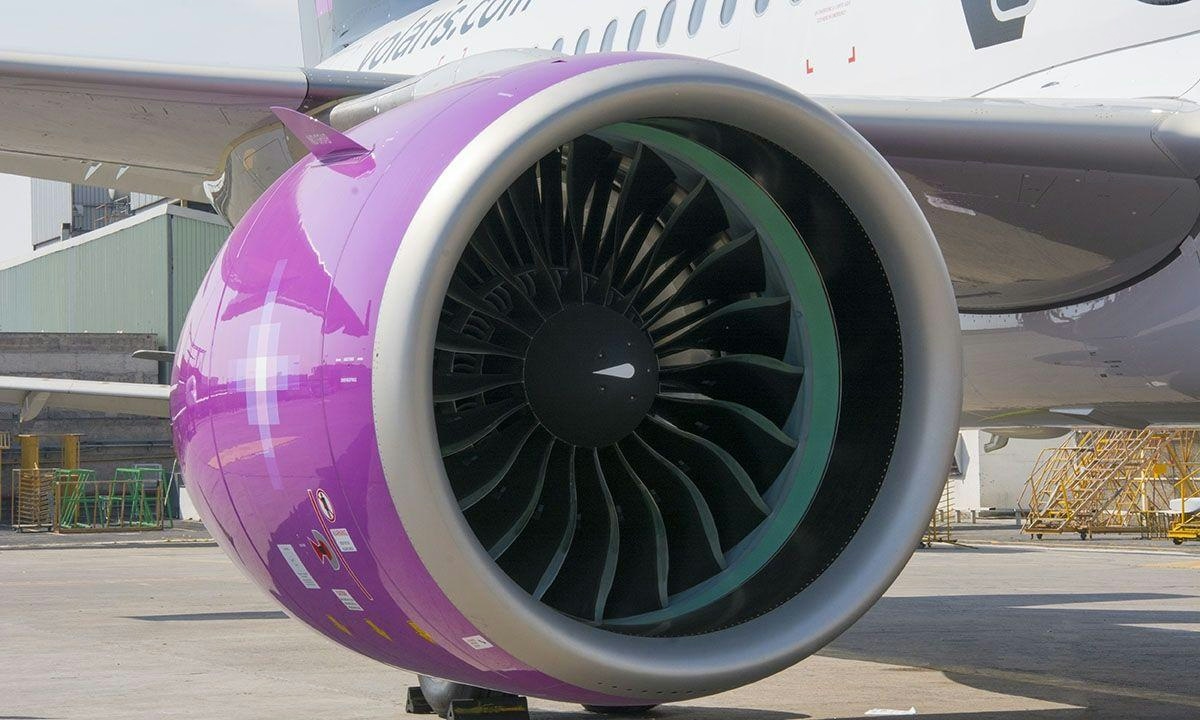
Pratt & Whitney Introduces Retrofit Kit to Extend Airbus A320neo Engine Life
Pratt & Whitney has unveiled a significant upgrade for its Geared Turbofan (GTF) engine family, aimed at extending the operational lifespan of engines powering the Airbus A320neo. The new Hot Section Plus (HS+) retrofit kit, comprising 35 components, addresses the growing industry focus on maximizing Time-On-Wing (TOW)—the duration an engine remains in service before requiring major maintenance. This development offers airlines a practical solution to enhance engine durability without resorting to full engine replacement, bridging the gap between existing fleet capabilities and the latest GTF Advantage standard.
Technical Advancements in the HS+ Retrofit Kit
The HS+ kit represents a substantial technical enhancement rather than a minor modification. It concentrates on the engine’s most thermally stressed areas, specifically the combustor and high-pressure turbine (HPT). By incorporating advanced airfoil designs and cutting-edge coatings, alongside improved cooling hole geometry and precision drilling techniques, the retrofit is engineered to better withstand the extreme temperatures that typically precipitate early engine removals. These improvements enable in-service PW1100G engines to achieve approximately 90 to 95 percent of the durability found in factory-new GTF Advantage engines.
For airlines, this translates into the potential to nearly double the TOW compared to baseline GTF configurations. Crucially, engines upgraded with the HS+ kit remain fully intermixable and interchangeable with both original GTF and newer GTF Advantage engines. This compatibility is vital for operators managing mixed fleets, as it eliminates the logistical complexities associated with maintaining different engine standards across their A320neo aircraft.
Implementation Challenges and Market Implications
The global rollout of the HS+ kit involves considerable logistical coordination across Pratt & Whitney’s 21 maintenance, repair, and overhaul (MRO) facilities. The success of the retrofit depends not only on engineering execution but also on the availability of shop capacity and a reliable supply of the 35 specialized components. Airlines must carefully plan retrofit schedules to avoid the very groundings the upgrade seeks to prevent.
The retrofit process demands both financial investment and operational downtime, which may pose challenges for some carriers. While many view the extended engine life as a cost-saving opportunity, others remain cautious about the additional maintenance requirements and potential disruptions during the transition period. Furthermore, ongoing shortages of critical engine parts—exemplified by supply constraints affecting GE90 engine controls—could exacerbate maintenance scheduling difficulties and delay retrofit timelines.
Market responses to the HS+ kit have been varied. Some airlines welcome the prospect of prolonging engine life and reducing long-term costs, whereas others are weighing the immediate capital outlay and operational complexities. Meanwhile, competitors such as Boeing’s 737 MAX series, which directly competes with the A320neo, may gain an advantage if airlines opt for aircraft with more efficient or longer-lasting engine options.
As Pratt & Whitney scales up advanced manufacturing capabilities to meet demand, the ultimate success of the HS+ retrofit will hinge on seamless integration within its global MRO network and the industry’s ability to manage persistent supply chain challenges. For now, the HS+ kit represents a critical step toward stabilizing the GTF engine fleet and reinforcing operator confidence in the Airbus A320neo platform.

Etihad Airways Suspends Airbus A380 Flights on Key Route

Aditya Birla Group Seeks Approval for Aircraft Leasing in GIFT City

Qatar Airways Highlights Innovation and Connectivity at Arabian Travel Market 2026

Hong Kong's Five-Year Plan Includes Andrew Fan's Aircraft Parts Processing Hub Proposal

ACIA Aero Leasing Delivers ATR72-600 to Air Nostrum

RTX Appoints Jill Albertelli as Head of Pratt & Whitney

TAT Technologies Joins Beyond Aero Hydrogen Aircraft Program

AURAK Study Highlights Barriers to Air Taxi Adoption in Emerging Economies

Xiamen Air Selects Altitude for 787 Maintenance at Heathrow

Etihad and Swissport Extend Global Partnership
