
Orchestrate AI insights into action

Trending
Categories
Renault Revives Its Record-Breaking Light Aircraft After Years of Inactivity
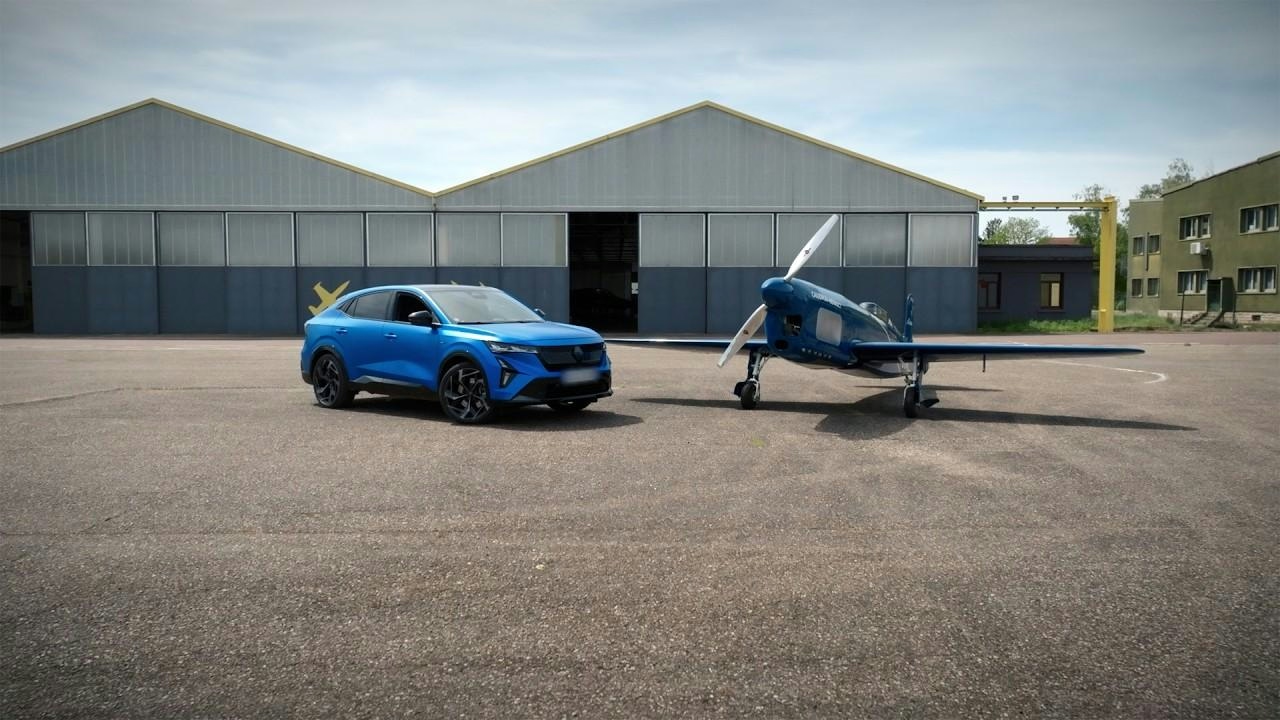
Renault Revives Its Record-Breaking Light Aircraft After Decades of Inactivity
Renault, widely recognized today for its distinctive French automobiles, has a rich history that extends beyond the automotive industry into aviation. In 1934, the Caudron-Renault Rafale C.460 set a remarkable speed record for light aircraft, reaching 314.32 miles per hour. Nearly ninety years later, Renault has resurrected this iconic plane, blending historical significance with modern engineering craftsmanship.
The Rafale name reemerged in 2023 when Renault launched its flagship coupe-style hybrid crossover. Rather than merely invoking the literal meaning of "Rafale"—a gust of wind—the company drew inspiration from the historic Caudron Rafale C.460. This aircraft was celebrated not only for its speed record but also for its success in air racing. Until now, no original C.460 remained airworthy, a gap Renault has recently addressed by unveiling a contemporary recreation of the legendary design. Although this is a modern build rather than a restored original, it pays tribute to one of the most innovative aircraft of the 1930s.
A Legacy Rooted in Early French Aviation
The origins of the Rafale trace back to Société des Avions Caudron, founded by brothers Gaston and René Caudron. As pioneers of French aviation, the Caudron brothers established a flight school and manufacturing facility in 1910. Their early aircraft, including the type A4 and the distinctive type B, set design standards that influenced many subsequent models. Their innovative approaches to fuselage construction and control systems helped shape the trajectory of French aviation and culminated in the development of the acclaimed G series by 1912.
Navigating a Competitive Modern Market
Renault’s revival of the Rafale C.460 arrives amid a period of robust growth in the business aviation sector. However, the company faces considerable challenges entering a market dominated by established manufacturers such as Bombardier and Textron Aviation, both of which maintain strong order books and entrenched positions. Textron, in particular, is intensifying its focus as a dedicated aerospace and defense company, heightening competitive pressures.
Reactions to Renault’s aircraft revival have been mixed. Aviation enthusiasts and brand loyalists have welcomed the homage to heritage and innovation, yet skepticism remains regarding the commercial viability of very light jets—a segment historically marked by profitability challenges. Competitors are likely to respond with increased marketing efforts and new product introductions to protect their market share, especially as industry leaders like Gulfstream Aerospace and Embraer continue to report strong sales and operational performance. These dynamics may overshadow niche projects such as Renault’s.
Despite these obstacles, Renault’s resurrection of the Rafale C.460 underscores the company’s innovative spirit and its willingness to revisit its diverse legacy. Whether this ambitious endeavor will secure a lasting foothold in the competitive skies remains uncertain, but for now, one of the 1930s’ most remarkable aircraft is airborne once again.

Etihad Airways Suspends Airbus A380 Flights on Key Route

Aditya Birla Group Seeks Approval for Aircraft Leasing in GIFT City

Qatar Airways Highlights Innovation and Connectivity at Arabian Travel Market 2026

Hong Kong's Five-Year Plan Includes Andrew Fan's Aircraft Parts Processing Hub Proposal

ACIA Aero Leasing Delivers ATR72-600 to Air Nostrum

RTX Appoints Jill Albertelli as Head of Pratt & Whitney

TAT Technologies Joins Beyond Aero Hydrogen Aircraft Program

AURAK Study Highlights Barriers to Air Taxi Adoption in Emerging Economies

Xiamen Air Selects Altitude for 787 Maintenance at Heathrow

Etihad and Swissport Extend Global Partnership
