
Orchestrate AI insights into action

Trending
Categories
The Dornier Do 31: The Only VTOL Jet Transport Ever Built
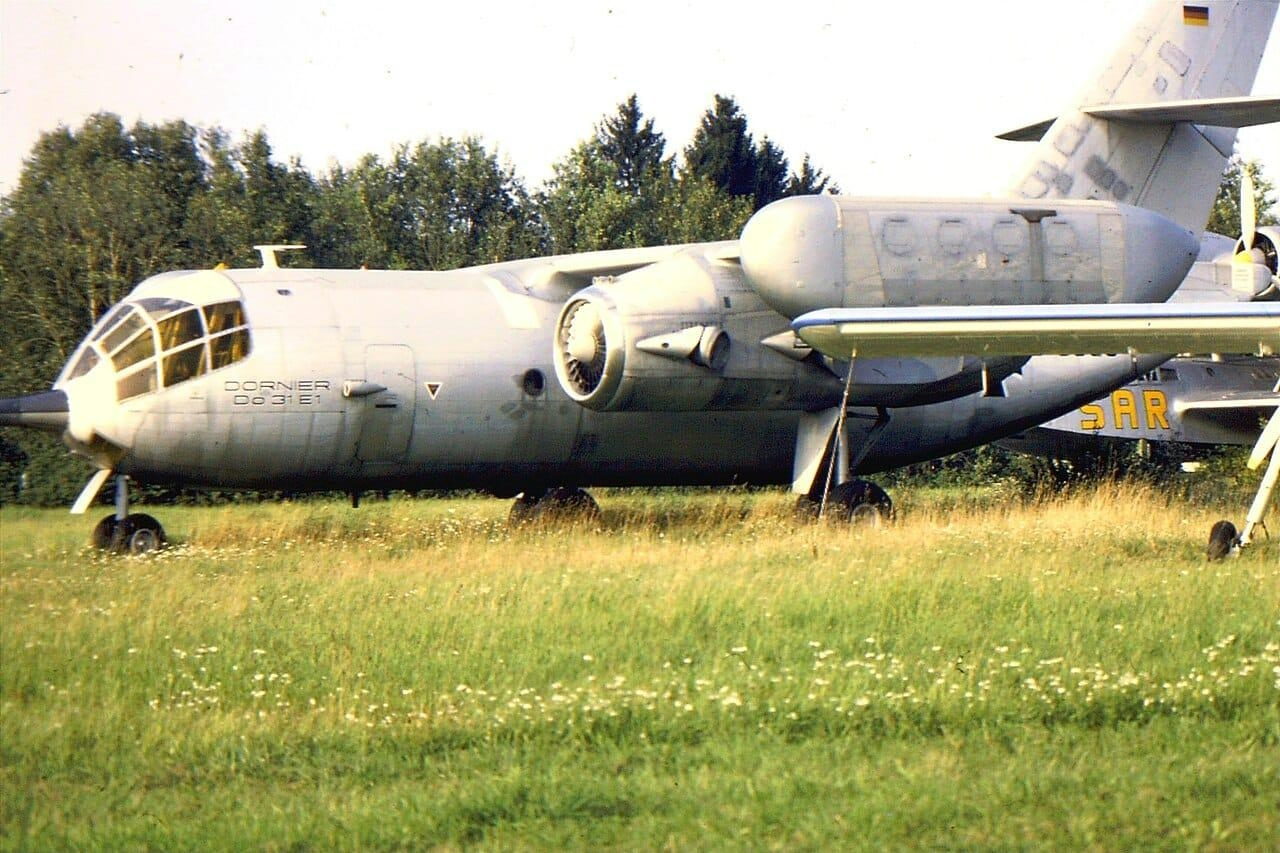
The Dornier Do 31: The Only VTOL Jet Transport Ever Built
The Dornier Do 31 remains a unique chapter in aviation history as the only jet-powered vertical takeoff and landing (VTOL) transport aircraft ever constructed. Its distinctive design featured an extraordinary total of ten engines: two Rolls-Royce Pegasus vectored-thrust turbofans, identical to those used in the Harrier jump jet, and eight additional lift jets housed in pods on the wingtips—four on each side. These lift engines were dedicated solely to vertical takeoff and landing, providing the necessary thrust to keep the 22-tonne aircraft airborne without forward motion. While the lift jets were inactive during cruise, the Pegasus engines powered the aircraft in conventional flight. The Do 31 first took to the skies in 1967, set several world records by 1969, but was ultimately cancelled in 1970. Nearly six decades later, it stands alone in its category.
Design and Specifications
The Do 31E was an experimental VTOL transport developed in West Germany during the Cold War. It was crewed by two pilots and capable of carrying 36 troops or 24 stretchers, with a useful load of approximately 3,500 kilograms. The aircraft’s maximum speed reached 730 kilometers per hour (452 miles per hour), and it had a range of 1,800 kilometers when fully loaded. The gross weight for vertical takeoff was 22,453 kilograms, increasing to a maximum of 27,422 kilograms for conventional flight. Only three airframes were built: the E1, which flew using only the Pegasus engines; the E2, a static test model; and the E3, which flew with all ten engines operational. Today, the E1 is preserved at the Dornier Museum Friedrichshafen, while the E3 is displayed at the Deutsches Museum Flugwerft Schleissheim.
Strategic Imperatives Behind the Do 31
The development of the Do 31 was deeply rooted in the strategic context of the Cold War. In 1960, West Germany was anticipated to be a primary battleground in a potential NATO–Warsaw Pact conflict. Military planners feared that airfields would be quickly rendered unusable by bombing or nuclear contamination, effectively grounding conventional aircraft. To counter this vulnerability, the German military pursued a strategy of dispersal, envisioning aircraft operating from autobahns, forest clearings, and other improvised locations. This approach led to various experimental projects, including zero-length launches of F-104 Starfighters and the supersonic VTOL fighter EWR VJ 101. Under NATO’s NBMR-4 requirement, a VTOL transport capable of operating without runways was mandated. Dornier formalized its design in 1961 under the leadership of Gustav Wieland and secured government funding the following year.
Engineering Challenges and Operational Complexity
Operating an aircraft powered by ten separate jet engines presented formidable engineering and piloting challenges. While generating sufficient lift was achievable by simply adding more engines, controlling the aircraft during hover was complicated by the interaction of sixteen distinct jets of hot exhaust gas—eight lift jets producing vertical thrust and two vectored-thrust engines. These “fountains” of hot gas created complex aerodynamic effects that demanded precise management to maintain stability and safety during vertical takeoff and landing.
Legacy and Influence on Modern VTOL Development
Despite its groundbreaking achievements, the Do 31 was ultimately hampered by excessive fuel consumption, which severely limited its payload capacity and operational range. These practical limitations contributed to the program’s cancellation in 1970. Since then, the landscape of VTOL aviation has evolved significantly. Contemporary efforts focus on electric and hybrid-electric VTOL (eVTOL) aircraft, driven by stringent environmental regulations and the global push toward carbon neutrality. These new technologies promise near-zero emissions and reduced noise levels, addressing critical challenges such as urban air congestion.
However, scaling eVTOL technology to accommodate larger transport aircraft remains a significant hurdle, as energy requirements and propulsion complexity increase exponentially with size. The future of vertical flight now depends heavily on government policies, incentives, and public-private partnerships to stimulate demand and develop the necessary infrastructure. The Dornier Do 31, once a solitary technological experiment, now serves as a historical touchstone informing the pursuit of cleaner, quieter, and more sustainable VTOL solutions.

Etihad Airways Suspends Airbus A380 Flights on Key Route

Aditya Birla Group Seeks Approval for Aircraft Leasing in GIFT City

Qatar Airways Highlights Innovation and Connectivity at Arabian Travel Market 2026

Hong Kong's Five-Year Plan Includes Andrew Fan's Aircraft Parts Processing Hub Proposal

ACIA Aero Leasing Delivers ATR72-600 to Air Nostrum

RTX Appoints Jill Albertelli as Head of Pratt & Whitney

TAT Technologies Joins Beyond Aero Hydrogen Aircraft Program

AURAK Study Highlights Barriers to Air Taxi Adoption in Emerging Economies

Xiamen Air Selects Altitude for 787 Maintenance at Heathrow

Etihad and Swissport Extend Global Partnership
