
Orchestrate AI insights into action

Trending
Categories
The Exploration Company Uses Siemens Xcelerator Software to Advance Reusable Spacecraft Development
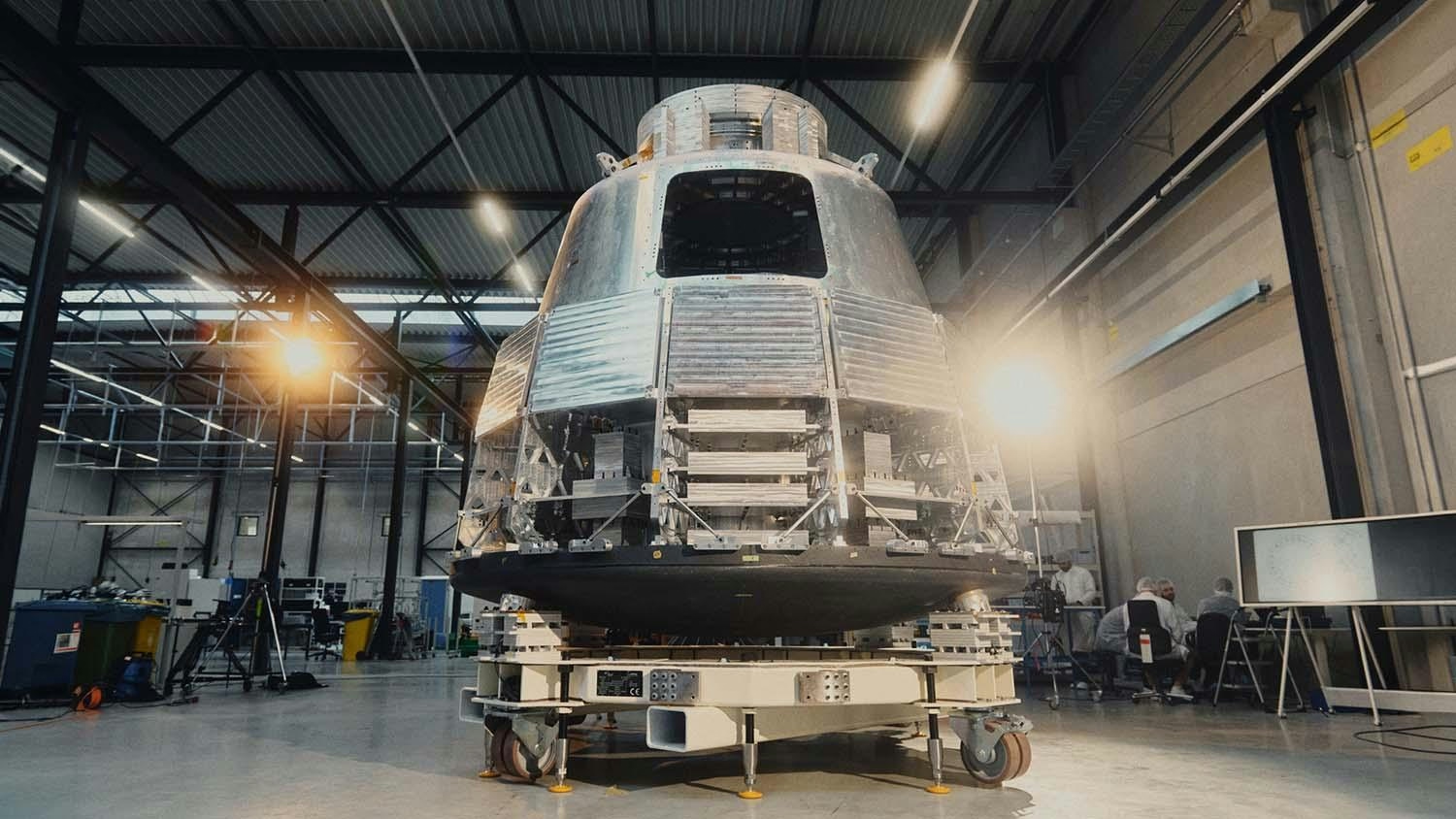
The Exploration Company Advances Reusable Spacecraft Development with Siemens Xcelerator Software
BERLIN — German aerospace startup The Exploration Company has integrated Siemens Xcelerator software into its engineering processes to accelerate the development of its reusable spacecraft. This strategic adoption aims to enhance collaboration and operational efficiency as the company scales its space transportation program amid a competitive and rapidly evolving market dominated by established aerospace players. The initiative addresses the significant technical and financial challenges inherent in advancing reusable spaceflight technologies.
Founded in 2021, The Exploration Company is focused on developing the Nyx family of reusable spacecraft and propulsion systems, designed to transport cargo—and eventually crew—to destinations in Earth orbit and beyond. The company’s launcher-agnostic design philosophy enables its spacecraft to be compatible with multiple launch vehicles, providing operators with greater flexibility in selecting launch providers.
Integrated Digital Engineering Environment
The Exploration Company employs a suite of Siemens Xcelerator tools, including Designcenter for mechanical engineering, Simcenter for simulation, Capital for electrical systems design, and Teamcenter for product lifecycle management. This integrated digital environment unifies mechanical, electrical, and simulation engineering disciplines into a single source of product data. As a result, modifications in one area are automatically synchronized across related models, reducing rework and enhancing configuration management throughout the design evolution.
A central feature of the Siemens platform is the creation of a digital twin—a comprehensive virtual representation of the spacecraft that merges design models with engineering simulations. This digital twin enables engineers to predict system interactions under real-world conditions, identify integration challenges early in the development cycle, and mitigate the risk of costly late-stage design changes. Furthermore, it supports the traceability requirements essential for aerospace certification processes.
Addressing Complexity and Supporting Rapid Development
Modern spacecraft incorporate a multitude of complex subsystems, ranging from mechanical structures to electrical architectures and thermal management systems. The Exploration Company leverages advanced simulation tools to evaluate system performance prior to manufacturing, thereby improving mission assurance and facilitating the early resolution of potential issues.
The Siemens software suite is instrumental in supporting the ongoing development of the Nyx spacecraft family, initially targeting cargo transport to low Earth orbit with plans to expand into crewed missions. The company’s engineering approach has already demonstrated rapid progress; its Mission Bikini orbital demonstration capsule advanced from concept to flight hardware within nine months. As future spacecraft designs grow larger and more complex, the integrated digital engineering environment is expected to be critical in maintaining this accelerated development pace.
Daniel Prudente Martins, principal EWIS and electrical interfaces engineer for Nyx Avionics at The Exploration Company, emphasized the impact of the collaboration: “Our mission is to make space more accessible through reusable technology. Working with Siemens and adopting its industrial software is helping us connect our engineering processes, reduce rework, accelerate development, and streamline manufacturing as we scale our operations.”
Navigating Market and Technical Challenges
Despite the advantages offered by Siemens Xcelerator, The Exploration Company continues to face significant challenges. Securing substantial funding, competing against established industry leaders such as SpaceX, and navigating complex regulatory frameworks remain critical hurdles. Recent setbacks in the industry, including SpaceX’s aborted Starship V3 launch, highlight the technical difficulties associated with developing reusable spacecraft and may influence investor sentiment and funding strategies.
The company’s progress has attracted increased interest from investors and government agencies, while competitors are expected to intensify efforts to advance their own technologies and market positions. As the race for reusable space transportation accelerates, digital engineering tools are becoming indispensable for startups striving to innovate and compete on the global stage.

Etihad Deploys Widebody Fleet to Meet Strong Demand

Korean Air Finalizes $36.2 Billion Deal with Boeing

Australia’s RFDS Queensland Section Orders Six King Air 260Cs

Korean Air Finalizes Order for 103 Boeing Jets and Engines

Embraer E195-E2 Features Distinctive Engine Placement Among Regional Jets

What Passengers Can Expect on Boeing’s New 777X Jet

How Ethiopian Airlines Became Africa’s Leading Carrier Amid Gulf Competition

Joby Aviation Extends Autonomous Flight Capabilities with Cross-Country Tour
Strengthening Europe's Aviation Supply Chain Amid Uncertainty
The Evolution of the Aircraft Maintenance Engineer Role
