
Orchestrate AI insights into action

Trending
Categories
The PD-35 Engine Operates Without a Gearbox
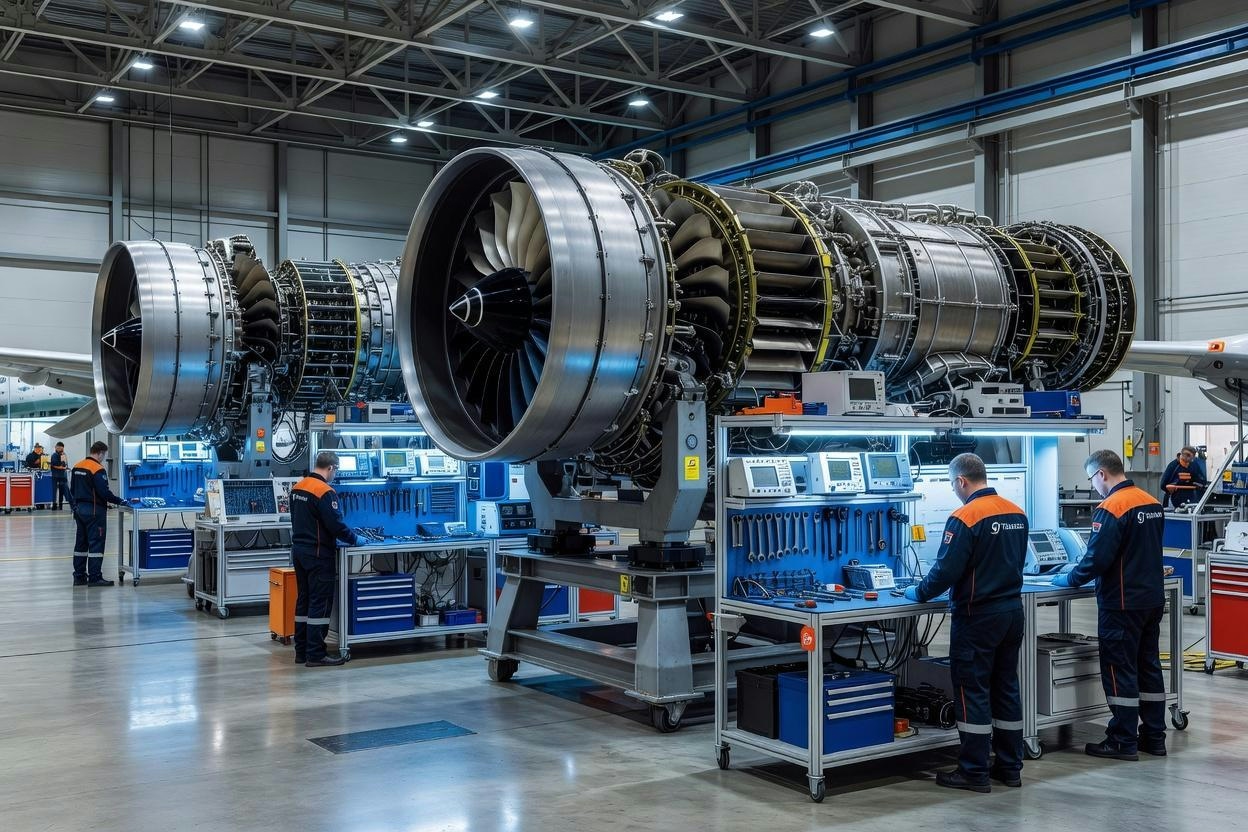
The PD-35 Engine Operates Without a Gearbox
Engineering Challenges of High-Power Transmission
Geared turbofan engines have long been recognized for their ability to enhance fuel efficiency by allowing the turbine to operate at high rotational speeds while the large fan turns more slowly at its optimal rate. This principle underpins Pratt & Whitney’s PW1000G family, where a gearbox facilitates the differing rotational speeds of the turbine and fan. However, Russia’s new PD-35 engine adopts a fundamentally different approach by eliminating the gearbox altogether and employing a direct drive system.
Alexander Inozemtsev, General Designer at ODK-Aviadvigatel, highlights the significant engineering difficulties involved in transmitting power levels of approximately 50 megawatts or more through a gearbox. According to the technical publication Pervy Tekhnichesky, the immense energy passing through the gears inevitably results in heat losses that cannot be mitigated simply by increasing the gearbox size. This thermal challenge introduces complex cooling requirements, which add weight and complicate the overall engine design.
Design Considerations and Comparisons
In traditional turbofan engines, the fan is directly connected to the turbine, causing both components to rotate at the same speed. Optimal efficiency, however, is achieved when the fan spins more slowly to improve thrust and reduce noise, while the turbine operates at higher speeds. Gearboxes enable this decoupling of rotational speeds, as demonstrated by Pratt & Whitney’s PW1100G and PW1400G engines. Yet, for super-heavy engines like the PD-35—designed to deliver 35 to 40 tons of thrust with a fan nearly three meters in diameter—the gearbox solution becomes less viable.
At power outputs exceeding tens of megawatts, even the most efficient gearboxes generate substantial heat that must be continuously dissipated. The cooling systems required to manage this heat increase the engine’s weight and complexity. To circumvent these issues, the PD-35’s designers opted for a direct drive configuration, thereby eliminating the gearbox and its associated thermal and mechanical challenges.
This design philosophy is shared by the American GE9X engine, developed for the Boeing 777X. With a fan diameter of approximately 3.4 meters, General Electric also chose to forgo a gearbox. Both the PD-35 and GE9X engines achieve high bypass ratios—11:1 for the PD-35 and about 10:1 for the GE9X—enhancing fuel efficiency during cruise by directing most airflow through the outer duct where the fan generates thrust.
Trade-offs and Industry Implications
Operating without a gearbox presents both advantages and drawbacks. The absence of a gearbox reduces mechanical complexity and potential failure points, which some industry experts consider beneficial. However, this design can lead to increased engine weight and may limit efficiency improvements compared to geared turbofans. The decision to eliminate the gearbox in the PD-35 was driven not by simplicity or cost considerations but by the unique challenges of transmitting extremely high power levels.
Market responses to this design choice have been mixed. While some stakeholders appreciate the reduced mechanical complexity, others express concerns regarding potential impacts on engine performance and reliability. This divergence may prompt competitors to explore alternative solutions for managing similar engineering challenges, potentially accelerating innovation in engine design and propulsion technologies.
The PD-35’s direct drive configuration thus represents a carefully calibrated compromise among efficiency, reliability, and engineering feasibility for next-generation, high-thrust engines. As the aerospace industry advances, the ongoing debate between gearbox and direct drive architectures is poised to influence the future trajectory of propulsion system development.

Etihad Deploys Widebody Fleet to Meet Strong Demand

Korean Air Finalizes $36.2 Billion Deal with Boeing

Australia’s RFDS Queensland Section Orders Six King Air 260Cs

Korean Air Finalizes Order for 103 Boeing Jets and Engines

Embraer E195-E2 Features Distinctive Engine Placement Among Regional Jets

What Passengers Can Expect on Boeing’s New 777X Jet

How Ethiopian Airlines Became Africa’s Leading Carrier Amid Gulf Competition

Joby Aviation Extends Autonomous Flight Capabilities with Cross-Country Tour

Strengthening Europe's Aviation Supply Chain Amid Uncertainty

The Evolution of the Aircraft Maintenance Engineer Role
