
Orchestrate AI insights into action

Trending
Categories
United Airlines Proposes Using AI to Explain Flight Delays
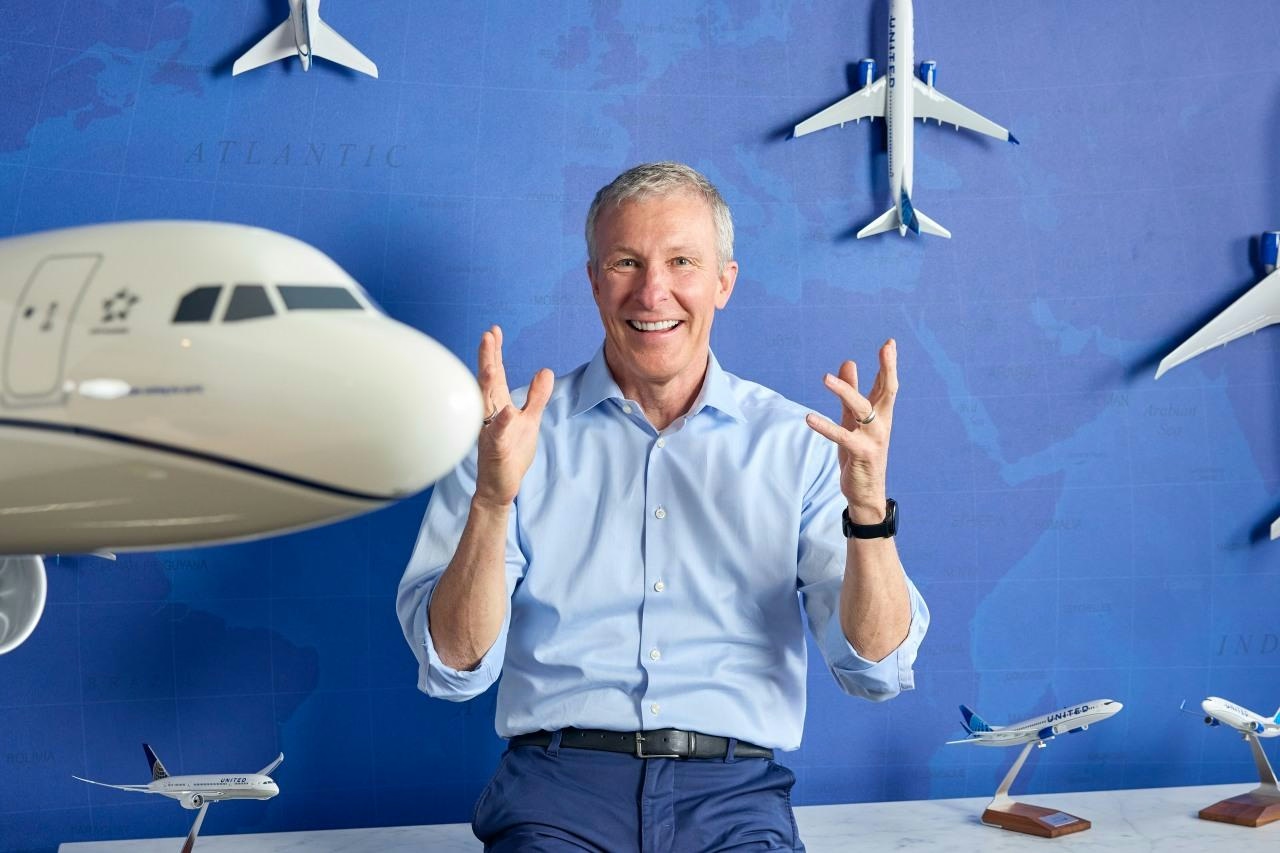
United Airlines Proposes AI-Driven Transparency for Flight Delays
United Airlines has announced an ambitious plan to leverage artificial intelligence (AI) and maintenance footage to enhance communication with passengers during flight delays. The initiative, revealed by CEO Scott Kirby at Bernstein’s 42nd Annual Strategic Decisions Conference, forms part of a broader investment in technology aimed at fostering customer loyalty and increasing transparency during irregular operations.
Enhancing Passenger Communication Through AI
Kirby highlighted that the uncertainty surrounding delays often causes more frustration than the delays themselves. United’s objective is to provide passengers with clear, straightforward explanations whenever a flight is delayed. The airline intends to send videos detailing maintenance issues alongside AI-generated updates that precisely describe the status of each flight. Kirby emphasized that the communication approach is designed to be as informative as if he were personally seeking updates while onboard.
While United has already improved the detail and frequency of delay notifications, Kirby acknowledged the complexity of scaling such communication across its extensive network of approximately 6,000 daily flights. Unpredictable factors such as severe weather and airport closures further complicate these efforts. Nonetheless, he asserted that United is currently “two to three times better than any other airline in the world” at keeping passengers informed, attributing this to years of system modernization and data organization.
Developing Real-Time, Automated Flight Updates
Looking ahead, United is developing a proprietary AI system capable of delivering real-time, flight-specific updates without human intervention. By harnessing vast operational data, this technology aims to reduce passenger uncertainty and improve the overall travel experience by providing timely and accurate information on flight status.
However, the rollout of these AI-driven tools faces challenges amid ongoing operational difficulties, including recent flight reductions at Chicago’s O’Hare International Airport due to Federal Aviation Administration (FAA) restrictions. These constraints may complicate the implementation of new communication technologies. Furthermore, the airline’s approach is expected to attract regulatory scrutiny, particularly concerning the accuracy and dependability of automated updates.
Industry Implications and Passenger Reception
Market response to United’s proposal is likely to be mixed. While some travelers may welcome enhanced transparency and prompt information, others remain cautious about AI’s capacity to address the underlying causes of delays or to provide genuinely useful updates. Building trust in automated communication systems remains a significant hurdle.
United’s initiative is also poised to influence the competitive landscape. Rival carriers, including American Airlines, may accelerate their own efforts to improve communication strategies or develop advanced AI tools, potentially intensifying competition in how airlines manage and explain delays to customers.
As United advances its AI-powered communication strategy, the airline is betting that delivering better information through innovative technology will distinguish it in an industry where uncertainty and passenger frustration are persistent challenges.

Etihad Airways Suspends Airbus A380 Flights on Key Route

Aditya Birla Group Seeks Approval for Aircraft Leasing in GIFT City

Qatar Airways Highlights Innovation and Connectivity at Arabian Travel Market 2026

Hong Kong's Five-Year Plan Includes Andrew Fan's Aircraft Parts Processing Hub Proposal

ACIA Aero Leasing Delivers ATR72-600 to Air Nostrum

RTX Appoints Jill Albertelli as Head of Pratt & Whitney

TAT Technologies Joins Beyond Aero Hydrogen Aircraft Program

AURAK Study Highlights Barriers to Air Taxi Adoption in Emerging Economies

Xiamen Air Selects Altitude for 787 Maintenance at Heathrow

Etihad and Swissport Extend Global Partnership
