
Orchestrate AI insights into action

Trending
Categories
Vertiport Breakthrough Could Unlock Urban Electric Air Taxis
Vertiport Breakthrough Could Unlock Urban Electric Air Taxis
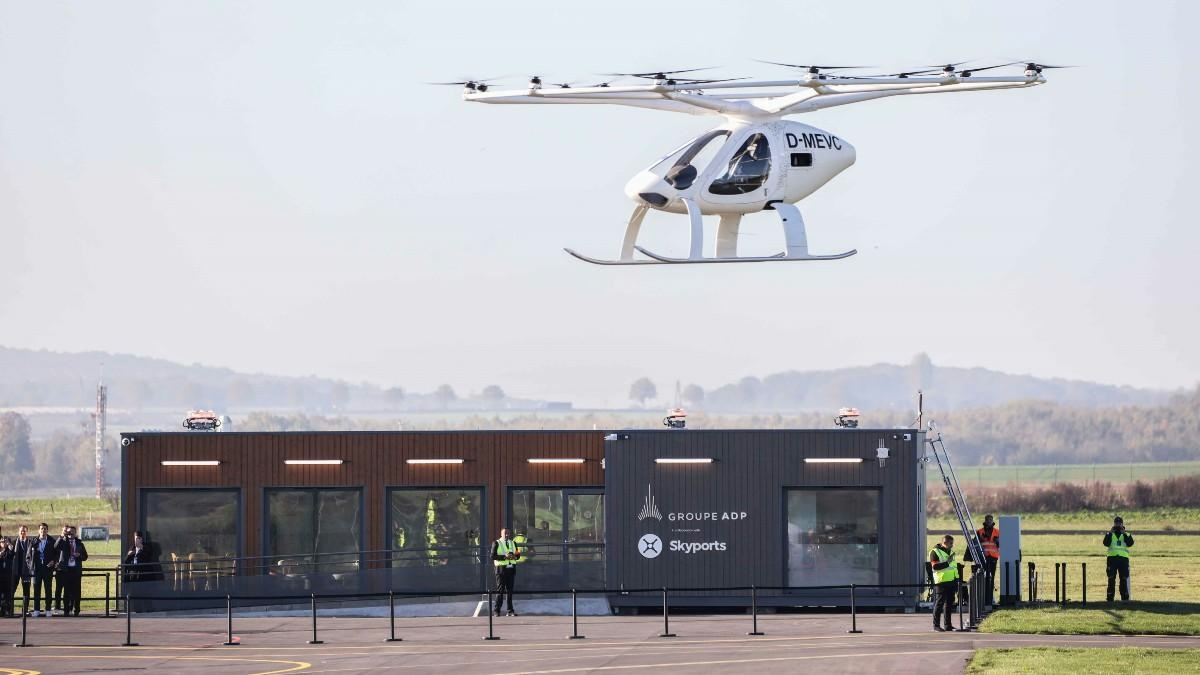
The development of electric vertical takeoff and landing (eVTOL) aircraft has attracted substantial private investment, driven by the vision of on-demand, point-to-point air travel that could revolutionize urban mobility. Recently, Joby Aviation’s electric air taxi completed a series of demonstration flights across New York City’s heliports and John F. Kennedy International Airport, underscoring the growing momentum within the sector.
Infrastructure Challenges and Aeroberm’s Innovation
Despite technological advances, the widespread adoption of urban air taxis remains hindered by a critical obstacle: the lack of dedicated takeoff and landing infrastructure. Without purpose-built vertiports—electrified hubs specifically designed for eVTOL operations—these aircraft are confined to existing helipads and airport facilities. This limitation restricts their operational flexibility and reduces their potential impact, effectively relegating them to the role of advanced helicopters. The construction of vertiports is often prohibitively expensive, and insurers remain cautious about the risks associated with emerging aviation technologies.
Addressing this challenge, Australia-based Aeroberm recently announced the commercial launch of its modular vertipad technology. Designed for rapid installation on a variety of rooftop environments, Aeroberm’s system offers a scalable solution to vertiport deployment. The company has extended its technology to participants in the Federal Aviation Administration’s (FAA) forthcoming eVTOL Integration Pilot Program (eIPP), a three-year flight test initiative scheduled to commence later this year.
Aeroberm’s vertipad distinguishes itself through its compact footprint and modular, off-the-shelf design, directly tackling key industry concerns such as safety, accessibility, and cost. The system is aircraft-agnostic, capable of accommodating eVTOL models from a range of manufacturers including Joby Aviation, Archer Aviation, Beta Technologies, and Boeing’s Wisk Aero. While many companies have pursued bespoke vertiport agreements with airports and fixed-base operators (FBOs), Aeroberm proposes a streamlined and scalable alternative that could accelerate infrastructure deployment.
Addressing Safety Through Fractal Panel Technology
A pivotal innovation of Aeroberm’s system lies in its ability to mitigate the intense downwash and outwash generated by eVTOL rotors during takeoff and landing. These powerful airflows pose significant safety risks to nearby individuals and structures. Recent FAA research indicates that some eVTOL models produce outwash speeds reaching 60 miles per hour at 100 feet, substantially exceeding the agency’s safety threshold of 34.5 miles per hour at a vertiport’s boundary, as specified in Engineering Brief 105A (EB 105A). Traditionally, developers have faced a difficult choice: construct large vertiports to dissipate airflow or devise methods to reduce wind speeds at ground level.
Aeroberm’s solution is a fractal panel technology unveiled this week. Drawing on mathematical principles, the system employs a self-similar arrangement of vanes at multiple scales, capturing and redirecting vortices of varying sizes. This design disrupts air columns and channels their energy downward beneath an elevated steel pad, effectively absorbing the force and enhancing operational safety.
The Road Ahead for Urban Air Mobility
Despite these technological advancements, the path to commercial urban air taxis remains complex. Regulatory challenges, particularly the FAA’s stringent certification process, continue to pose significant hurdles for companies such as Joby Aviation. Infrastructure development—including the establishment of charging networks and vertiport deployment—must progress in tandem with aircraft innovation. Public acceptance also remains a critical factor, as communities weigh the potential benefits against concerns related to noise, safety, and integration within urban environments.
Market response to these developments has been largely positive, with major cities expressing keen interest in solutions that could reduce commute times and alleviate congestion. As Aeroberm’s breakthrough gains attention, competitors are expected to intensify their own development and testing efforts, accelerating the race to transform urban air taxis from futuristic concepts into operational realities.

Etihad Airways Suspends Airbus A380 Flights on Key Route

Aditya Birla Group Seeks Approval for Aircraft Leasing in GIFT City

Qatar Airways Highlights Innovation and Connectivity at Arabian Travel Market 2026

Hong Kong's Five-Year Plan Includes Andrew Fan's Aircraft Parts Processing Hub Proposal

ACIA Aero Leasing Delivers ATR72-600 to Air Nostrum

RTX Appoints Jill Albertelli as Head of Pratt & Whitney

TAT Technologies Joins Beyond Aero Hydrogen Aircraft Program

AURAK Study Highlights Barriers to Air Taxi Adoption in Emerging Economies

Xiamen Air Selects Altitude for 787 Maintenance at Heathrow

Etihad and Swissport Extend Global Partnership
