
Orchestrate AI insights into action

Trending
Categories
Vietnam Airlines Plans to Acquire Up to 30 Wide-Body Aircraft
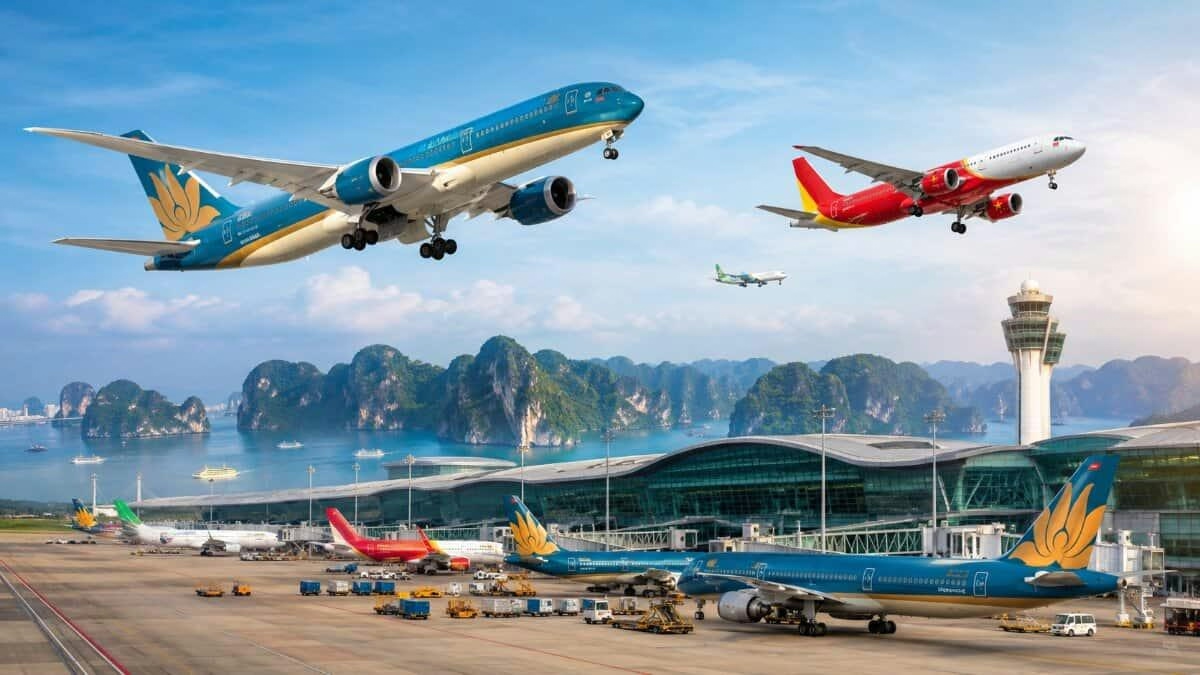
Vietnam Airlines Plans Major Fleet Expansion with Up to 30 Wide-Body Aircraft
Vietnam Airlines has announced plans to acquire up to 30 new wide-body aircraft as part of a comprehensive fleet modernization and expansion strategy. Chairman Dang Ngoc Hoa revealed that the airline is currently preparing an investment proposal for submission to regulatory authorities and is engaged in discussions with Boeing, Airbus, and international aircraft lessors. The acquisition strategy is expected to involve a combination of purchases and leases to meet future capacity requirements.
This planned wide-body expansion complements an existing order for 50 next-generation Boeing narrow-body jets, which are scheduled for delivery between 2030 and 2032. To address more immediate capacity needs, Vietnam Airlines also intends to lease approximately 20 narrow-body aircraft during 2027 and 2028. The airline’s current fleet comprises around 105 aircraft, including 31 wide-body jets.
Strategic Rationale and Industry Context
Chairman Hoa emphasized that the global aviation industry continues to face aircraft shortages in the aftermath of the COVID-19 pandemic, making early negotiations with manufacturers and lessors essential to securing future capacity. The planned fleet upgrades aim to modernize Vietnam Airlines’ aircraft, improve fuel efficiency, reduce emissions, and strengthen the carrier’s competitiveness on international routes.
Despite these ambitions, the expansion faces significant challenges, particularly in securing adequate financing. Recently, Vietnam Airlines obtained a $2.9 billion loan from the Export-Import Bank of the United States to support its Boeing 737 Max 8 orders, highlighting the substantial investment required for fleet renewal. The airline’s expansion plans also come amid intensifying competition, with global carriers such as American Airlines considering wide-body orders to keep pace with rivals like Delta and United. Regionally, competitors including Sun PhuQuoc Airways are expanding their fleets and networks to capitalize on growing leisure travel demand, potentially increasing market pressures.
Network Growth and Market Focus
Chief Executive Le Hong Ha highlighted the airline’s recent network expansion, noting new or announced routes to Amsterdam, Phuket, and Colombo in the first half of the year. Additionally, Vietnam Airlines has increased frequencies to destinations such as Singapore, Manila, Moscow, Kaohsiung, Melbourne, and Sydney. The airline plans to prioritize long-haul markets in Europe and Australia while continuing to expand services across Northeast Asia, Southeast Asia, India, and China.
Ha reported strong demand on European routes, with seat occupancy rates reaching approximately 91 percent, partly due to service suspensions by some Middle Eastern carriers amid regional conflicts. Vietnam Airlines intends to maintain its focus on business travelers, international passengers, and frequent flyers. Meanwhile, its subsidiaries Pacific Airlines and VASCO will continue to serve more price-sensitive market segments.
As Vietnam Airlines advances its fleet expansion, the carrier seeks to secure the capacity necessary for sustained growth while navigating financial constraints and heightened competition in a rapidly evolving global aviation environment.

Etihad Deploys Widebody Fleet to Meet Strong Demand

Korean Air Finalizes $36.2 Billion Deal with Boeing

Australia’s RFDS Queensland Section Orders Six King Air 260Cs

Korean Air Finalizes Order for 103 Boeing Jets and Engines

Embraer E195-E2 Features Distinctive Engine Placement Among Regional Jets

What Passengers Can Expect on Boeing’s New 777X Jet

How Ethiopian Airlines Became Africa’s Leading Carrier Amid Gulf Competition

Joby Aviation Extends Autonomous Flight Capabilities with Cross-Country Tour
Strengthening Europe's Aviation Supply Chain Amid Uncertainty

The Evolution of the Aircraft Maintenance Engineer Role
