
Orchestrate AI insights into action

Trending
Categories
X-BAT: The AI-Powered Jet Transforming Military Aviation
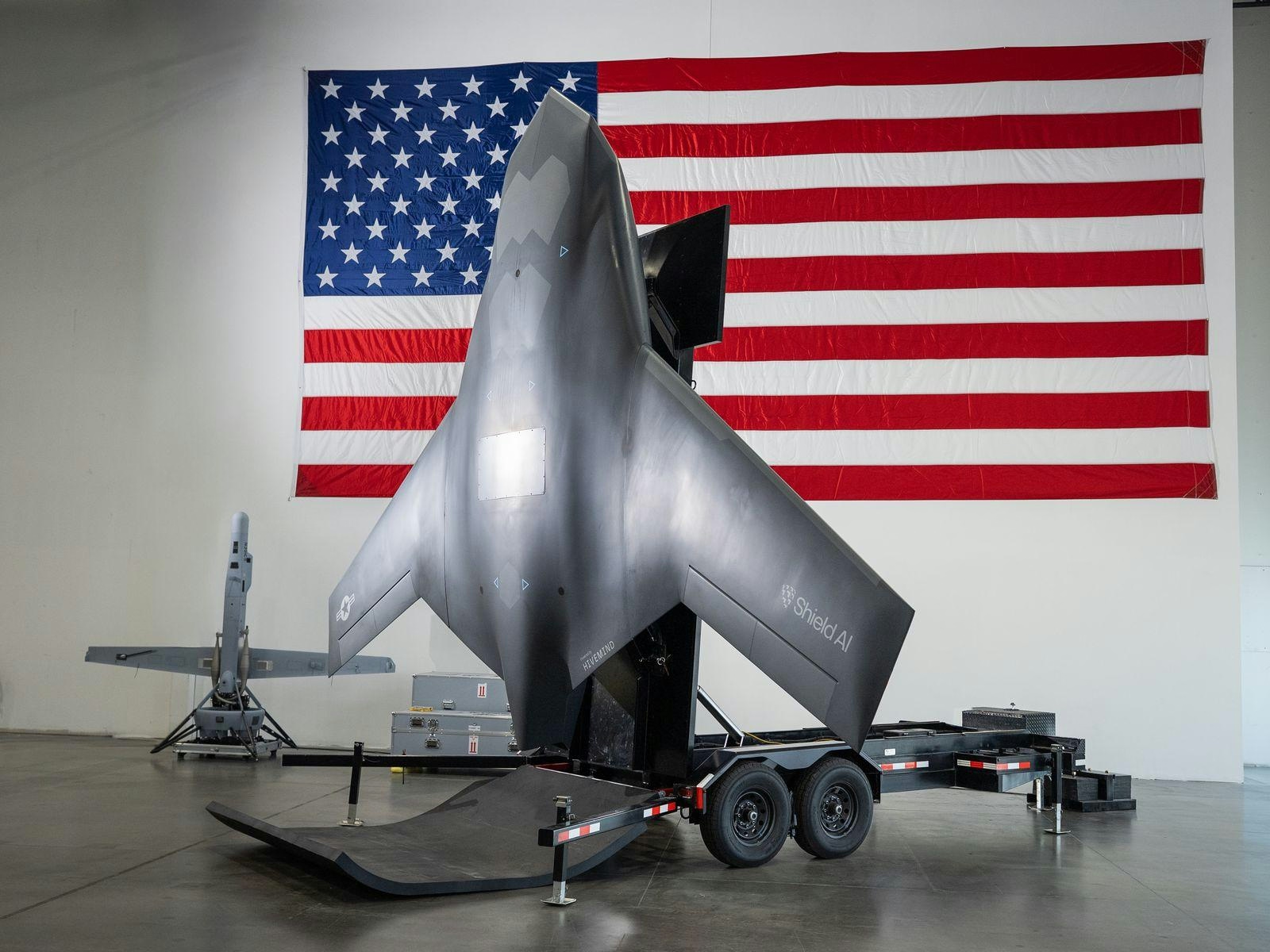
X-BAT: The AI-Powered Jet Transforming Military Aviation
Shield AI has introduced the X-BAT, the world’s first AI-powered fighter jet capable of vertical takeoff and landing (VTOL) without the need for a pilot or runway. This unmanned aircraft represents a significant advancement in military aviation, offering autonomous operations that can be launched from virtually any location—whether an aircraft carrier, remote outpost, or improvised landing zone. By eliminating the dependence on traditional airstrips, the X-BAT expands the strategic and tactical possibilities for air combat deployment.
Redefining Air Combat with Autonomy and Flexibility
The X-BAT’s VTOL capability enables it to ascend vertically like a helicopter before transitioning to high-speed jet flight, effectively merging the maneuverability of drones with the speed and firepower of modern fighter jets. Central to its operation is Shield AI’s proprietary “Hivemind” software, which allows the aircraft to function independently even in environments where GPS signals are jammed or communications are disrupted. This autonomy surpasses conventional remote piloting, empowering the X-BAT to make mission-critical decisions autonomously if contact with human operators is lost.
Shield AI’s design philosophy for the X-BAT rests on four key pillars: VTOL capability, extended operational range, multirole combat functionality, and full-spectrum autonomy encompassing both air and digital domains. These attributes position the jet as a versatile asset capable of conducting operations deep behind enemy lines, particularly in contested or electronically denied airspace. According to Shield AI, the X-BAT is engineered to provide robust air support to ground forces regardless of their location.
Strategic and Market Implications
The X-BAT’s ability to operate without runways could fundamentally reshape the strategic landscape of military aviation. Its compact design allows three X-BATs to occupy the space of a single legacy fighter, enabling higher sortie rates and reducing logistical burdens. This flexibility permits military forces to project air power from previously inaccessible locations such as isolated islands or temporary helipads, potentially transforming the geography of air combat operations.
Entering a market dominated by established defense contractors, the X-BAT is poised to provoke mixed reactions within the industry. While some may regard it as a revolutionary leap in military technology, others may express caution regarding the integration of advanced AI systems and the overall cost-effectiveness of such platforms. The introduction of the X-BAT is likely to accelerate competitors’ efforts to develop their own autonomous and AI-powered aircraft, intensifying the race for technological dominance in military aviation.
Furthermore, the X-BAT’s combination of multirole and VTOL capabilities may disrupt traditional supplier dynamics, compelling rival manufacturers to innovate and adapt to the evolving demands of modern warfare. As armed forces worldwide assess the potential of AI-driven jets, the X-BAT stands at the forefront of a new era in which autonomy, operational flexibility, and rapid deployment could redefine the future of air combat.

Etihad Airways Suspends Airbus A380 Flights on Key Route

Aditya Birla Group Seeks Approval for Aircraft Leasing in GIFT City

Qatar Airways Highlights Innovation and Connectivity at Arabian Travel Market 2026

Hong Kong's Five-Year Plan Includes Andrew Fan's Aircraft Parts Processing Hub Proposal

ACIA Aero Leasing Delivers ATR72-600 to Air Nostrum

RTX Appoints Jill Albertelli as Head of Pratt & Whitney

TAT Technologies Joins Beyond Aero Hydrogen Aircraft Program

AURAK Study Highlights Barriers to Air Taxi Adoption in Emerging Economies

Xiamen Air Selects Altitude for 787 Maintenance at Heathrow

Etihad and Swissport Extend Global Partnership
