Изображение

Превращайте аналитические выводы ИИ в реальные действия

Присоединяйтесь к списку ожидания AeroGenie уже сегодня!

В тренде

Categories

Boeing 777X Composite Wing Costs $2 Billion, Rivaling Airbus A330neo Development
September 7, 2026By ePlane AI
Boeing 777X Composite Wing Costs $2 Billion, Rivaling Airbus A330neo Development
0
0
Boeing 777X
Composite Wing
Airbus A330neo

Boeing 777X Composite Wing Costs $2 Billion, Rivaling Airbus A330neo Development

Contrasting Approaches to Widebody Modernization

The Boeing 777 and Airbus A330 have long stood as pillars of the widebody aircraft market, both introduced in the 1990s and forming the backbone of numerous global fleets. While only select variants such as the A330-300 and 777-200/200ER directly competed, both aircraft families have recently faced increasing pressure from newer, more technologically advanced widebodies. In response, Airbus and Boeing have pursued markedly different strategies to refresh their flagship models.

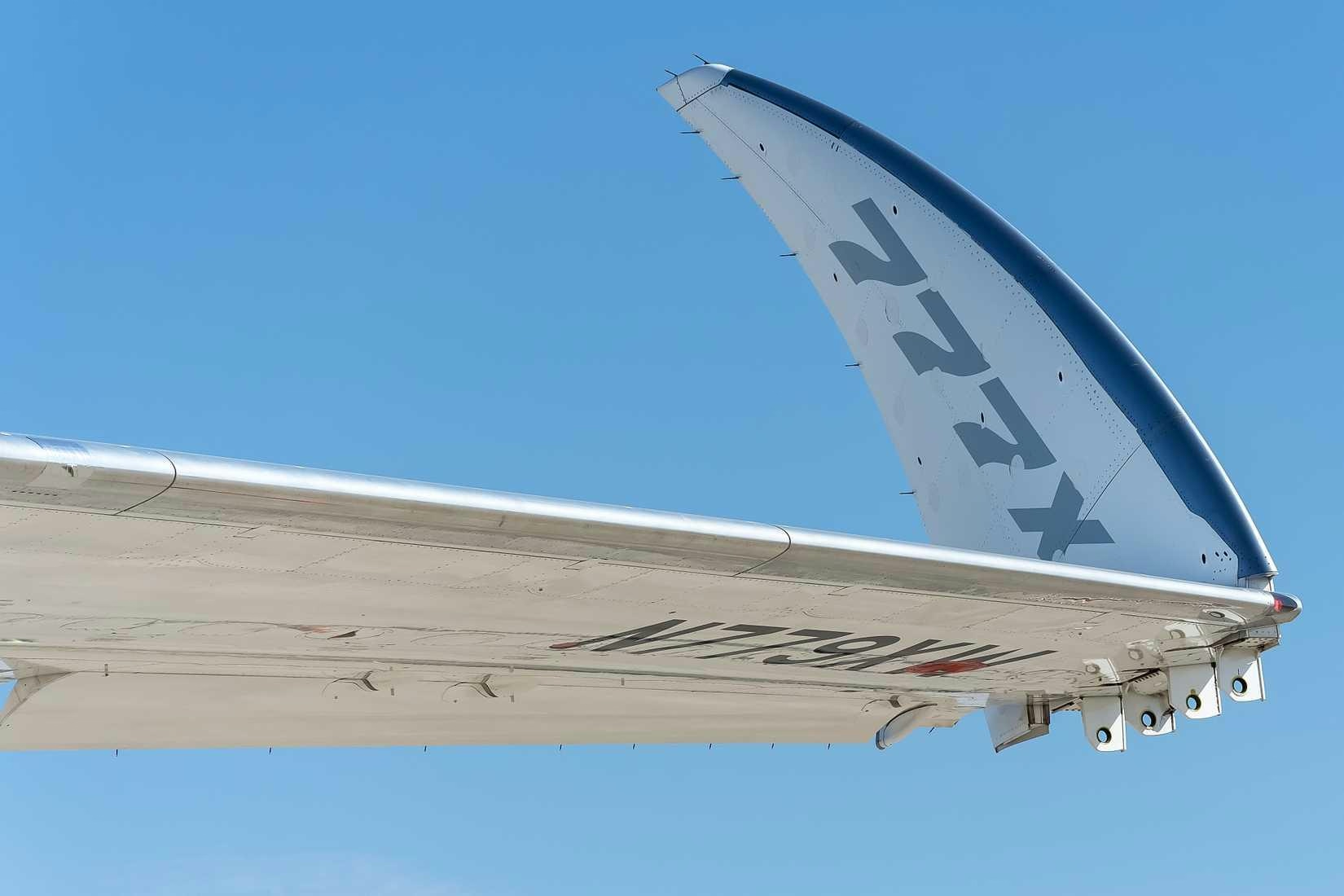
Airbus chose a cost-effective approach with the A330neo, targeting airlines seeking lower acquisition and operating costs while positioning the aircraft to compete with Boeing’s 787. Boeing, by contrast, embarked on a comprehensive redesign with the 777X, incorporating significant technological advancements. Central to this effort was the development of a new carbon fiber reinforced polymer wing, a project that alone has cost approximately $2 billion—an amount roughly equivalent to the entire development budget of the A330neo program.

Technological Innovations and Program Challenges

The 777X, now in its third generation, features a composite wing with a record-breaking span of 235 feet, 5 inches (71.75 meters), the widest ever produced for a Boeing airliner. To comply with airport infrastructure constraints, the aircraft incorporates folding wingtips that reduce the wingspan to 212 feet, 9 inches (64.85 meters) when on the ground. Powered by the General Electric GE9X—the largest commercial turbofan engine ever built—the 777X also boasts an updated Boeing Sky Interior and a cockpit design inspired by the 787. The 777-9 variant, measuring 251 feet, 9 inches (76.7 meters) in length, holds the distinction of being the longest commercial airliner ever produced.

Despite securing over 600 orders, the 777X program has experienced significant delays, with first deliveries now anticipated in 2027, seven years behind the original schedule. These setbacks have driven total development costs beyond $15 billion, and Boeing has yet to realize substantial revenue from the program. The complexity and expense associated with composite manufacturing technology have been major contributing factors to these challenges. Both Boeing and Airbus continue to invest heavily in accelerating composite production to meet evolving market demands.

Airbus has encountered its own difficulties with the A330neo, which, as a lighter refresh of its predecessor, has faced production delays primarily due to quality issues with the horizontal tail plane. Both manufacturers are navigating the challenges posed by advanced materials and the imperative to streamline manufacturing processes in an increasingly competitive environment.

Shifting Market Dynamics and Emerging Competitors

The competitive landscape of long-haul aviation is further evolving with the emergence of new players. China’s COMAC C919 recently completed its first international flight, signaling ambitions to challenge the longstanding Airbus-Boeing duopoly. However, the C919 remains heavily reliant on foreign components and has yet to secure certification from major aviation regulators, limiting its immediate impact on the global market.

Meanwhile, the era of the superjumbo appears to be waning. The Airbus A380, once the world’s largest passenger aircraft, is experiencing declining utilization as airlines grapple with rising maintenance costs and parts shortages. This trend underscores the industry’s shift toward more efficient, next-generation widebodies.

In this rapidly changing environment, both Boeing and Airbus face mounting pressure to deliver innovation while controlling costs, as new entrants and evolving airline requirements continue to reshape the future of long-haul aviation.

More news
Can Archer's Multi-City Flight Tour Strengthen Commercial Readiness?

Can Archer's Multi-City Flight Tour Strengthen Commercial Readiness?

Can Archer's Multi-City Flight Tour Strengthen Commercial Readiness? Archer Aviation Inc. (NYSE: ACHR) is intensifying its real-world flight operations as it moves closer to launching commercial air taxi services. On September 3, 2026, the company initiated its No Roads flight tour, a multi-city campaign beginning in Northern California and scheduled to extend to Los Angeles, Texas, and Florida. This initiative follows a productive August during which Archer completed over 70 test flights, including a piloted roundtrip between Salinas and Monterey, California. Expanding Operational Experience Across Diverse Locations The No Roads tour is designed to demonstrate the capabilities of Archer’s Midnight aircraft across a variety of locations such as Hollister, Monterey, San Martin, San Jose, Oakland, and San Francisco. All flights are conducted in coordination with the Federal Aviation Administration (FAA), underscoring the regulatory scrutiny faced by the emerging electric vertical takeoff and landing (eVTOL) sector. Operating in multiple environments allows Archer to gain critical experience managing different routes, airports, and operational challenges—essential steps before launching broader passenger services. Archer’s approach involves increasing the frequency of flights to test Midnight’s capacity for high-tempo, short-distance trips with minimal charging intervals. The ongoing flight-test campaign is also gathering safety-critical data to support the aircraft’s certification process. By broadening its operational footprint, Archer aims to assess aircraft performance under varied conditions, further preparing for early commercial operations. Navigating Challenges Amid Industry Competition Despite the promise of the multi-city tour, significant challenges remain. Regulatory hurdles persist as the FAA and other authorities continue to develop frameworks for eVTOL operations. Safety concerns and technological limitations, including battery performance and airspace integration, also present potential obstacles. Nevertheless, market sentiment has been largely positive. Archer’s stock experienced a surge following its acquisition of Boeing’s flying-taxi enterprise, reflecting investor confidence in the company’s growth prospects. Competition within the electric air mobility sector is intensifying. Joby Aviation, Inc. has flown its first FAA-conforming aircraft and conducted piloted flights in the San Francisco Bay Area as it prepares for eVTOL Integration Pilot Program (eIPP) operations. Eve Holding, Inc. has advanced its full-scale prototype into flight testing, completing numerous flights and progressing toward transition-flight evaluation and certification. While competitors like Joby and EHang have made notable progress, Archer’s recent milestones, combined with its broader aerospace and defense strategy—including work on defense drones and autonomy software—position the company favorably for long-term growth in the autonomous aviation market. Archer intends to leverage the No Roads campaign to support preparations for the eVTOL Integration Pilot Program and its anticipated role at the LA28 Olympic Games. Successful execution across multiple markets could significantly enhance Archer’s operational readiness ahead of planned passenger services, marking a critical transition from aircraft development to commercial deployment.
Engine issue forces Malaysia Airlines flight to make emergency landing in Chennai

Engine issue forces Malaysia Airlines flight to make emergency landing in Chennai

Engine Issue Forces Malaysia Airlines Flight to Make Emergency Landing in Chennai A Malaysia Airlines flight carrying 186 passengers was compelled to make an emergency landing at Chennai airport on Thursday after experiencing an engine malfunction mid-flight. Flight MH156, operating from Kuala Lumpur to Jeddah, reported a suspected fault in its second engine, prompting the pilot to contact Chennai air traffic control and request immediate clearance to land. Authorities promptly declared a full emergency in response to the situation. Emergency Response and Passenger Safety As the aircraft approached Chennai, emergency services including ambulances, fire engines, and personnel from the Central Industrial Security Force (CISF) were placed on high alert. The plane landed safely, and all passengers disembarked without injury. Their baggage was also removed without incident. A spokesperson for Malaysia Airlines confirmed that a comprehensive assessment of the aircraft and the technical issue is currently underway, involving both the airline’s technical teams and relevant authorities. Despite the emergency, airport operations at Chennai continued without disruption. Investigations and Broader Context Aviation authorities in Delhi and Chennai have initiated investigations to determine the root cause of the engine malfunction. This event marks the second emergency landing involving a commercial flight in India within a week. Earlier, an IndiGo flight traveling from Goa to Delhi was forced to return to Goa airport after reporting an engine problem shortly after takeoff. Flight 6E 2102 declared a full emergency and landed safely, with all passengers accommodated without incident. The recent series of emergency landings has intensified scrutiny of airline safety protocols across the industry. For Malaysia Airlines, the incident may result in increased regulatory oversight, potential compensation claims from passengers, and reputational challenges. Industry analysts suggest that such events can temporarily affect airline stock prices due to heightened perceptions of operational risk. Meanwhile, competitors may leverage the situation to emphasize their own safety records and reliability in marketing campaigns. Authorities continue to stress the critical importance of rigorous maintenance and safety standards within the aviation sector as investigations into both incidents proceed.
Skyports to Launch Electric Air Taxi Networks in Japan

Skyports to Launch Electric Air Taxi Networks in Japan

Skyports to Launch Electric Air Taxi Networks in Japan Skyports Infrastructure, a global leader in Advanced Air Mobility (AAM) infrastructure, has entered into a new agreement to establish electric vertical takeoff and landing (eVTOL) flight routes in Japan’s Oita Prefecture. This initiative marks a significant advancement toward the commercialization of air taxi services in the region, reflecting growing momentum in the development of AAM networks worldwide. Developing Infrastructure for Advanced Air Mobility As eVTOL manufacturers approach certification milestones, industry focus is increasingly shifting toward addressing the operational and infrastructural challenges inherent in AAM deployment. Central to these efforts are vertiports—specialized hubs designed to accommodate eVTOL operations. However, the establishment of such networks requires comprehensive studies to identify optimal vertiport locations and flight paths that align with the unique needs of local communities. This process demands close collaboration among local government bodies, infrastructure experts, aircraft manufacturers, and other key stakeholders. Japan’s complex geography and variable weather conditions make it an ideal candidate for AAM solutions. The country’s mountainous terrain and extensive coastlines often render traditional road and rail travel inefficient, particularly in regions like Oita Prefecture. Local officials are therefore exploring air taxi services as a means to enhance regional connectivity and reduce travel times. The initial phase of Skyports’ project will concentrate on sightseeing flights around Beppu Bay and short-distance routes connecting Beppu and Yufuin. Plans for subsequent phases include expanding the network to link Oita City, Beppu, Yufuin, and Oita Airport, thereby facilitating longer-distance and more frequent air taxi services. Challenges and Competitive Landscape Headquartered in London with major hubs in Dubai and New York, Skyports brings extensive expertise in flight route mapping and vertiport site identification. The company will collaborate closely with local authorities and eVTOL manufacturers, although specific partners have yet to be disclosed. Despite this promising start, several challenges remain. Regulatory frameworks in Japan must evolve to accommodate eVTOL operations, posing a significant hurdle. Additionally, the development of necessary infrastructure will require substantial investment and coordination. Skyports faces competition from established players such as ANA Holdings and Joby Aviation, both of which are actively advancing their own AAM projects within Japan. Market responses to these developments have been mixed. While some investors express optimism about the transformative potential of advanced air mobility to address longstanding transportation inefficiencies, others remain cautious due to technological uncertainties and the financial risks associated with infrastructure development and scaling operations. In response to the competitive environment, industry participants are accelerating efforts to secure regulatory approvals, develop cutting-edge technologies, and expand their operational networks. For instance, Japanese eVTOL manufacturer SkyDrive, in partnership with Suzuki and Air India, recently announced a project aimed at deploying eVTOL medical logistics services in India, underscoring the global race to commercialize AAM. Skyports’ portfolio includes innovative vertiport concepts, such as a recently unveiled air taxi and cargo vertiport in Abu Dhabi designed to support both passenger and drone logistics. As the company advances its plans in Japan, the coming years will be critical in determining whether electric air taxis can emerge as a practical and scalable solution for regional mobility challenges.
Japan’s Fire and Disaster Management Agency Orders First H160 Helicopter

Japan’s Fire and Disaster Management Agency Orders First H160 Helicopter

Japan’s Fire and Disaster Management Agency Orders First H160 Helicopter to Bolster Disaster Response Japan’s Fire and Disaster Management Agency (FDMA) has taken a significant step toward modernizing its emergency response capabilities by placing its first order for the Airbus H160 helicopter. This next-generation aircraft will be based in Kumamoto prefecture on Kyushu, complementing the FDMA’s existing fleet and enhancing the country’s ability to respond swiftly and effectively to natural disasters nationwide. Enhancing Disaster Response with Advanced Technology The H160 is expected to play a crucial role in rapid aerial reconnaissance and the collection of real-time visual intelligence during major natural disasters, including the anticipated large-scale Nankai Trough earthquake. Equipped with Helisat advanced satellite technology, the helicopter can transmit high-definition data directly via satellite, circumventing potentially compromised ground communication infrastructure. This capability will provide emergency commanders with continuous, real-time situational awareness, enabling more informed and timely decision-making during critical response operations. The recent magnitude 5.9 earthquake in the Kanto region has underscored the urgent need for such advanced aerial tools in disaster management. Moreover, global events like the recent earthquake in Indonesia further emphasize the importance of reliable and robust emergency response technologies. Operational Adaptations and Market Implications To ensure the H160’s operational effectiveness across Japan’s varied climate, Airbus is developing specialized snow landing gear to facilitate safe and stable operations in heavy-snow regions and challenging winter conditions. Despite these advancements, integrating the H160 into existing emergency protocols will require addressing challenges such as specialized pilot training and ensuring the helicopter’s reliability across diverse disaster scenarios. The FDMA’s acquisition is also expected to influence the broader emergency response market. Industry analysts predict that other agencies may follow suit in procuring similar advanced helicopters, prompting competitors to accelerate upgrades to their fleets or develop new models to maintain their market positions. As Japan continues to confront the threat of natural disasters, the deployment of the H160 represents a forward-looking investment in cutting-edge technology aimed at safeguarding communities and strengthening the nation’s disaster resilience.
AvioNexus Unveils Version 3.0 of Privacy-Focused Flight Management Software at ACE

AvioNexus Unveils Version 3.0 of Privacy-Focused Flight Management Software at ACE

AvioNexus Unveils Version 3.0 of Privacy-Focused Flight Management Software at ACE Scottish aviation software developer AvioNexus introduced Version 3.0 of its flight management platform at the Air Charter Expo 2026, held on September 8 at London Biggin Hill Airport. The updated platform is specifically designed to address escalating concerns over data privacy within the aviation sector by eliminating the need for operators, brokers, and fixed-base operators (FBOs) to share sensitive information—such as passport details and passenger manifests—via unsecured channels like email or messaging applications. Instead, all communication and data exchanges are consolidated within a single, secure system. Enhancing Privacy and Operational Efficiency AvioNexus asserts that this integrated approach not only streamlines workflows but also substantially mitigates risks associated with GDPR compliance. The platform offers FBOs real-time visibility into flight activities and confirmed passenger details, thereby improving operational efficiency while maintaining stringent data protection standards. Andrew Douglas, founder and CEO of AvioNexus, emphasized the importance of safeguarding passenger data, stating, “Passenger data privacy is something every operator, FBO, and brokerage needs to prioritize. We know from our own experiences over the years we can make their busy work lives much easier.” Market Position and Industry Context Established in 2019 by a team of aviation specialists, designers, and software developers in Scotland, AvioNexus has carved out a niche as a privacy-first solution in a competitive market. However, the company faces competition from established industry players such as Lineaum, which recently launched BrokerOS, an integrated platform targeting private jet brokers. As the aviation industry increasingly prioritizes privacy and data security, AvioNexus’s focus on these areas may bolster its market position. At the same time, competitors are likely to respond by enhancing their own privacy features or developing new flight management solutions to maintain their competitive advantage. While market reactions to AvioNexus’s latest release are yet to be fully determined, the company’s dedication to data protection and operational efficiency aligns with broader trends shaping the future of aviation software.
Abelo Completes Delivery of ATR Aircraft to Air Astra

Abelo Completes Delivery of ATR Aircraft to Air Astra

Abelo Completes Delivery of ATR Aircraft to Air Astra Abelo has successfully finalized the delivery of three ATR 72-600 aircraft to Air Astra, a Bangladeshi airline and subsidiary of the US-Bangla Group. This milestone completes a strategic agreement designed to expand Air Astra’s fleet and strengthen domestic air connectivity within Bangladesh. The arrival of the third and final turboprop aircraft represents a significant enhancement in the airline’s capacity, enabling it to better meet the growing demand for domestic air travel. Enhancing Regional Connectivity with Efficient Aircraft The ATR 72-600 is widely recognized for its fuel efficiency and suitability for short-haul routes, making it an ideal choice for Air Astra’s regional operations. These new aircraft are expected to play a pivotal role in the development of Bangladesh’s domestic aviation network by improving service levels and operational reliability. For Abelo, the successful delivery reinforces its standing in the regional turboprop leasing market and highlights its capability to supply modern, efficient aircraft to emerging carriers. Market Challenges and Competitive Pressures Despite this achievement, Abelo faces ongoing challenges related to maintaining delivery schedules and managing production costs amid rising demand. Investors are closely monitoring the company’s ability to uphold reliable deliveries as it seeks to fulfill future orders in a competitive environment. The regional turboprop market is becoming increasingly contested, with competitors such as FLY91 recently placing a substantial order for 40 ATR 72-600 aircraft. This development is likely to intensify competition and pressure Abelo to secure additional contracts to preserve its market share. With the completion of the Air Astra delivery, Abelo reaffirms its commitment to supporting airline growth in emerging markets while navigating the operational and competitive complexities inherent in expanding its leasing portfolio.
Sylvain Fagot Appointed Head of Components at AFI KLM E&M

Sylvain Fagot Appointed Head of Components at AFI KLM E&M

Sylvain Fagot Appointed Head of Components at AFI KLM E&M Air France Industries KLM Engineering & Maintenance (AFI KLM E&M) has announced the appointment of Sylvain Fagot as Senior Vice President of Components at Air France Industries, effective October 1, 2026. Fagot succeeds François Gueguen, who will transition to the role of Executive Vice President Fleet, Engineering & Maintenance at Transavia France. Extensive Experience Within Air France-KLM Group Sylvain Fagot brings over twenty years of experience within the Air France-KLM group, having held senior technical and operational positions across various divisions. Most recently, he served as head of Fleet, Engineering & Maintenance at Transavia France, where he was responsible for overseeing the airline’s technical operations. Prior to this, Fagot was Senior Vice President of Engineering & Maintenance at HOP! Air France, managing engineering and maintenance activities while cultivating a broad base of leadership expertise. His earlier career includes more than two decades at Air France Industries, where he held multiple management roles that provided him with comprehensive knowledge of aircraft maintenance, engineering, and maintenance, repair, and overhaul (MRO) operations. Strategic Focus and Industry Context In his new capacity, Fagot will concentrate on advancing Air France Industries’ component capabilities, aiming to enhance both performance and customer service. His appointment arrives at a critical juncture for the components division, which faces the dual challenges of integrating new leadership within an established team and maintaining seamless operations amid a highly competitive market environment. Industry analysts suggest that Fagot’s extensive technical expertise and leadership experience could strengthen investor confidence in AFI KLM E&M, potentially eliciting a favorable market response. At the same time, competitors are likely to intensify efforts to attract top talent and reinforce their own components divisions to safeguard their market positions. The recent awarding of a contract to Binani Air for a new MRO hangar exemplifies the dynamic and competitive landscape in which AFI KLM E&M operates, highlighting the critical role of strategic leadership in sustaining and enhancing its market standing. Fagot’s combination of technical proficiency and leadership acumen positions him well to address these challenges and to drive continued growth and innovation within the components division.
P&W Receives $25 Million Investment for Polish Engine Facility

P&W Receives $25 Million Investment for Polish Engine Facility

Pratt & Whitney Secures $25 Million Investment to Expand Polish Engine Facility Pratt & Whitney has announced a $25 million (PLN 95 million) investment to expand its manufacturing facility in Niepołomice, Poland. This expansion aims to increase production capacity for complex tubular assemblies used in both commercial and military aircraft engines. Scheduled to be operational by 2028, the project is expected to create over 120 new jobs, reflecting the company’s response to growing global demand for advanced aircraft engines. Strengthening Poland’s Role in Global Manufacturing The Niepołomice facility currently produces precision components for several critical engine programs, including the GTF engine for commercial aircraft, the PW800 for business jets, and the F135 engine that powers all variants of the F-35 Lightning II fighter. The new investment will further solidify Poland’s position as a central hub within Pratt & Whitney’s global manufacturing network. Dariusz Stopa, general manager of Pratt & Whitney in Niepołomice, emphasized the strategic importance of the site, stating, “Poland plays a vital role as a key hub in Pratt & Whitney’s global engine production, a commitment further strengthened by our US$125 million investment in facilities this year. Our employees in Niepołomice manufacture high-precision engine components that support commercial and military aircraft around the world. Growing this team will increase our ability to meet global demand for advanced aircraft engines.” Broader Investment and Strategic Implications The investment is supported by the Polish government through its Polish Investment Zone Programme and forms part of a broader $125 million expansion in Poland this year. This includes a recently announced $100 million investment in Pratt & Whitney’s Rzeszów facilities, aimed at enhancing production capacity and adding advanced capabilities for processing isothermally forged parts for the GTF, F135, and F100 engines. Poland represents RTX’s largest investment and employee base outside the United States, with more than 9,500 employees across its Collins Aerospace, Pratt & Whitney, and Raytheon businesses in the country. Pratt & Whitney’s Polish operations provide advanced manufacturing and technology development for commercial and military engines, turboprops, and auxiliary power units. Key products manufactured in Poland include the GTF fan drive gear system, F100 static structures, and critical F135 components. While the expansion demonstrates strong confidence in Poland’s manufacturing capabilities and is expected to enhance investor sentiment in RTX’s global growth strategy, the project may encounter challenges. These include navigating regulatory requirements, managing supply chain disruptions, and addressing potential labor disputes as the workforce expands. Industry analysts also note that competitors may respond with similar investment initiatives or strategic moves to maintain their market positions in the increasingly competitive aerospace sector. Despite these potential obstacles, Pratt & Whitney’s continued investment highlights its commitment to expanding production capacity and supporting the evolving demands of the global aviation industry.
QOCO Expands Data Services for Rolls-Royce Trent Fleet

QOCO Expands Data Services for Rolls-Royce Trent Fleet

QOCO Expands Data Services for Rolls-Royce Trent Fleet Strengthening the Partnership to Enhance Engine Maintenance QOCO Systems and Rolls-Royce have announced an expansion of their collaboration to extend QOCO’s intelligent data service, which provides real-time airline operator data to Rolls-Royce systems. This enhancement aims to improve engine reliability and streamline maintenance operations across the Trent engine fleet. Delivered through QOCO’s Aviadex platform, the service now includes dozens of additional operators, with ambitions to support the entire in-service modern Trent fleet and broaden coverage to legacy engine models. The Rolls-Royce Trent family powers prominent long-haul aircraft such as the Airbus A350, A330neo, and a significant share of Boeing 787s globally. The expansion of this data service is a critical component of Rolls-Royce’s broader strategy to deepen the integration of digital technologies within its aftermarket operations. By leveraging automated data exchange alongside advanced analytics and optimisation tools, Rolls-Royce seeks to enhance engine reliability, accelerate troubleshooting processes, reduce overhaul turnaround times, and develop innovative digital services for its customers. Current Deployment and Operational Impact At present, QOCO’s solution supports the majority of Rolls-Royce’s operational modern Trent fleet, both in terms of the number of operators onboarded and engine volume. More than 40 operators are actively using the Aviadex platform, with further operators expected to join in the near future. The platform consolidates accurate and timely data from multiple sources across the airline operator network, delivering the robust data management capabilities essential for critical maintenance and operational decision-making. Challenges and Market Dynamics Despite the progress, QOCO faces several challenges as it scales its data services. Ensuring the accuracy and reliability of incoming data, integrating a growing variety of data sources, and maintaining strict compliance with aviation regulations remain significant hurdles. The increasing reliance on data-driven decision-making is also likely to invite heightened scrutiny from investors and airline customers, who will closely monitor the tangible improvements in operational efficiency and engine reliability. The competitive environment is evolving rapidly, with industry rivals such as GE Aerospace and Safran expected to enhance their own data analytics offerings. This development could intensify competition within the engine data services market, prompting further innovation and investment. A Longstanding Digitalisation Partnership QOCO has served as Rolls-Royce’s digitalisation partner since 2018, supporting key initiatives including the ‘Blue Data Thread’ programme and the company’s ‘Intelligent Engine’ vision. By automating and standardising data exchange, QOCO reduces integration complexity and improves transparency for airlines, solidifying its role as a vital enabler of digital transformation in the aviation sector.
Russian Airlines Risk Losing Superjet Fleet Without Engine Subsidies

Russian Airlines Risk Losing Superjet Fleet Without Engine Subsidies

Russian Airlines Face Uncertain Future for Superjet Fleet Without Engine Subsidies Russian airlines are confronting the prospect of a gradual loss of their Sukhoi Superjet 100 (SSJ-100) fleets unless the government intervenes with substantial subsidies to support engine replacements. Sergei Alexandrovsky, CEO of Aeroflot, emphasized that replacing the aircraft’s foreign-made SaM-146 engines with domestically produced alternatives is only feasible with significant state backing. Without such financial assistance, airlines may be compelled to phase out the SSJ-100, a development that would affect all operators of the type across Russia. Impact of Sanctions and Technical Challenges The difficulties stem largely from Western sanctions that have severely disrupted Russia’s commercial aviation sector, impeding access to authorized maintenance and spare parts for aircraft reliant on foreign components. Between 2023 and 2025, Russian regulators grounded over 480 aircraft—nearly half of the country’s commercial fleet—citing technical defects and falsified maintenance records. This widespread non-compliance with safety standards has been attributed to the inability of airlines to secure proper repairs amid sanctions. Once a symbol of Russia’s ambition to modernize its aviation industry, the SSJ-100 now faces an uncertain future. The technical and financial challenges of re-engining the fleet have intensified since 2022, when French aerospace firm Safran withdrew from its joint venture with Russia’s United Engine Corporation (UEC). Safran had been responsible for manufacturing and servicing the hot section of the Superjet’s original SaM-146 engines. Following Safran’s exit, certification of the Russian-made PD-8 engine, intended as a replacement, has been delayed until late 2026 or early 2027. Industry estimates place the cost of replacing the SaM-146 engines with PD-8 engines between 2.1 and 2.3 billion rubles ($24.2 million to $26.5 million) per aircraft. However, some insiders argue that these figures underestimate the true expense, noting that the production cost of a single PD-8 engine already exceeded 1 billion rubles ($11.5 million) in 2024 and continues to rise. Doubts also persist regarding UEC’s capacity to manufacture sufficient PD-8 engines to meet demand. Financial Burden and Technical Complexity Vadim Badekha, head of the United Aircraft Corporation (UAC), has indicated that airlines would be expected to bear the cost of engine replacements themselves. Without government subsidies, this financial burden could precipitate a gradual reduction in the Superjet fleet. Alexandrovsky reiterated this concern, underscoring that engine replacement is only viable with state support. The re-engining process is highly complex and involves more than simply swapping engines. It requires replacing engine nacelles, modifying wing pylons and the wing box, and updating onboard cable networks and auxiliary power unit systems. The SSJ-100 manufacturer acknowledged in 2023 that such an extensive overhaul would not be possible without government assistance. With the lifespan of existing SaM-146 engines nearing expiration, UEC has forecasted that nearly the entire SSJ-100 fleet could be retired by 2030. Currently, Russian airlines operate approximately 160 SSJ-100s, with 78 in service at Rossiya Airlines, a subsidiary of Aeroflot. In the absence of subsidies, airlines may be forced to redistribute flight hours across their remaining fleets and increasingly rely on the introduction of new MS-21 aircraft to sustain operations. The future of the SSJ-100 remains uncertain as the industry awaits a government decision on subsidies, which will ultimately determine whether the fleet can be preserved or faces a gradual phase-out.
line









