
Превращайте аналитические выводы ИИ в реальные действия

В тренде
Categories
Russian Airlines Risk Losing Superjet Fleet Without Engine Subsidies
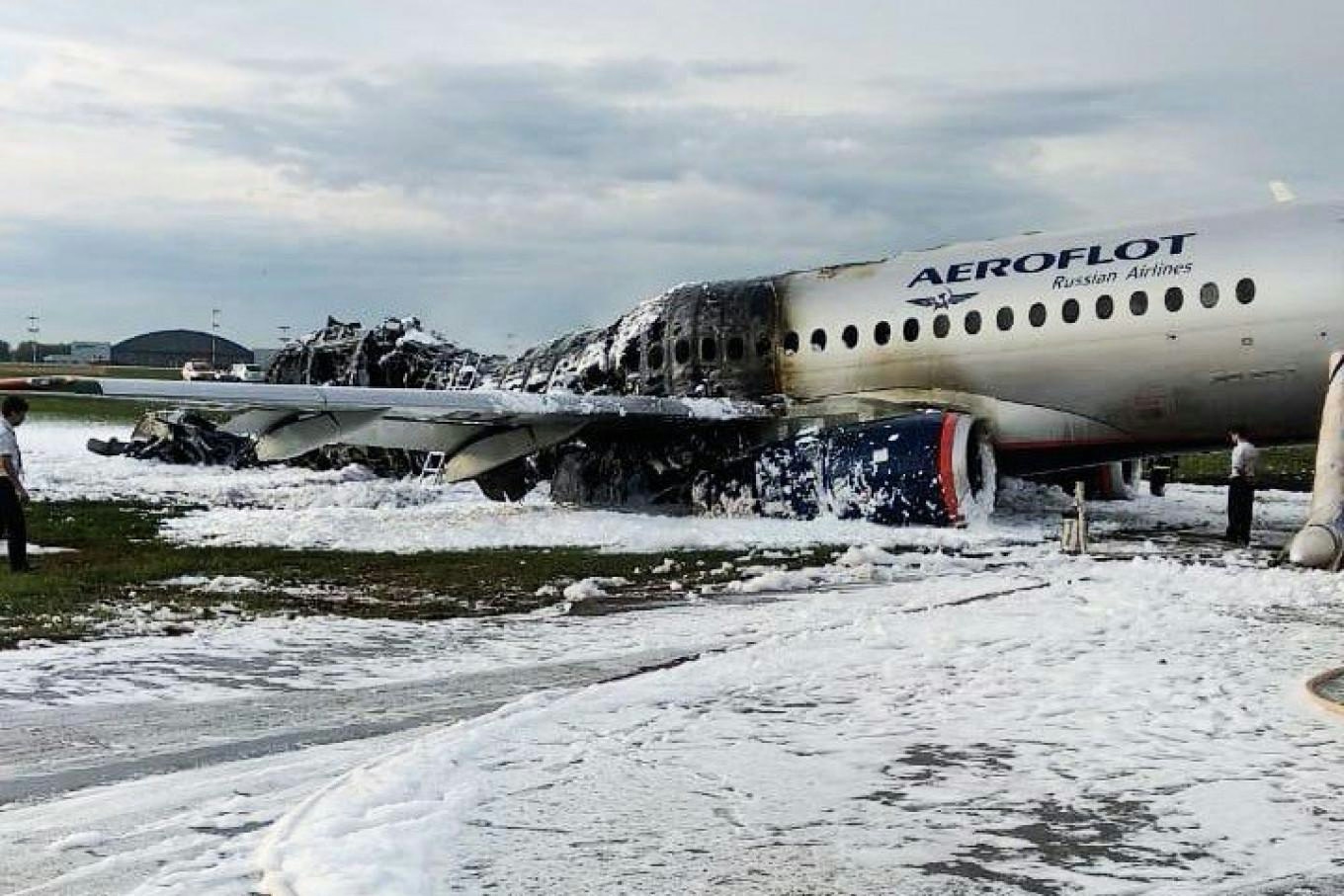
Russian Airlines Face Uncertain Future for Superjet Fleet Without Engine Subsidies
Russian airlines are confronting the prospect of a gradual loss of their Sukhoi Superjet 100 (SSJ-100) fleets unless the government intervenes with substantial subsidies to support engine replacements. Sergei Alexandrovsky, CEO of Aeroflot, emphasized that replacing the aircraft’s foreign-made SaM-146 engines with domestically produced alternatives is only feasible with significant state backing. Without such financial assistance, airlines may be compelled to phase out the SSJ-100, a development that would affect all operators of the type across Russia.
Impact of Sanctions and Technical Challenges
The difficulties stem largely from Western sanctions that have severely disrupted Russia’s commercial aviation sector, impeding access to authorized maintenance and spare parts for aircraft reliant on foreign components. Between 2023 and 2025, Russian regulators grounded over 480 aircraft—nearly half of the country’s commercial fleet—citing technical defects and falsified maintenance records. This widespread non-compliance with safety standards has been attributed to the inability of airlines to secure proper repairs amid sanctions.
Once a symbol of Russia’s ambition to modernize its aviation industry, the SSJ-100 now faces an uncertain future. The technical and financial challenges of re-engining the fleet have intensified since 2022, when French aerospace firm Safran withdrew from its joint venture with Russia’s United Engine Corporation (UEC). Safran had been responsible for manufacturing and servicing the hot section of the Superjet’s original SaM-146 engines. Following Safran’s exit, certification of the Russian-made PD-8 engine, intended as a replacement, has been delayed until late 2026 or early 2027.
Industry estimates place the cost of replacing the SaM-146 engines with PD-8 engines between 2.1 and 2.3 billion rubles ($24.2 million to $26.5 million) per aircraft. However, some insiders argue that these figures underestimate the true expense, noting that the production cost of a single PD-8 engine already exceeded 1 billion rubles ($11.5 million) in 2024 and continues to rise. Doubts also persist regarding UEC’s capacity to manufacture sufficient PD-8 engines to meet demand.
Financial Burden and Technical Complexity
Vadim Badekha, head of the United Aircraft Corporation (UAC), has indicated that airlines would be expected to bear the cost of engine replacements themselves. Without government subsidies, this financial burden could precipitate a gradual reduction in the Superjet fleet. Alexandrovsky reiterated this concern, underscoring that engine replacement is only viable with state support.
The re-engining process is highly complex and involves more than simply swapping engines. It requires replacing engine nacelles, modifying wing pylons and the wing box, and updating onboard cable networks and auxiliary power unit systems. The SSJ-100 manufacturer acknowledged in 2023 that such an extensive overhaul would not be possible without government assistance.
With the lifespan of existing SaM-146 engines nearing expiration, UEC has forecasted that nearly the entire SSJ-100 fleet could be retired by 2030. Currently, Russian airlines operate approximately 160 SSJ-100s, with 78 in service at Rossiya Airlines, a subsidiary of Aeroflot. In the absence of subsidies, airlines may be forced to redistribute flight hours across their remaining fleets and increasingly rely on the introduction of new MS-21 aircraft to sustain operations.
The future of the SSJ-100 remains uncertain as the industry awaits a government decision on subsidies, which will ultimately determine whether the fleet can be preserved or faces a gradual phase-out.

Etihad Airways Suspends Airbus A380 Flights on Key Route

Aditya Birla Group Seeks Approval for Aircraft Leasing in GIFT City

Qatar Airways Highlights Innovation and Connectivity at Arabian Travel Market 2026

Hong Kong's Five-Year Plan Includes Andrew Fan's Aircraft Parts Processing Hub Proposal

ACIA Aero Leasing Delivers ATR72-600 to Air Nostrum

RTX Appoints Jill Albertelli as Head of Pratt & Whitney

TAT Technologies Joins Beyond Aero Hydrogen Aircraft Program

AURAK Study Highlights Barriers to Air Taxi Adoption in Emerging Economies

Xiamen Air Selects Altitude for 787 Maintenance at Heathrow

Etihad and Swissport Extend Global Partnership
